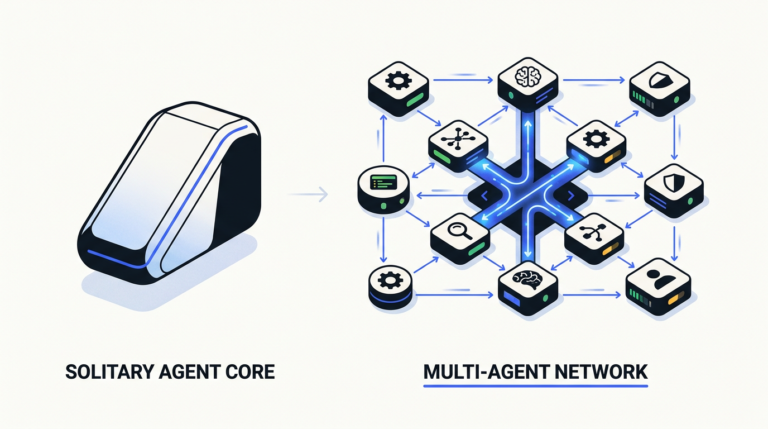
Single-Agent vs Multi-Agent Systems: A Clear Guide
A single-agent system uses one AI agent to handle a task end to end, while a multi-agent system…
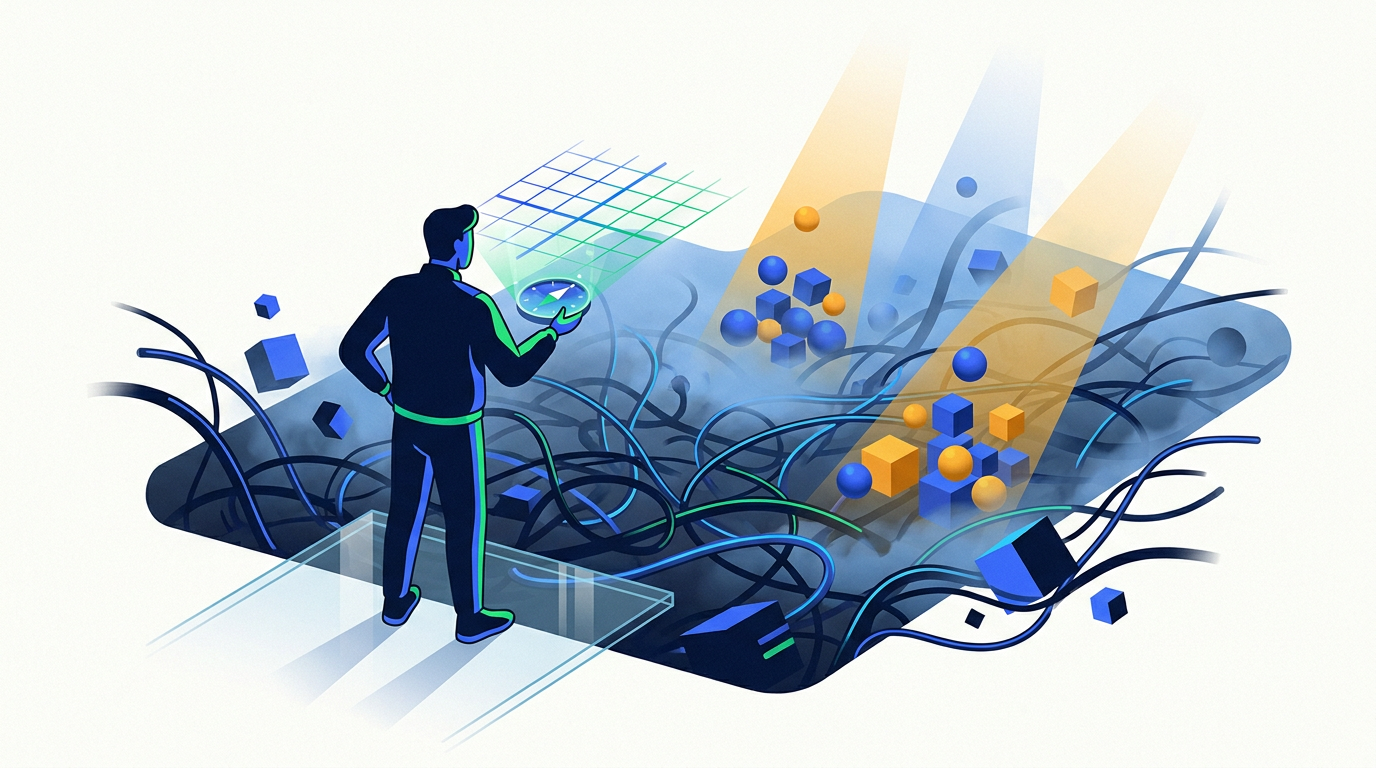
The five main types of AI agents are simple reflex, model-based reflex, goal-based, utility-based, and learning agents, ordered from simplest to most capable. Each one adds more memory, foresight, or adaptability than the last. Advanced setups add hierarchical and multi-agent systems. This guide explains every type with real examples.
Let’s cut through the noise. When you hear about “AI agents,” it sounds like we’re all about to get robot butlers. The reality is a bit more practical and a lot more interesting. Understanding the different types of AI agents isn’t just for academics; it’s like learning the different levels in a video game. Each level up adds a new, powerful ability.
Most guides just give you a dry, academic list. We’re not going to do that. Instead, we’ll look at these agents as a ladder of intelligence. We’ll start with the dumbest, simplest agent and climb up to the sophisticated ones that power the AI you actually use every day.
We’ll cover the five main types of agent in ai—from simple reflex to complex learning agents—and show you exactly what makes each one tick, what it’s good for, and what it’s not. By the end, you’ll see how these concepts build on each other and understand where the real power in AI decision-making comes from.
The five primary types of AI agents, in increasing order of complexity, are:
These different types of AI agents form a hierarchy, with each type building on the capabilities of the one before it.
Thinking about AI agent types as a simple list is a mistake. It’s not a buffet where you pick one. It’s a ladder. Each rung represents a new level of intelligence, a new capability that the previous rung lacked.
Every type of AI agent we’ll discuss is just another step up this ladder. Understanding this progression is the key to understanding what makes AI seem “smart.”
Here’s a quick comparison of the core ai agent types.
| Agent Type | Key Feature | Decision Basis | Example | Best For |
|---|---|---|---|---|
| 1. Simple Reflex | No memory | Current situation only (“If this, then that”) | Thermostat, basic email spam filter | Simple, predictable environments |
| 2. Model-Based Reflex | Internal memory/model | Current situation + recent past | Adaptive cruise control, simple game AI | Environments you can’t see all at once |
| 3. Goal-Based | Planning & goals | Future outcomes that achieve a goal | GPS navigation, puzzle-solving AI | Problems requiring a sequence of steps |
| 4. Utility-Based | Measures “happiness” | The best future outcome among many | Advanced GPS (fastest vs. scenic route) | Complex decisions with trade-offs |
| 5. Learning | Adapts and improves | Feedback and past experience | Netflix recommendations, AlphaGo | Dynamic, changing environments |
This is the most basic type of AI agent. Think of it as a knee-jerk reaction. It perceives its environment through sensors and acts upon it using actuators, but it has zero memory of the past. Its entire world is the present moment.
How they work: Simple reflex agents operate on a single, powerful rule: the condition-action rule. This is just a fancy way of saying “If X happens, then do Y.” It directly maps a percept (what it senses) to an action. There is no thinking, no planning, no memory. If the condition is met, the action is triggered. Period.
Example: A smart thermostat. If the sensor perceives the temperature is below 68°F (the condition), it triggers the heater (the action). It doesn’t remember that it was 75°F an hour ago or that you always turn it down at night. It only knows what the temperature is right now. A basic email spam filter that flags emails with “VIAGRA” in the subject line is another perfect example.
Who it’s for: Situations where the correct action only depends on the current state and a rapid response is needed.
Pros:
Con:
The standout: Its simplicity is its defining feature. It’s a blunt instrument, but for some jobs, a blunt instrument is all you need.
This is a simple reflex agent that went to summer school. It still acts on reflex, but now it has a little notebook—an internal model of how the world works. This gives it a small amount of memory, allowing it to handle situations where it can’t see everything at once.
It uses its internal model to keep track of the part of the world it can’t see right now. This is a huge upgrade because most real-world environments are “partially observable.”
How they work: The agent uses its sensors to perceive the world, but it also updates its internal model. For example, a self-driving car’s camera might not see a car in its blind spot for a second. A simple reflex agent would think the lane is clear. A model-based agent “remembers” the car was there a moment ago and assumes it probably still is. This model gives it crucial context.
Example: Adaptive cruise control in a car. It doesn’t just see the car in front (current percept), it models its speed and trajectory to predict where it will be in the next few seconds, adjusting its own speed accordingly.
Who it’s for: Anyone building agents that operate in the real world, where you can’t have eyes everywhere at once.
Pros:
Con:
The standout: The internal model is the key. It’s the first step towards an agent that has a “mental image” of its surroundings.
Now we’re getting somewhere. This is where AI starts to look “intelligent.” Unlike reflex agents that just react, goal-based agents can think ahead. They have a specific goal or objective and can formulate a plan to get there.
This is the jump from just reacting to planning. These autonomous agents consider the future.
How they work: A goal-based agent asks, “What will happen if I do this action?” It considers different sequences of actions and chooses the one that leads to its goal state. This often involves search and planning algorithms. It’s no longer just “if this, then that,” but “if I do this, then that will happen, and then I can do this other thing, which will get me to my goal.”
Example: A GPS navigation system is the perfect example. Your goal is “get to 123 Main Street.” The agent considers all possible routes, traffic, and turn sequences to find a path that achieves that goal. A puzzle-solving AI, like one that solves a Rubik’s Cube, is also goal-based.
Who it’s for: Problems that require a sequence of steps to solve, where the final destination is more important than any single move.
Pros:
Con:
The standout: The ability to plan is its superpower. It’s the difference between wandering aimlessly and following a map.
A goal-based agent is happy just to reach the finish line. A utility-based agent is a connoisseur. It doesn’t just want to finish; it wants to finish in style. It adds a layer of nuance on top of goal-based behavior by asking, “Which path to the goal is the best one?”
This is the agent type that makes trade-offs. It brings a concept of “happiness” or “desirability” to decision-making.
How they work: This agent uses a utility function that assigns a numerical score to different states of the world. The agent’s goal is to choose the sequence of actions that leads to the state with the highest utility score. It’s an evolution of the goal-based agent, but instead of a simple goal state (yes/no), it deals with a spectrum of outcomes.
Example: An advanced GPS. A goal-based GPS finds a route. A utility-based GPS might ask if you want the fastest route, the shortest route, the most scenic route, or the route with the fewest tolls. Each of these is a valid path to the goal, but the utility function helps the agent choose the one that best matches your preferences.
Who it’s for: Situations where there are multiple solutions and you need to find the optimal one based on certain criteria (e.g., speed, cost, safety, efficiency).
Pros:
Con:
The standout: The utility function gives the agent a personality, a set of preferences that guide its choices beyond simply achieving the goal.
This is the pinnacle of the types of agents in artificial intelligence. A learning agent can start with no knowledge and, through trial and error, become a master. It can operate in completely unknown environments and get better over time.
All the previous agents were designed with a fixed set of rules or models. A learning agent can change its own rules.
How they work: A learning agent has four main components:
This cycle of acting, getting feedback, and updating its internal rules is often powered by reinforcement learning.
Example: Netflix’s recommendation system. It suggests a movie (action), you watch it or you don’t (feedback), and the “critic” tells the learning element to adjust its understanding of your taste. Over time, it gets scary good at predicting what you’ll like. Google’s AlphaGo, which taught itself to beat the world’s best Go players, is another prime example.
Who it’s for: Anyone tackling problems in dynamic, complex, or unknown environments where the rules might change or aren’t fully understood.
Pros:
Con:
The standout: Its ability to improve itself is what defines modern AI. This is the agent that can genuinely surprise you.
The five core types are the building blocks. In the real world, complex AI systems often combine these ideas into more advanced structures.
Hierarchical Agents: Think of this as a company org chart. You have a CEO agent at the top that makes high-level decisions (“Increase market share”). It passes that goal down to manager agents (“Launch a new product”), who then pass tasks to worker agents (“Design the button,” “Write the code for the login screen”). Each level of the hierarchy deals with a different level of abstraction. This is how you solve incredibly complex problems without the top-level agent getting bogged down in tiny details.
Multi-Agent Systems (MAS): This is a team of autonomous agents all working in the same environment. They might be working together (a fleet of delivery drones coordinating routes to avoid collisions) or competing (AI traders in a simulated stock market). The big challenge here is communication and coordination. How do they share information, negotiate, and work as a team instead of just a chaotic crowd? These systems are crucial for modeling complex, real-world phenomena from traffic flow to economies.
You might sometimes hear about four types of agents in artificial intelligence. This is usually just a simplified version of the five-type model. Most often, this happens when people group Goal-Based and Utility-Based agents together under a single “planning” category.
While they are related, the distinction is important. A goal-based agent just needs to get the job done. A utility-based agent tries to get the job done perfectly. For most serious applications, this difference matters, which is why the five-type model is more precise and useful.
The difference is simple but crucial: a goal-based agent has a binary, black-and-white view of the world, while a utility-based agent sees shades of gray.
utility function to assign a score to outcomes, allowing it to choose the path that is not just successful, but also faster, cheaper, safer, or more efficient. It seeks the optimal outcome.In short: Goal-based finds a solution. Utility-based finds the best solution.
Real-life examples of AI agents are all around us, often hiding in plain sight. Here are a few, categorized by their type:
You don’t need a learning agent to run a thermostat. Choosing the right ai agent type is about matching the complexity of the agent to the complexity of the problem.
Start with the simplest thing that could possibly work. Is your environment totally predictable? Does the same condition always require the same action? Use a Simple Reflex Agent. It’s fast, cheap, and reliable for simple jobs.
If you can’t see the whole picture… Does your agent need to remember what happened a second ago to make a good choice now? You need a Model-Based Agent. This is your default for most simple real-world robotics or games.
If the task requires multiple steps… Do you need to plan a sequence of actions to reach a final state? You need a Goal-Based Agent. This is for logistics, routing, and any problem that looks like a puzzle.
If there are trade-offs and “best” is subjective… Are there multiple ways to win? Do you need to balance competing priorities like speed and cost? You need a Utility-Based Agent. This is for optimization problems and complex decision-making.
If you don’t know the rules or they might change… Is the environment dynamic, uncertain, or just too complex to model? This is the job for a Learning Agent. When you need the system to adapt and improve on its own, this is your only real choice.
These agent types map surprisingly well to the broader, more philosophical classifications of AI capabilities:
Understanding the five types of ai agents with examples gives you a practical framework for seeing how we’re climbing this ladder from simple reactive machines toward more sophisticated and capable intelligence.
What is the simplest type of AI agent?
The simplest type is the Simple Reflex Agent. It operates purely on a “condition-action” (if-then) basis, reacting only to the current state of its environment with no memory of the past.
Are all AI programs considered agents?
Not necessarily. An “agent” specifically refers to an entity that perceives its environment and acts upon it autonomously to achieve goals. A simple algorithm that just processes data without this perception-action loop (like one that sorts a list) wouldn’t typically be called an agent.
What is the difference between an AI agent and an algorithm?
An algorithm is a set of instructions for solving a problem. An AI agent is a system that uses algorithms to perceive, reason, and act. Think of the algorithm as a single recipe, while the agent is the chef who can choose recipes, gather ingredients (perceive), and cook the meal (act).
Which type of AI agent is ChatGPT?
ChatGPT is a very advanced form of a Learning Agent. It was trained on a massive dataset of text and uses a complex internal model (a transformer network) to generate human-like responses. It learns from interactions and is constantly being updated, fitting the core definition of a learning agent that improves over time.

Part of the Thinker's Automation Labs content team. Researches with the SEO Blog Research Agent, drafts the piece, and routes it through review before publishing. Every claim is fact-checked against primary sources.
A single-agent system uses one AI agent to handle a task end to end, while a multi-agent system…
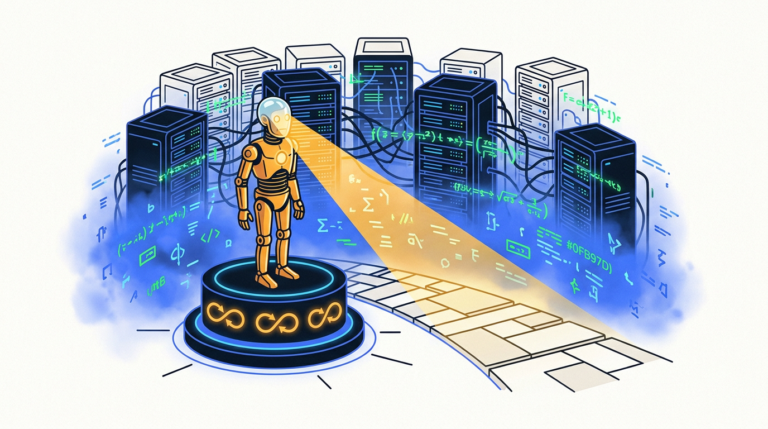
A learning agent is an AI agent that improves its own performance over time by learning from feedback.…
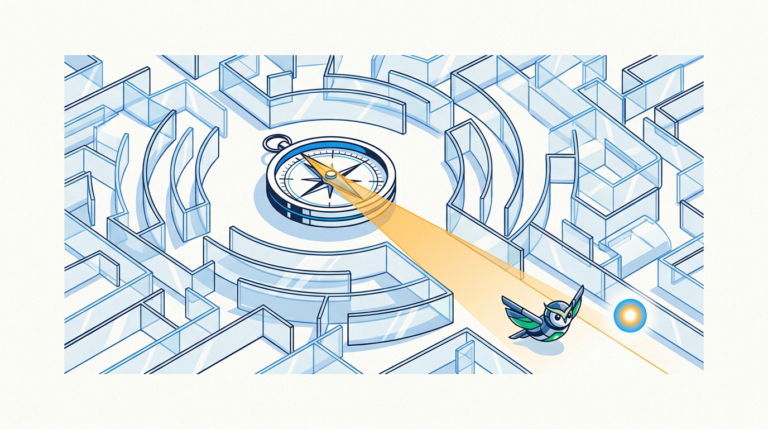
A goal-based agent is an AI agent that chooses actions by asking whether they move it closer to…