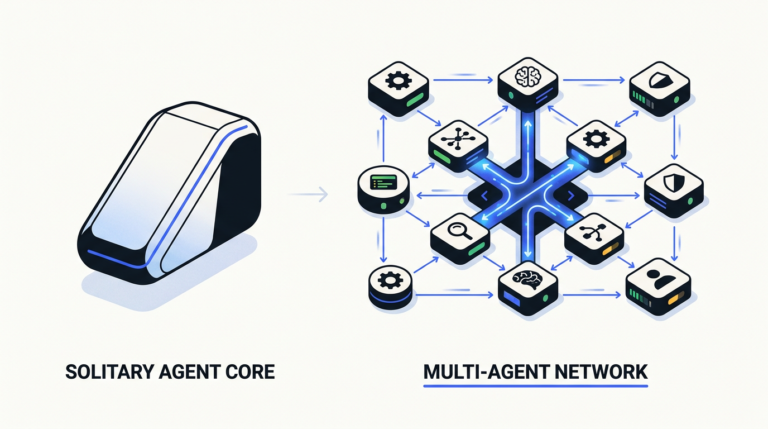
Single-Agent vs Multi-Agent Systems: A Clear Guide
A single-agent system uses one AI agent to handle a task end to end, while a multi-agent system…
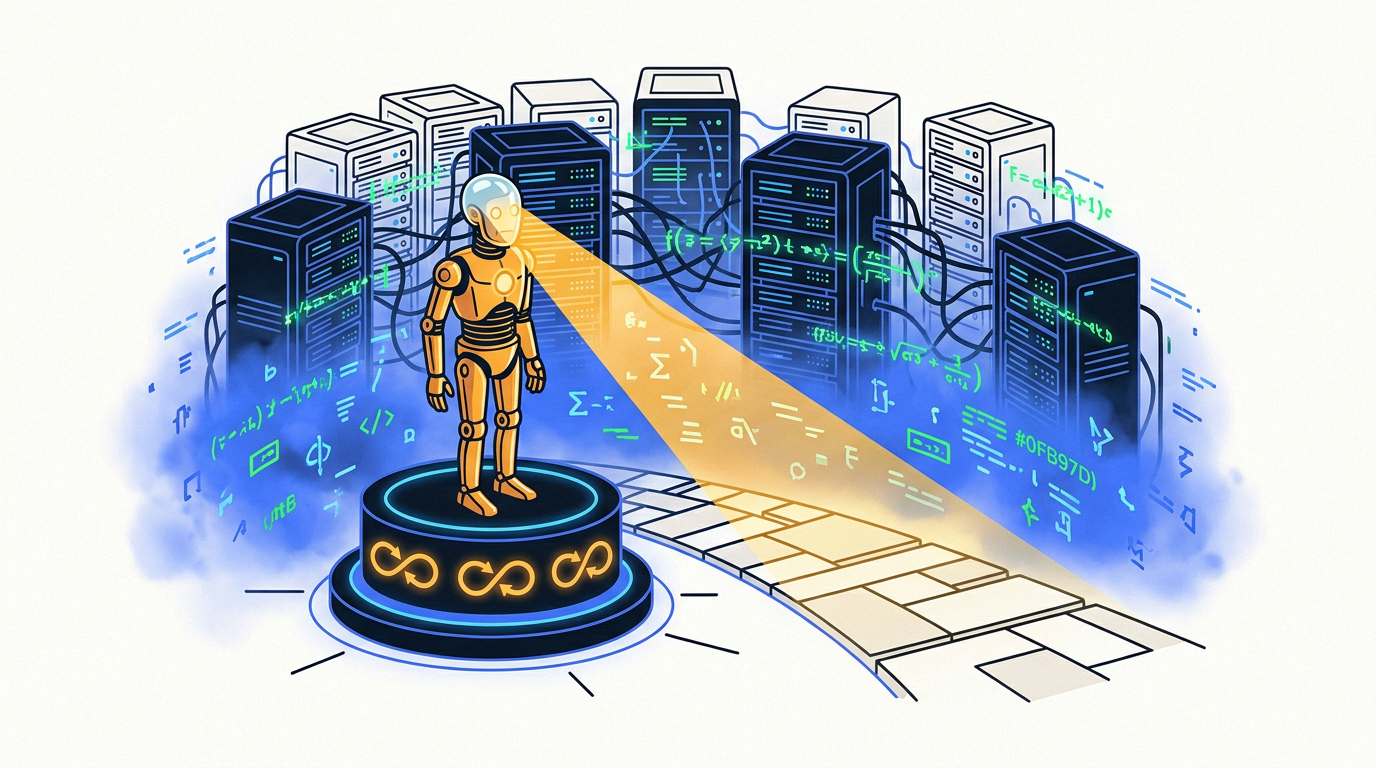
A learning agent is an AI agent that improves its own performance over time by learning from feedback. It has four parts: a learning element that makes improvements, a performance element that acts, a critic that judges results, and a problem generator that suggests new things to try.
Most software is dumb. Not in a mean way, it’s just a fact. The app you use today will be the exact same app tomorrow. It follows its programming, and that’s that. But what if a program could get better at its job, all by itself, after you’ve shipped it?
That’s the entire point of a learning agent in AI. It’s the difference between a simple calculator that only does what you tell it and a smart assistant that learns your preferences without you having to spell them out every single time. It’s the only type of AI agent that isn’t frozen in time.
Most of the AI hype focuses on the models themselves, but the real magic is in the systems that allow them to learn continuously. The agent is just the athlete; the truly valuable thing is the training ground—the digital gym—where it gets stronger. This article breaks down how these learning agents work, what they’re made of, and why they’re the most interesting part of AI today.
A learning agent is a type of AI agent that can improve its performance at a task by learning from its experiences. Instead of just following a fixed set of rules, it observes its environment, takes actions, sees the results, and adjusts its internal strategy to do better next time.
Think of it like learning to cook a new dish. The first time, you follow the recipe (the initial programming). Maybe you burn the onions. That’s feedback. The next time, you know to turn down the heat. You’ve learned and adapted. A learning agent does the same thing, just with data and algorithms. It uses “sensors” (like a camera or data input) to perceive the world and “actuators” (like a robotic arm or a software command) to act on it.
Every true learning agent in artificial intelligence is built from four key parts that work together. Understanding these components is the key to understanding how an AI can actually learn. It’s a simple, powerful architecture.
| Component | What It Does | Analogy |
|---|---|---|
| Performance Element | The “doer.” This is the part of the agent that observes the environment and decides which action to take. It’s the standard agent part that exists in all AI agents. | Your hands that actually chop the vegetables or stir the pot. |
| Critic | The “judge.” After the performance element acts, the critic evaluates how well it did and provides feedback. This feedback could be a score, a penalty, or a simple “good/bad” signal. | Your sense of taste telling you the dish is too salty. |
| Learning Element | The “brain.” This is the most important part. It takes the feedback from the critic and uses it to modify the performance element. Its job is to figure out how to make better decisions in the future. | You, deciding to use half a teaspoon of salt next time instead of a full one. |
| Problem Generator | The “explorer.” This component is responsible for suggesting new, exploratory actions. Instead of just doing what it thinks is best, it might suggest trying something new and slightly risky to see what happens. This is crucial for discovering better strategies. | You, deciding to add a pinch of paprika to the recipe, just to see what it tastes like. |
These four components don’t just sit there; they operate in a continuous cycle. This loop is the engine of adaptation. It’s how a learning agent goes from a clumsy novice to a seasoned expert.
Perceive: The agent uses its sensors to gather information about the current state of its environment. For a self-driving car, this is data from its cameras and LiDAR. For a Netflix recommender, it’s you logging in and what you’ve just watched.
Act: Based on its current rules, the performance element selects and executes an action using its actuators. The car turns the wheel slightly. The recommender shows you a row of true-crime documentaries.
Critique: The outcome of the action is observed. Did the car stay in the lane? Did you click on one of the recommended shows, or did you ignore them and search for something else? The critic turns this outcome into a feedback signal. A positive signal for staying in the lane, a negative one for you ignoring its suggestions.
Improve: The learning element receives this feedback. If the feedback was positive, it reinforces the rule that led to the good outcome. If it was negative, it adjusts the rule to make that action less likely in the future. This is where it uses a machine learning algorithm to update its internal knowledge base.
Explore (Sometimes): The problem generator might interject, suggesting an action that isn’t the “optimal” one according to the current rules. For example, the recommender might show you a stand-up comedy special even if you’ve never watched one before. If you happen to click it and watch the whole thing, the agent has just discovered a whole new, valuable category of content for you. Without this exploration, the agent would just keep recommending more of the same.
This cycle repeats, thousands or even millions of times. With each loop, the agent refines its performance, getting progressively better at achieving its goal.
The “learning element” can use different strategies to make improvements. These are generally grouped into three main types of machine learning.
Supervised Learning: This is like learning with an answer key. The AI is given a huge dataset that has been pre-labeled by humans. For example, you show it a million pictures of animals, each one labeled “cat,” “dog,” or “bird.” The agent learns the patterns connecting the images to the labels. This is great for classification and prediction tasks, but it requires a lot of upfront human labor to create the labeled data.
Unsupervised Learning: This is like being thrown into a library and told to “find patterns.” The AI is given a bunch of data with no labels and has to find the underlying structure on its own. For example, a business might feed an agent all of its customer purchase data, and the agent might identify distinct groups (or clusters) of customers—like “weekend bargain hunters” and “high-value weekly shoppers”—that the humans never noticed.
Reinforcement Learning: This is learning from trial and error, like training a dog with treats and scolding. The agent is given a goal and is let loose in an environment to figure things out. It gets positive rewards for actions that move it closer to the goal and negative penalties for actions that move it away. This is the most common type of learning used in complex learning agents, from game-playing AI to robotics. The entire four-component architecture is built to support this kind of learning.
You’ll often see the learning agent architecture represented in a standard diagram. It’s simple, but it shows how all the pieces fit together.
Imagine a large box representing the Agent. Inside this box are the four components: the Performance Element, Critic, Learning Element, and Problem Generator.
Outside the box is the Environment.
Inside the agent box, arrows show the flow of information:
This diagram shows that the agent is a self-contained system that learns by interacting with an external world, constantly refining its own brain based on the consequences of its actions.
This all sounds a bit abstract, but you interact with learning agents every day.
Recommender Systems: This is a classic learning agent example. When Spotify builds a “Discover Weekly” playlist for you, it’s acting as a learning agent. Its performance element is the algorithm that picks the songs. Its sensors see what you listen to, skip, or add to a playlist. The critic provides feedback based on your behavior (a skip is negative feedback). The learning element updates your taste profile, and the problem generator might toss in a song from a totally new genre to see if you bite.
Game-Playing AI: The AI opponents in many modern video games are learning agents. An AI in a strategy game might notice you always attack from the left flank. After a few losses (negative feedback from the critic), its learning element will update its strategy to better defend that side. Google DeepMind’s AlphaGo, which taught itself to defeat the world’s best Go players, is one of the most powerful examples of a learning agent using reinforcement learning.
Autonomous Robots: A robotic vacuum cleaner learns the most efficient path to clean your specific apartment layout. A factory robot with a vision system can learn to pick up and orient new types of parts by trying, failing, and getting feedback from its sensors. Self-driving cars are arguably the most complex learning agents, constantly learning from a torrent of real-world data to improve their driving policies.
It’s not all sunshine and self-improving robots. Learning agents come with a serious set of challenges that are important to understand. This is the stuff the hype cycle conveniently ignores.
Data Bias: A learning agent is only as good as the data it learns from. If the feedback it receives is biased, the agent will become biased. For example, if a hiring agent is trained on historical company data where only men were promoted to management, it may learn to penalize female candidates, even if that bias is unintentional.
Interpretability: Often, the internal rules of a highly complex learning agent (especially one using deep learning or neural networks) become a “black box.” The agent might be performing well, but we have no idea why it’s making the decisions it is. This is a massive problem for safety-critical applications. If a self-driving car makes a mistake, we need to know why, and “the neural network decided to” isn’t a good enough answer.
Computational Cost: The trial-and-error process of reinforcement learning can be incredibly slow and expensive. Training a single, sophisticated agent can require millions of simulated runs, consuming massive amounts of computing power and energy. This is a major barrier to entry and a reason why the “race to free AI” and more efficient training methods are so important.
The Exploration Problem: How do you let an agent explore without causing a disaster? The problem generator is essential for learning, but its suggestions can be dangerous in the real world. You can’t let a self-driving car “try” driving on the wrong side of the road just to see what happens. This requires building careful constraints and keeping a human in the loop for high-stakes environments.
Ultimately, the goal isn’t to build fully autonomous agents and fire everyone. It’s to use these agents to handle the grunt work, allowing humans to focus on judgment, strategy, and final approval.
What’s the difference between a simple AI agent and a learning agent?
A simple AI agent (like a thermostat) operates on a fixed set of rules. A learning agent can change its own rules based on experience to improve its performance over time. All learning agents are AI agents, but not all AI agents are learning agents.
Is a chatbot like ChatGPT a learning agent?
It’s complicated. The underlying Large Language Model (LLM) like GPT-4 was trained using learning techniques. However, the public-facing ChatGPT you talk to is generally not a learning agent in real-time. It doesn’t permanently update its core knowledge based on your specific conversation (for privacy and safety reasons). It has memory within a single session but doesn’t “learn” from you in the same way a Spotify recommender learns your taste.
Are all learning agents based on machine learning?
Yes. The “learning element” component is, by definition, an application of machine learning. It’s the part of the agent that uses algorithms to find patterns in feedback and update the agent’s behavior. Whether it’s supervised, unsupervised, or reinforcement learning, machine learning is the engine that powers the agent’s adaptation.

Part of the Thinker's Automation Labs content team. Researches with the SEO Blog Research Agent, drafts the piece, and routes it through review before publishing. Every claim is fact-checked against primary sources.
A single-agent system uses one AI agent to handle a task end to end, while a multi-agent system…
A goal-based agent is an AI agent that chooses actions by asking whether they move it closer to…
A utility-based agent is an AI agent that chooses actions to maximize a utility function, a score of…