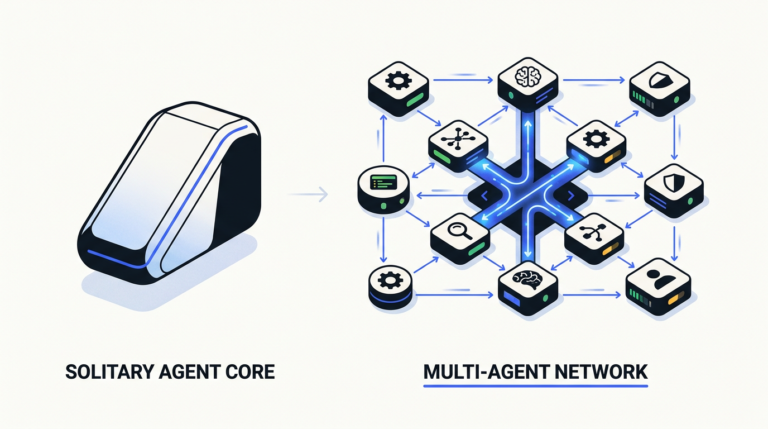
Single-Agent vs Multi-Agent Systems: A Clear Guide
A single-agent system uses one AI agent to handle a task end to end, while a multi-agent system…

A simple reflex agent acts only on the current percept using condition-action rules, so it fails in partially observable environments. A model-based reflex agent keeps an internal model of the world, using memory of past percepts to handle situations it can’t fully see. The model, in short, is the difference.
Let’s talk about two of the most fundamental types of AI agents: the simple reflex agent and the model-based reflex agent. Understanding the difference between them isn’t just academic; it’s the key to understanding how an AI can go from being a dumb robot to a smart one.
The core of the simple reflex vs model-based reflex agent debate boils down to one thing: memory. One has it, the other doesn’t. This single difference is what separates an AI that gets easily confused from one that can navigate a complex, dynamic environment. We’ll break down exactly how each one works, where they shine, where they fail, and which one you actually need.
Imagine you’re driving and the car in front of you suddenly hits its brakes. You see the red lights, and your foot instinctively hits your own brake pedal. That’s a reflex. You didn’t need to remember what color the car was or where you were five minutes ago. You saw a stimulus, and you reacted.
Now, imagine you want to change lanes. You check your mirror. You see a car in your blind spot. You wait. A few seconds later, you check again. The lane is clear. But you don’t just pull over—you remember the car was there. Your brain has a little model of the road that says, “A moment ago, that space was occupied. Has enough time passed for it to be clear?”
That’s the test. Does the agent’s decision depend only on what it sees right this second? Or does it depend on what it saw a moment ago? That’s the difference between a simple reflex and a model-based one.
A simple reflex agent is the most basic type of AI agent. It makes decisions based only on the current percept—what its sensors are telling it right now. It has no memory of the past and no concept of the future. It’s pure stimulus-response.
The entire “brain” of a simple reflex agent is a collection of condition-action rules, which are just fancy if-then statements.
IF the temperature sensor reads > 72°F)THEN turn on the air conditioner)It maps a specific state of the world directly to a specific action. That’s it. There’s no deeper reasoning component, no memory, no planning. It’s a mindless but often effective little machine.
Simple reflex agents are everywhere, precisely because they are simple and fast.
IF bumper is pressed, THEN turn right 90 degrees and move forward. This works, but it’s dumb. The robot can get stuck in loops, bouncing between two chair legs forever, because it has no memory of where it’s been. It can’t build a map; it can only react to the obstacle directly in front of it. This is a classic failure case in a partially observable environment—where the agent can’t see the whole picture at once.IF the email subject contains "viagra", THEN move to spam. It’s a simple, fast rule. But it fails when a legitimate email from your doctor mentions the word in a clinical context. The agent lacks the context that memory would provide.The weakness is clear: simple reflex agents are useless when a correct decision requires knowing something about the past.
A model-based reflex agent is the smarter sibling. Like a simple reflex agent, it still uses rules to act. But it has a crucial upgrade: an internal model of the world. This allows it to handle partially observable environments by keeping track of the parts of the world it can’t see right now.
The “model” isn’t a physical thing. It’s a piece of programming that represents the agent’s beliefs about how the world works. This allows the agent to maintain an internal state—a running description of the current situation based on its percept history.
Think of it like this:
IF my internal state says 'lane is clear' AND my goal is 'change lanes', THEN activate turn signal and steer.)The internal model answers two questions: “How does the world evolve on its own?” (e.g., other cars move forward) and “What will happen if I take this action?” (e.g., if I brake, I will slow down). This gives it a rudimentary ability to predict the consequences of its actions.
The easiest way to see the difference between a simple reflex and a model-based agent is to put them head-to-head.
| Criterion | Simple Reflex Agent | Model-Based Reflex Agent |
|---|---|---|
| Memory | None. Acts only on the current percept. | Maintains an internal state based on percept history. |
| Decision-Making | Simple condition-action (if-then) rules. | Condition-action rules that use the internal state, not just the current percept. |
| Environment Type | Only works in fully observable environments. | Can handle partially observable environments. |
| Logic | “What is the world like now?” | “Based on my memory, what is the world like now?” |
| Speed | Extremely fast. No complex processing. | Slower. Must update its internal model. |
| Complexity | Very simple to design and build. | More complex. Requires building and maintaining an accurate model of the world. |
If we were to draw these two agents on a whiteboard, the difference in their workflow would be immediately obvious.
Simple Reflex Agent Architecture:
It’s a straight line. Information comes in from sensors, goes through a single logic check, and an action comes out.
Sensors → What the world is like now → Condition-Action Rules → Action → ActuatorsModel-Based Reflex Agent Architecture:
It has a loop. Information comes in, but before an action is chosen, it’s used to update a running memory of the world. The final decision is based on that memory.
Sensors → What the world is like now → Internal State (How the world is now) → Condition-Action Rules → Action → ActuatorsInternal State is constantly updated by the Percept History and the Internal Model (which knows how the world evolves and what actions do).The model-based agent’s diagram has more boxes and arrows for a reason: it’s doing more thinking. It’s not just reacting; it’s maintaining a world-view.
The key difference is that a model-based reflex agent has an internal model of the world and memory (an internal state), while a simple reflex agent does not. This allows the model-based agent to act intelligently in partially observable environments where it can’t see everything at once, whereas a simple reflex agent would fail because it only reacts to what its sensors perceive at that exact moment.
You should use a model-based agent instead of a simple reflex agent when the correct action depends on information that isn’t immediately visible. If the environment is partially observable or dynamic, and the agent needs to remember past events to make a good decision, a model-based approach is necessary. For example, navigating a busy street requires remembering cars that are no longer in direct view.
Choosing between these two isn’t about which is “better”—it’s about picking the right tool for the job. Your strategy should come before the software.
Use a Simple Reflex Agent when:
Use a Model-Based Reflex Agent when:
While more powerful, model-based agents aren’t a perfect solution. Their biggest weakness is right in the name: the model.
Simple reflex and model-based reflex agents are just the first two rungs on the ladder of AI agent complexity. It’s helpful to know what comes next.
Ultimately, the most effective AI automation often involves a system of specialized agents working together. You might use a simple reflex agent for a quick safety check, while a more complex goal-based agent handles the long-term planning. It’s not about finding one monolithic AI, but about orchestrating a team.
What is the difference between a simple reflex agent and a model-based reflex agent?
The core difference is memory. A simple reflex agent has none and acts only on current sensory input. A model-based reflex agent maintains an internal model of the world, allowing it to use a history of past percepts to make decisions in situations it cannot fully observe.
What is a simple reflex agent with example?
A simple reflex agent is an AI that follows simple “if-then” rules based on immediate input. A classic example is a basic thermostat: if the temperature sensor reads below 68°F (condition), it turns on the heat (action). It has no memory of past temperatures.
What is a model-based reflex agent with example?
A model-based reflex agent uses an internal model and memory to act. An example is a self-driving car’s lane-change logic. It remembers a car was in its blind spot a moment ago (internal state) even if it can’t see it now, and uses that memory to decide if it’s safe to move.
When should you use a model-based agent instead of a simple reflex agent?
Use a model-based agent when the environment is partially observable and making the right choice requires knowing about things you can’t currently see. If the agent needs to track objects, remember past events, or predict how a situation will evolve, a model is essential.

Part of the Thinker's Automation Labs content team. Researches with the SEO Blog Research Agent, drafts the piece, and routes it through review before publishing. Every claim is fact-checked against primary sources.
A single-agent system uses one AI agent to handle a task end to end, while a multi-agent system…
A learning agent is an AI agent that improves its own performance over time by learning from feedback.…
A goal-based agent is an AI agent that chooses actions by asking whether they move it closer to…