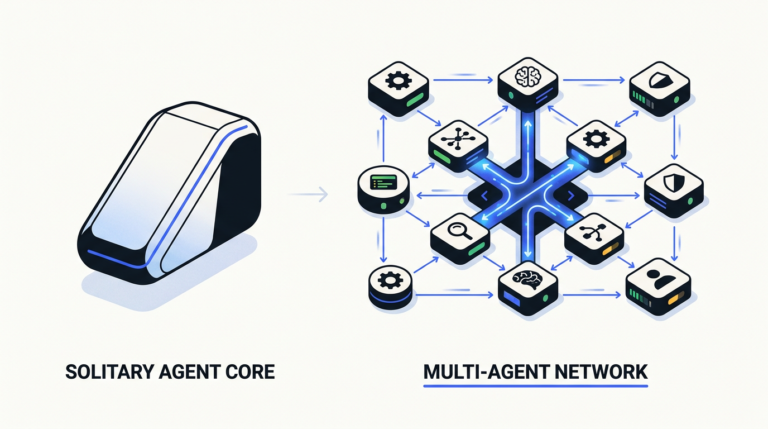
Single-Agent vs Multi-Agent Systems: A Clear Guide
A single-agent system uses one AI agent to handle a task end to end, while a multi-agent system…
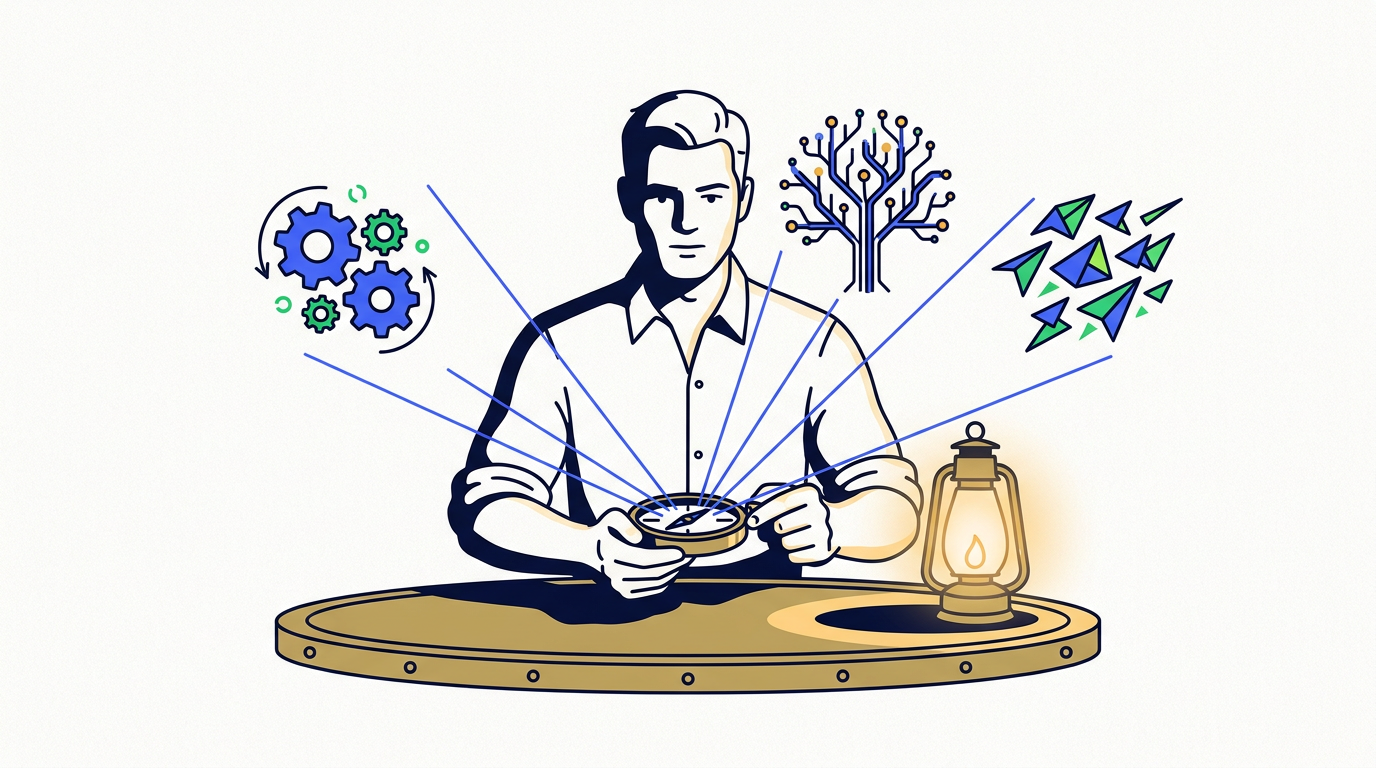
A simple reflex agent acts only on the current percept using fixed condition-action (if-then) rules, with no memory of the past. A model-based reflex agent adds an internal model of the world, so it can handle partially observable environments. This guide compares both with clear, everyday examples.
Think about your home thermostat. It does one thing, and it does it well. If the temperature drops below your setting, it turns the heat on. If it goes above, it turns it off. It has no memory of yesterday’s weather, no prediction for tomorrow’s. It just sees the current temperature and reacts. This is a simple reflex agent in AI at its most basic.
Now, think about a self-driving car approaching a traffic light. It sees the car in front of it has its brake lights on. A simple reflex would be: “If brake lights on, then slow down.” But what if the car is on a steep hill? It needs to brake harder. What if it just saw that car accelerate erratically a moment ago? It might keep more distance. This requires an internal understanding—a model—of how cars, hills, and physics work. This is a model-based reflex agent.
One is a simple, reliable switch. The other is a junior physicist making decisions in real-time. Understanding the difference between them is the first step to understanding how AI actually makes decisions, from the mundane to the miraculous. Most guides make this confusing. We won’t.
A simple reflex agent is the most basic type of intelligent agent. It makes decisions based only on the current situation it perceives, completely ignoring any past history. It operates on a single, powerful principle: the condition-action rule, better known as an “if-then” rule.
Imagine an agent with blinders on, only able to see what’s directly in front of it right now. It doesn’t remember what it saw a second ago or what might happen next. Its entire “brain” is a list of predefined rules. If it perceives a specific condition, it triggers a corresponding action. That’s it. There’s no learning, no memory, no strategy.
The entire logic of a simple reflex agent is built on condition-action rules. These are just plain English statements translated for a machine.
The rule is: IF the room is dark, THEN turn on the light.
This is a rule-based system in its purest form. The agent has a list of these rules, and it simply finds the one that matches the current percept (the sensory input) and executes the action. It’s fast, efficient, and incredibly predictable.
To really get it, you need to visualize the workflow. This is the perception-action cycle. It’s a simple loop that runs over and over, and it’s the foundation of how these agents interact with their environment.
Here’s the step-by-step breakdown:
The cycle then repeats, instantly. The agent perceives the new state of the environment and does it all again.
The Simple Reflex Agent Loop
Environment
(e.g., A dirty floor)
Sensors
(e.g., Dirt sensor)
Percept: “Dirt detected”
Condition-Action Rules
IF “Dirt detected” THEN “Activate vacuum”
Actuators
(e.g., Vacuum motor)
Action
(e.g., Sucking up dirt)
The architecture of a simple reflex agent is refreshingly straightforward. It consists of three main parts:
The classic simple reflex agent in artificial intelligence example is an automated vacuum cleaner. When its sensor detects dirt, it triggers the “suck” action. When its bumper hits a wall, it triggers the “turn and move forward” action.
Each decision is an isolated reflex. The vacuum doesn’t remember that it just cleaned that spot a minute ago, which is why it sometimes cleans the same area repeatedly. It has no map, no memory, just a set of reactions to its immediate surroundings.
Another perfect example is a thermostat.
It works perfectly because the environment is fully observable from the perspective of the agent’s goal. The only thing it needs to know—the temperature—is directly available to its sensor.
A model-based reflex agent is a significant step up. Like its simpler cousin, it uses reflexes. But it has a crucial addition: an internal state, or a “model” of the world. This model allows it to handle situations where it can’t see everything at once—what AI folks call a partially observable environment.
This agent doesn’t just react to what it sees right now. It combines what it sees now with its internal understanding of how the world works to make a better decision. It keeps track of the parts of the world it can’t see, based on what it has seen in the past.
The “model” in a model based agent in ai is just its own private simulation of the world. It’s a representation of how the environment changes over time and how its own actions affect that environment.
Let’s go back to the self-driving car example. The car in front brakes.
This allows it to make inferences. If it can’t see the car in front anymore because of fog, it doesn’t just forget the car exists. Its internal model tells it, “A car was there, it was slowing down, and it’s probably still there, just obscured.” It will act more cautiously as a result. This ability to handle missing information is the key difference.
A model-based agent follows a more sophisticated perception-action cycle. It still perceives and acts, but it has two extra steps in the middle where it consults its internal knowledge.
The crucial part is that its decision is based on a richer, model-informed picture of the world, not just the raw, immediate sensory data.
The main difference is memory and context. A simple reflex agent is purely reactive, using if-then rules on the current percept alone. A model-based agent uses an internal model of the world to maintain an internal state, allowing it to handle partial information and make decisions based on a history of percepts.
Here’s a direct comparison:
| Feature | Simple Reflex Agent | Model-Based Reflex Agent |
|---|---|---|
| Decision Basis | Current percept only | Current percept + internal state (model of the world) |
| Memory | None. It is stateless. | Maintains an internal state to track the world. |
| Environment Type | Best for fully observable environments. | Can handle partially observable environments. |
| Example Rule | IF car-in-front-is-braking, THEN brake. | IF car-in-front-is-braking AND I am on a downhill slope, THEN brake harder. |
| Complexity | Very simple and fast. | More complex, requires maintaining the world model. |
| “Thought Process” | “What I see is what I do.” | “Based on what I see and what I know, here’s what I should do.” |
So, why would anyone use a “dumber” simple reflex agent if a model-based one is smarter? Because “smarter” isn’t always better. It’s often slower and more expensive. This is about picking the right tool for the job.
Simple Reflex Agents:
Model-Based Reflex Agents:
Choosing between them is a core engineering decision. Over-engineering a solution with a model-based agent when a simple one would do is a waste of time and resources.
Simple reflex agents aren’t just a footnote; they are the foundation. In the early days of AI, much of the work in robotics and automation was based on these simple, reactive systems. They demonstrated that useful behavior could emerge from a small set of simple rules, a concept central to the field.
Think of AI agents as a ladder of increasing complexity and intelligence:
Simple and model-based agents are the building blocks. Even the most complex AI systems have reactive, reflexive components deep inside. Understanding them is not just an academic exercise; it’s about understanding the fundamental principles that modern AI is built upon. If you’re exploring how to apply AI to your business, you may find that many problems don’t need a super-intelligent, learning system; sometimes, a reliable set of if-then rules is all you need. We’ve helped many clients realize that the simplest solution is often the most effective one, and our AI consulting services focus on finding that right-fit solution.
What is a simple reflex agent in AI?
A simple reflex agent is an AI agent that makes decisions based only on its current perception of the environment. It uses pre-programmed “condition-action” (if-then) rules and has no memory of past events.
What is an example of a simple reflex agent?
A great simple reflex agent example is a thermostat. If it senses the temperature is below a set point (condition), it turns on the heat (action). It doesn’t remember past temperatures; it only reacts to the present moment. An automatic door is another example.
How does a model-based agent work?
A model-based agent works by combining its current sensory input with an internal “model” of the world. This model helps it keep track of things it can’t currently see. It updates its internal state based on new perceptions and then chooses an action based on this more complete picture of reality.
What is the difference between simple reflex and model-based agents?
The key difference is memory. A simple reflex agent is stateless and reacts only to the present. A model-based agent maintains an internal state (a memory or model of the world) that it updates over time, allowing it to handle situations where the environment is only partially observable.

Part of the Thinker's Automation Labs content team. Researches with the SEO Blog Research Agent, drafts the piece, and routes it through review before publishing. Every claim is fact-checked against primary sources.
A single-agent system uses one AI agent to handle a task end to end, while a multi-agent system…
A learning agent is an AI agent that improves its own performance over time by learning from feedback.…
A goal-based agent is an AI agent that chooses actions by asking whether they move it closer to…