
AI Workflow Automation: A Complete Guide for Business (2024)
AI workflow automation uses artificial intelligence to manage and execute complex, multi-step business processes. It goes beyond simple…
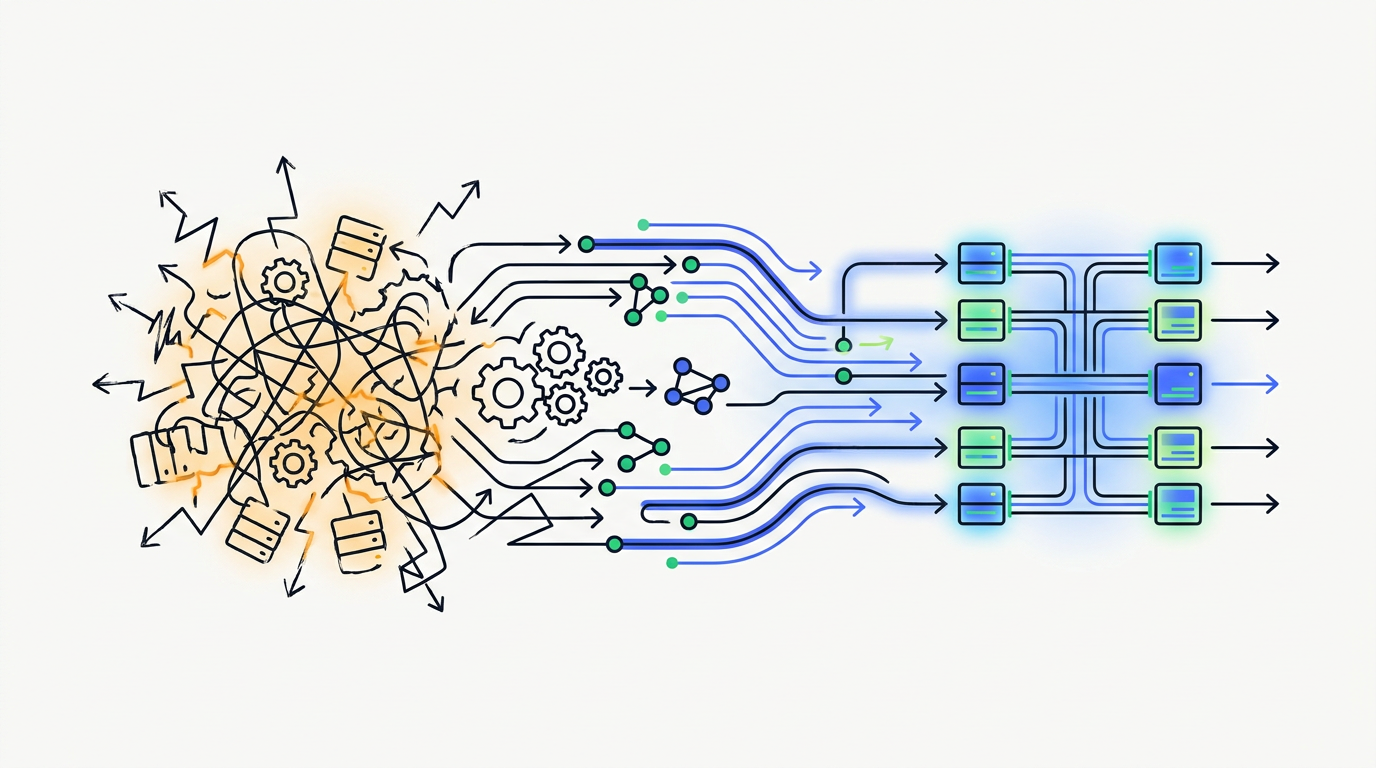
Resilient automation architecture is a design approach for building automated systems that can withstand failures and continue operating. It uses principles like fault tolerance, redundancy, and monitoring to ensure workflows can gracefully handle errors, recover quickly, and maintain stability without manual intervention, ensuring business continuity.
Let’s be honest. Anyone can chain a few API calls together in a visual builder and call it “automation.” It’s exciting for about five minutes, until an API goes down, a server hiccups, or a webhook gets lost in the ether. Suddenly, your “game-changing” workflow is a digital house of cards, and you’re left manually cleaning up the mess.
This is the dirty secret of the automation world: most of it is incredibly fragile. The real work of building production-grade automation isn’t about the initial setup; it’s about preparing for the inevitable moment when things break.
This is where resilient automation architecture comes in. It’s a complete mindset shift—from building workflows that work when everything is perfect, to designing systems that survive when everything goes wrong. It’s what separates a hobbyist’s fragile toy from a reliable business process. Forget the hype. This is the framework you actually need to build automations that last.
That workflow you built to process new orders? It probably works great 99% of the time. But what happens when your payment processor’s API has a momentary outage? Does the automation crash and burn, leaving an order in limbo? Does it retry foolishly, potentially charging the customer twice?
Or consider a data pipeline that syncs customer information between your CRM and your marketing platform. If the sync fails halfway through, do you end up with incomplete records and a data consistency nightmare?
These aren’t hypothetical edge cases; they are the daily reality of working with distributed systems. The internet is a messy, unreliable place. APIs change, servers need reboots, and networks drop packets. Building an automation without planning for failure is like building a house without a foundation. It looks fine on a sunny day, but the first storm will bring it down.
Resilient automation architecture is a set of design principles and patterns for building systems that can gracefully handle and recover from failures. The goal isn’t to prevent failure—that’s impossible. The goal is to accept that failure is a given and build systems that can withstand it without collapsing.
A resilient system can detect when something is wrong, isolate the impact, and either recover automatically or fail over to a backup process, all while maintaining as much functionality as possible. It’s about ensuring the continuous operation of your business processes, even when the underlying technology is misbehaving.
People often use “robust” and “resilient” interchangeably, but they mean different things.
In automation, you need both. But resilience is the harder, and more important, quality to achieve because you can never anticipate every possible failure mode.
The core principles of resilient automation are a set of guidelines for designing systems that can withstand and recover from failure. They focus on accepting failure as inevitable and building mechanisms to handle it gracefully, ensuring stability and continuous operation.
To make this easy to remember, think of the SAFE framework. Resilient automations are:
Don’t build one giant, do-it-all automation. This is a classic mistake. A monolithic workflow is a single point of failure. If one small part breaks, the entire process dies.
Instead, break your process down into smaller, independent, single-purpose modules. Think of it like a team of specialists instead of one overworked generalist. An “intake” bot, a “data enrichment” bot, and a “notification” bot. If the enrichment bot fails, the intake bot can still queue up new tasks, and the system can recover without losing data. This modular approach, often seen in microservices, is fundamental to resilience.
For critical components of your automation, you need a backup plan. Redundancy means having duplicate instances of a service running. If one fails, traffic is automatically rerouted to a healthy one. This is called a failover.
For a simple automation, this might be overkill. But for a mission-critical process like payment processing, having a redundant setup can be the difference between a minor hiccup and a major outage that costs you revenue and customer trust. It’s the digital equivalent of a hospital’s backup generator.
You can’t fix what you can’t see. As your automations become more complex and autonomous, you risk creating blind spots. Observability is the practice of instrumenting your systems so you can understand their internal state from the outside.
This goes beyond simple “it worked” or “it failed” logs. It means capturing detailed telemetry data—logs, metrics, and traces—that allows you to ask arbitrary questions about your system’s behavior after the fact. Good monitoring and observability are like a dashboard, security cameras, and an alarm system for your automations. They are prerequisites for trust and rapid incident response.
So how do you actually design a fault-tolerant automation workflow? It’s not about a single tool, but about applying proven architectural patterns. Here are four common blueprints for building resilience into different types of automation.
Most modern automation is event-driven; it kicks off when something happens, like a new user signing up or a payment being received via a webhook. The biggest risk here is losing the event if your system is down or busy.
The Fix: Use a message queue.
Instead of your webhook endpoint processing the data directly, have it do one tiny job: drop the incoming data onto a message queue (like RabbitMQ or AWS SQS). Then, have a separate worker process pull messages from the queue and handle them.
Serverless functions (like AWS Lambda or Google Cloud Functions) are fantastic for running small, isolated pieces of code. But by default, if they fail, they fail.
The Fix: Use a Dead-Letter Queue (DLQ).
Configure your function so that if it fails a certain number of times, the triggering event is automatically sent to a DLQ. This is a special queue for failed messages. You can then inspect the DLQ later to diagnose the problem and re-process the failed events without losing them.
CI/CD (Continuous Integration/Continuous Deployment) is the automation that builds and deploys your software. A failure here can block your entire development team.
The Fix: Make stages idempotent and restartable.
Design each stage of your pipeline (build, test, deploy) so that it can be re-run safely. For example, a deployment script shouldn’t fail if the software is already deployed; it should simply recognize the state and report success. Use a robust orchestration tool like Jenkins or GitLab CI that maintains the state of the pipeline.
Data pipelines move data from a source (like an application database) to a destination (like a data warehouse). They are notoriously brittle.
The Fix: Use batch processing with watermarks.
Instead of streaming data record-by-record, process it in small batches (e.g., every 5 minutes). Keep track of the last successfully processed record or timestamp (a “high-water mark”). If the pipeline fails, it knows exactly where to resume from on the next run, preventing both data loss and duplicates.
Idempotency is a fancy word for a simple, vital concept: doing something multiple times should have the same result as doing it once. It is critical for resilient automation because networks are unreliable, and retrying a failed operation is a fundamental part of fault tolerance.
Think about pressing an elevator button. You press it once, and it lights up. If you press it again (and again), nothing new happens. The elevator is still just called once. The “call elevator” operation is idempotent.
Now imagine if every press sent another elevator. That would be chaos. Many automations behave like this by default. If a workflow to “create user account” is retried, does it create a second, duplicate account? If so, it’s not idempotent, and it’s dangerous.
A resilient, idempotent workflow would be designed to first check if the user account already exists. If it does, it simply succeeds without taking any action. This allows your automation error handling logic to safely retry failed operations without causing unintended side effects. Without idempotency, your retry strategy becomes a liability.
When an API call fails, the naive solution is to just try again immediately. This is often a bad idea. If the service is overloaded, hammering it with retries will only make things worse.
A much smarter approach is to use an exponential backoff strategy.
This gives the failing service time to recover. It’s a simple, highly effective technique for building stability into any automation that relies on external services.
A resilient automation must be stateful. It needs to know where it is in a multi-step process. If an automation that involves three API calls fails on the second call, it needs a way to resume from that point, not from the beginning.
This involves storing the state of the workflow somewhere persistent—like a database. Before executing a step, the automation checks its state. After completing a step, it updates its state. This ensures data consistency and allows for graceful recovery, preventing half-finished processes and corrupted data.
No single technology makes a system resilient. It’s about combining the right components to create a fault-tolerant architecture. The most common categories include orchestration tools, message queues, and monitoring platforms.
Orchestrators are the “conductors” of your automation. They manage the lifecycle of your services and workflows.
These are the “post offices” of your architecture. They provide a buffer between services, enabling asynchronous communication.
These platforms are your “eyes and ears.” They collect, visualize, and alert on the health and performance of your systems.
Once you’ve mastered the fundamentals, you can explore more advanced techniques to make your automations virtually unbreakable.
Chaos Engineering is the practice of intentionally injecting failure into your systems to find weaknesses before they cause real outages. It’s like a fire drill for your infrastructure. For automation, this could mean:
It sounds scary, but it’s the only way to build true confidence in your system’s resilience.
The ultimate goal of resilience is to create systems that can fix themselves without human intervention. This is known as self-healing. An orchestrator like Kubernetes provides a basic level of this by restarting failed pods.
A more advanced self-healing system might automatically detect a surge in errors from a specific API, reroute traffic to a backup provider, and notify the engineering team—all within seconds. This moves beyond simple recovery to proactive, automated incident response.
Traditional monitoring relies on setting static thresholds (e.g., “alert me if CPU is over 90%”). But what about subtle, “weird” problems that don’t trip a specific alarm?
This is where AI can help. By training machine learning models on your system’s normal telemetry data, you can build an anomaly detection system that flags unusual patterns of behavior. It might notice a slight increase in latency combined with a strange error message that, together, signal an impending failure long before any traditional alert would fire.
If you can’t measure it, you can’t improve it. Vague goals like “high uptime” aren’t enough. You need specific Key Performance Indicators (KPIs) to track the resilience of your automation infrastructure.
This is the most basic metric. It’s the percentage of workflow executions that fail.
AFR = (Number of Failed Executions / Total Number of Executions) * 100
Track this over time. Is it going up or down? What types of failures are most common? This simple metric can guide your improvement efforts.
These two metrics are crucial for incident response.
Your goal is to drive both of these numbers as close to zero as possible.
These are not measurements, but business objectives that you define.
Defining your RTO and RPO is a critical strategic step. It dictates how much you need to invest in redundancy, backups, and disaster recovery planning.
Building a resilient automation architecture isn’t a one-time project; it’s a cultural shift. It requires you to move from a “happy path” mindset to one of defensive design.
Start small. Don’t try to re-architect everything at once. Pick one critical workflow and apply these principles. Add a queue to handle incoming webhooks. Implement an exponential backoff strategy for a flaky API. Set up better monitoring so you know when it fails.
Remember, the goal is not to achieve zero failures. The goal is to build a system where failure is a boring, non-eventful, automatically-handled occurrence. That is the true mark of a production-grade automation system.
What is the first step to making my automations more resilient?
Start with observability. You can’t fix what you can’t see. Implement structured logging and basic monitoring for your most critical workflow. Just knowing when and why it fails is the first and most important step.
Is this only for big companies with large engineering teams?
No. The principles apply at any scale. Even a solo creator can apply resilience patterns. Using a tool with a built-in queue, or adding a “retry with delay” step to a visual workflow, is a form of resilient design. The key is the mindset, not the team size.
Does using a specific platform like Zapier or n8n make my automations resilient?
Not automatically. While some platforms have features that help (like built-in retries), resilience comes from how you design the workflow. A poorly designed workflow will be fragile on any platform. You still need to think about decoupling, error handling, and state management.
How much resilience is “enough”?
It depends on the process. An automation that posts to social media can tolerate more downtime than one that processes financial transactions. Use the RTO/RPO framework to decide. The more critical the process, the more you need to invest in its resilience.

Part of the Thinker's Automation Labs content team. Researches with the SEO Blog Research Agent, drafts the piece, and routes it through review before publishing. Every claim is fact-checked against primary sources.
AI workflow automation uses artificial intelligence to manage and execute complex, multi-step business processes. It goes beyond simple…

Event-driven workflow orchestration is a system where a central service manages and coordinates tasks. Unlike scheduled jobs, these…
Playwright is a modern browser automation framework ideal for enterprise web scraping. It excels at reliably extracting data…