Limitations of Generative AI: The Awkward Truth of What’s Wrong
Generative AI’s primary limitations include producing factually incorrect information (hallucinations), inheriting biases from its training data, and posing…
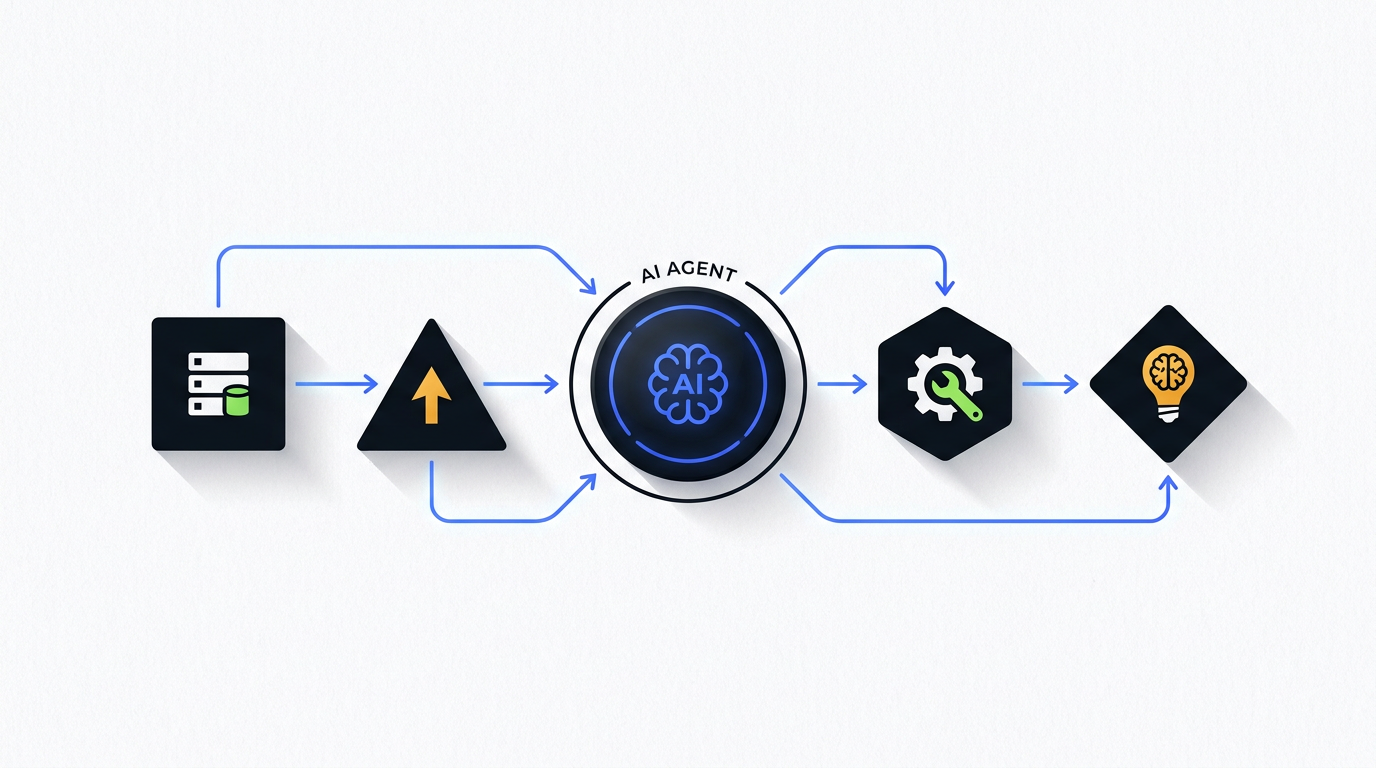
A learning agent in AI has four main components: the Learning Element, which makes improvements; the Critic, which provides feedback on performance; the Performance Element, which chooses actions; and the Problem Generator, which suggests new exploratory actions. These parts work together, enabling the agent to learn from experience.
If you’ve ever tried to study for an AI exam or just get your head around the basics, you’ve probably run into a diagram that looks like a bowl of spaghetti, full of boxes and arrows labeled “Critic” and “Performance Element.” It’s a classic topic for multiple-choice questions, and most explanations are dry enough to bore a rock.
Let’s fix that.
The goal here isn’t to help you memorize terms for a test. It’s to help you understand what’s actually happening inside an AI that learns. Once you get the logic, you can answer any learning agent components mcq they throw at you, because you’ll know how the pieces fit together. Think of this as the plain-English owner’s manual for any AI that gets smarter over time.
Forget the jargon for a second. Any system that learns—whether it’s a baby learning to walk, a chess grandmaster honing their strategy, or an AI learning to drive a car—has a few things in common.
It needs a way to do things, a way to judge if those things were good or bad, a way to update its strategy based on that judgment, and sometimes, a way to try something new just to see what happens.
That’s it. Those four ideas are the foundation of a learning agent in artificial intelligence. The official terms are just fancy labels for these very simple concepts. We’re going to break down each one, so you can stop cramming and start seeing how it all connects.
First, what’s an “agent”? In AI, an agent is simply something that perceives its environment and acts upon it. A thermostat is a simple agent; it perceives the room temperature (with a sensor) and acts by turning the heater on or off (with an actuator).
But a thermostat doesn’t learn. If you open a window, it just works harder; it doesn’t learn to anticipate you opening the window at 8 AM every day.
A learning agent, on the other hand, can improve its performance over time through experience. It starts off clumsy or naive and gradually gets better. Its initial knowledge might be incomplete, but it adapts. The ultimate goal is to become a rational agent—one that always takes the action expected to maximize its performance—by learning from its successes and failures.
Every learning agent is built from four main conceptual parts. Think of them as a team of specialists working together inside the AI’s “head.” To make this easy, imagine the agent is a student learning a new skill, like playing a video game.
Let’s look at each specialist’s job description.
The Performance Element is the part of the agent that takes what it already knows and chooses an action. It’s the “doing” part. It observes the current situation (a percept) through the agent’s sensors and decides what to do next.
Think of it as the agent’s current skill set. In a self-driving car, the performance element is the system that takes in camera data and decides to “turn the wheel 5 degrees left” or “apply the brake.” In a chess AI, it’s the function that analyzes the board and picks a move.
Critically, the Performance Element doesn’t learn. It just executes based on the rules it currently has. It’s the learning element that changes those rules.
How does an agent know if it did a good job? That’s the Critic‘s role. The Critic evaluates the agent’s action and tells the Learning Element how well the agent is doing. It provides feedback.
This feedback is based on a “performance standard.” In a game, the standard is the score or winning/losing. For a vacuum robot, it might be how much dirt it picked up. The Critic essentially looks at the outcome and says, “That was a good move, you get +10 points,” or “That was a terrible move, you crashed, -500 points.”
Without the Critic, there is no learning. It’s the voice that provides the raw data for improvement. Which component of a learning-based agent assesses its performance? The Critic. Always.
This is where the magic happens. The Learning Element is responsible for making improvements. It takes the feedback from the Critic and uses it to modify the Performance Element.
If the Critic says, “That last action led to a bad outcome,” the Learning Element figures out what part of the Performance Element’s logic was responsible and tries to change it. Its job is to make the agent better for the future.
For example, if a self-driving car gets negative feedback from the Critic for braking too hard, the learning element might adjust the braking algorithm in the Performance Element to be gentler next time. This is the heart of machine learning within the agent agent architecture.
If an agent only ever does what it knows is “safe,” it might never discover a better way. The Problem Generator is responsible for suggesting new, exploratory actions. It pushes the agent to experiment.
A chess AI might be programmed to win, but the problem generator could suggest an unconventional opening move—one that isn’t guaranteed to be good—just to gather new data. A recommendation algorithm might suggest a movie from a genre you’ve never watched, just to see if you’ll bite.
This creates new experiences (or “problems”) for the Performance Element to handle, which generates new feedback from the Critic, which in turn gives the Learning Element new information to learn from. It’s the component that prevents the agent from getting stuck in a rut.
These four components operate in a continuous loop that allows the agent to get smarter.
environment with its sensors. The Performance Element takes this percept sequence and chooses an action.Critic observes the outcome and compares it to the performance standard, generating feedback.Learning Element takes the Critic’s feedback and modifies the rules inside the Performance Element.Problem Generator suggests a new, novel action, which feeds into the Performance Element, starting the cycle over with a new experiment.This cycle of acting, getting feedback, and updating its strategy is the fundamental process of any AI agent that learns.
A learning agent doesn’t exist in a vacuum. Its components interact with the world through three key concepts:
percept.The agent uses its sensors to understand the state of the environment, and its actuators to execute the action chosen by the Performance Element.
The Performance Element is the component responsible for selecting external actions. It uses the agent’s current knowledge and rules to choose what to do in the environment based on the information it receives from its sensors.
The role of the Critic is to evaluate the agent’s performance and provide feedback. It compares the outcome of the agent’s actions against a fixed performance standard and tells the Learning Element whether the action was good, bad, or how it could be improved.
The Learning Element improves performance by taking the feedback from the Critic and using it to make changes to the Performance Element. It modifies the agent’s internal rules, knowledge base, or decision-making logic so that future actions are more likely to be successful.
The key difference is that the Performance Element acts while the Learning Element improves. The Performance Element executes actions based on the agent’s current knowledge. The Learning Element is responsible for updating that knowledge based on new experiences and feedback.
The structure of a learning agent maps cleanly onto different types of machine learning.
Critic‘s feedback is directly based on these rewards (e.g., “+1 for winning the game,” “-1 for crashing”). This is how most game-playing AIs learn.feedback comes from a set of labeled training data. For an image classifier, the Critic would compare the agent’s guess (“cat”) to the correct label (“cat”) and provide feedback: “Correct” or “Incorrect.” The Learning Element then adjusts.For most learning agent components mcq questions you’ll encounter, the underlying model is reinforcement learning, as it uses the full feedback loop most explicitly.
This agent architecture isn’t just theoretical. It’s at work all around you.
feedback. The Learning Element uses this data to refine future recommendations for you.Ready to test your understanding? Here are a few common questions styled like the ones you’d find on an exam.
Question 1: Which component is responsible for suggesting novel actions to create new learning opportunities?
A) The Critic
B) The Learning Element
C) The Problem Generator
D) The Performance Element
Answer: C) The Problem Generator.
Question 2: An AI agent playing chess makes a move. After the opponent responds, the agent determines that its board position has worsened. This determination is made by the:
A) Actuator
B) Sensor
C) Critic
D) Learning Element
Answer: C) The Critic.
Question 3: What is the relationship between the Learning Element and the Performance Element?
A) The Learning Element executes actions suggested by the Performance Element.
B) The Performance Element provides feedback to the Learning Element.
C) The Learning Element modifies the Performance Element based on feedback.
D) They are two names for the same component.
Answer: C) The Learning Element modifies the Performance Element based on feedback.
What is a percept in the context of intelligent agents?
A percept is a single piece of input that an agent’s sensor receives from the environment at any given moment. A sequence of these inputs over time is called a percept sequence, which gives the agent a history of what it has observed.
Can a learning agent exist without a Critic?
No. For an agent to learn, it needs some form of feedback to know whether its actions are good or bad. The Critic provides this essential feedback. Without it, the Learning Element has nothing to work with, and the agent cannot improve.
Is the Problem Generator always necessary for a learning agent?
Not strictly, but it’s highly recommended for creating a robust agent. An agent without a Problem Generator can still learn, but it might get stuck in a suboptimal routine because it never explores potentially better, unknown strategies. It’s the difference between perfecting a known technique and discovering a new, more effective one.
Which component of a learning agent is most like traditional machine learning models?
The Learning Element is the component that most directly corresponds to the concept of a machine learning model. It’s the part that contains the algorithm (e.g., a neural network, a decision tree) that gets updated and trained based on data (the feedback from the Critic).

Part of the Thinker's Automation Labs content team. Researches with the SEO Blog Research Agent, drafts the piece, and routes it through review before publishing. Every claim is fact-checked against primary sources.
Generative AI’s primary limitations include producing factually incorrect information (hallucinations), inheriting biases from its training data, and posing…

Generative AI for business refers to artificial intelligence systems that create new, original content—like text, images, and code—from…

Generative AI examples include tools that create original content across various formats. Common applications are text generation with…