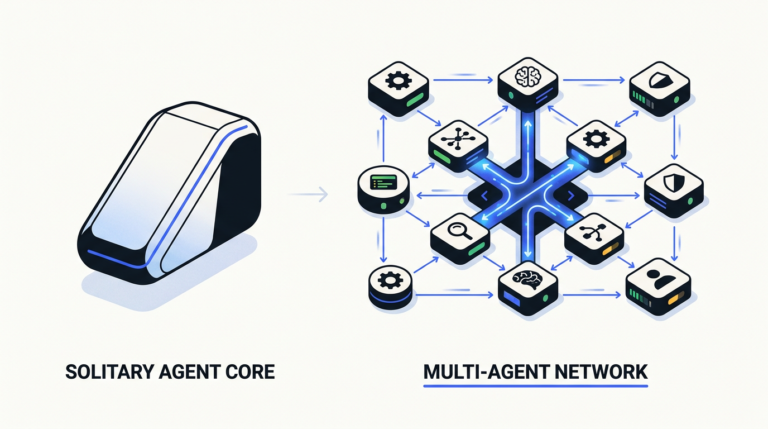
Single-Agent vs Multi-Agent Systems: A Clear Guide
A single-agent system uses one AI agent to handle a task end to end, while a multi-agent system…

A knowledge-based agent makes decisions by reasoning over a stored knowledge base of facts and rules, using an inference engine to draw new conclusions. It relies on three operations, TELL, ASK, and RETRACT, to update and query what it knows. This guide explains how knowledge-based agents reason and act.
Most of the AI you hear about today is a brilliant guesser. Large language models, image generators—they work by finding patterns in massive datasets and making a statistically probable prediction. But there’s another, older branch of AI that doesn’t guess. It knows. This is the world of the knowledge-based agent in AI, and understanding it is key to seeing the whole picture of artificial intelligence.
Unlike a machine learning model that learns patterns from data, a knowledge-based agent (KBA) operates from a set of explicit facts and rules that have been programmed into it. It’s less like a student cramming for an exam and more like a seasoned expert consulting their own internal library. While not as trendy as generative AI, the principles behind knowledge-based agents—logic, reasoning, and transparency—are more important than ever.
Imagine a simple thermostat. It perceives the temperature and reacts: if it’s too cold, it turns on the heat. This is a simple reflex agent. It doesn’t know anything about seasons, electricity bills, or that you’re about to leave for vacation. It just reacts to the current input.
A knowledge-based agent is fundamentally different. It maintains an internal state of knowledge about the world. It doesn’t just react; it reasons. It could know that “mornings are usually colder,” that “turning the heat on costs money,” and that “the family is away next week.” Based on this knowledge, it can make more intelligent decisions than a simple reflex agent. It acts based on a logical conclusion, not just an immediate trigger.
A knowledge-based agent is an artificial intelligence program that uses a knowledge base of facts and rules to make decisions. It perceives its environment, reasons about its options using an inference engine, and then performs an action. Its intelligence comes from the explicit information it has been given about its world.
At the heart of every knowledge-based agent are two distinct but deeply connected components. Get these two, and you’ve understood the whole system.
Think of a detective working a case. They have two things:
A knowledge-based agent works the same way. Its two core parts are:
These two parts are separate. You can update the knowledge base with new information without having to reprogram the inference engine. This separation makes knowledge-based systems more flexible and easier to maintain than systems where the knowledge and reasoning are tangled together.
A knowledge-based agent operates through a continuous cycle of perceiving its environment, updating its knowledge, and deciding on an action. This process is managed by three fundamental operations: TELL, ASK, and RETRACT.
This simple loop—perceive, TELL, ASK, act—is how the agent navigates its world, constantly updating its understanding and reasoning about its next move.
The power of a knowledge-based agent depends entirely on how well its knowledge is structured. This is the field of knowledge representation. It’s not enough to just dump text into the knowledge base; the information must be in a formal language the inference engine can understand and process logically.
There are several ways to represent this knowledge, each with its own strengths.
IsMan(Socrates)). This is the foundation for the inference engine’s reasoning.The choice of representation is critical. A good representation makes it easy to store knowledge and efficient for the inference engine to reason with it.
The inference engine is what gives the agent its spark of reason. It’s the process that connects the dots in the knowledge base. Two of the most common inference methods are forward chaining and backward chaining.
Imagine a simple medical diagnostic system with these rules in its knowledge base:
Forward Chaining is data-driven. It starts with the known facts and works forward to see what conclusions can be drawn.
Forward chaining is great when you have new data and want to see what happens.
Backward Chaining is goal-driven. It starts with a possible conclusion (a hypothesis) and works backward to see if the facts support it.
Let’s say we want to test the hypothesis: “Does the patient have pneumonia?”
Backward chaining is perfect for diagnostic or advisory systems where you have a specific question you need to answer.
The primary components of a knowledge-based agent are the Knowledge Base (KB), which stores facts and rules about the world, and the Inference Engine, which applies logic to the knowledge base to derive new conclusions and make decisions. It also has sensors to perceive its environment and actuators to perform actions.
In an era of “black box” AI, where even the creators of a model can’t fully explain why it gave a specific answer, knowledge-based agents are a breath of fresh air. Their greatest strength is their explainability.
Because the knowledge and reasoning steps are explicit, you can ask a knowledge-based agent why it made a particular decision. The system can retrace its logical steps and present the exact facts and rules it used to reach its conclusion. This transparency is invaluable in high-stakes fields like medicine, finance, and law, where “because the algorithm said so” is not an acceptable answer. This ability to audit the reasoning process builds trust and allows for easier debugging.
If these agents are so logical and transparent, why aren’t they everywhere? The answer lies in their greatest weakness: the knowledge-acquisition bottleneck.
A knowledge-based agent is only as smart as its knowledge base. And building that knowledge base is an incredibly difficult, expensive, and time-consuming process. Every single fact and rule has to be researched, formalized, and manually coded by human experts.
For any complex domain, the amount of knowledge required is vast. Worse, knowledge changes. Rules have exceptions. Keeping the knowledge base comprehensive, consistent, and up-to-date is a monumental task. This bottleneck is the primary reason why machine learning—which learns its own rules from data, bypassing manual coding—has become the dominant approach in modern AI.
One of the most famous examples of a knowledge-based agent is MYCIN, an early expert system developed in the 1970s to diagnose bacterial infections. Doctors would input patient symptoms and test results, and MYCIN would ASK its knowledge base, which contained about 600 rules derived from medical experts. Using backward chaining, it would reason through the data to recommend a diagnosis and treatment plan, even explaining the logical steps it took to arrive at its conclusion.
It’s helpful to see how knowledge-based agents stack up against the other major paradigms in AI today. They are not competing technologies so much as different tools for different jobs.
| Aspect | Knowledge-Based Agents | Machine Learning (e.g., Classifiers) | Generative AI (e.g., LLMs) |
|---|---|---|---|
| How it Learns | Doesn’t learn automatically. Knowledge is manually programmed by experts. | Learns patterns and rules by analyzing large, labeled datasets. | Learns statistical relationships and structures from vast, unlabeled datasets. |
| Core Engine | Inference engine applying logical rules. | A trained model (e.g., neural network) making predictions. | A transformer model predicting the next word/pixel. |
| Explainability | High. Can provide the exact rules and facts used for a decision. | Low to Medium. Often a “black box,” though methods like SHAP are improving this. | Very Low. Can’t explain its reasoning in a verifiable, logical way. |
| Data Needs | Needs high-quality, explicit knowledge, not large datasets. | Needs large, well-structured, and labeled datasets for training. | Needs massive, internet-scale datasets. |
| Best For | Expert systems, diagnostics, compliance, where rules are clear and explainability is critical. | Classification, regression, forecasting, when patterns exist in data. | Content creation, summarization, chatbots, where fluency is key. |
The future isn’t about one approach winning. It’s about hybrid AI models. The most powerful systems will combine the logical reasoning of a knowledge-based agent with the pattern-matching power of machine learning, creating AI that is both smart and understandable.
What is the main goal of a knowledge-based agent?
The main goal is to make intelligent decisions by reasoning logically over a set of explicitly stored knowledge, mimicking the problem-solving process of a human expert in a specific domain.
Is a chatbot a knowledge-based agent?
It depends. A simple, rule-based chatbot that follows a strict script can be seen as a very basic knowledge-based agent. However, modern chatbots like ChatGPT are based on large language models (a form of generative AI), not an explicit knowledge base and inference engine.
Are knowledge-based agents still relevant today?
Yes, absolutely. While they are not the focus of mainstream hype, their principles are critical. They are used in specialized expert systems for finance, medicine, and engineering. More importantly, their concepts of knowledge representation (like ontologies) and reasoning are being integrated into modern AI systems to make them more reliable and transparent.

Part of the Thinker's Automation Labs content team. Researches with the SEO Blog Research Agent, drafts the piece, and routes it through review before publishing. Every claim is fact-checked against primary sources.
A single-agent system uses one AI agent to handle a task end to end, while a multi-agent system…
A learning agent is an AI agent that improves its own performance over time by learning from feedback.…
A goal-based agent is an AI agent that chooses actions by asking whether they move it closer to…