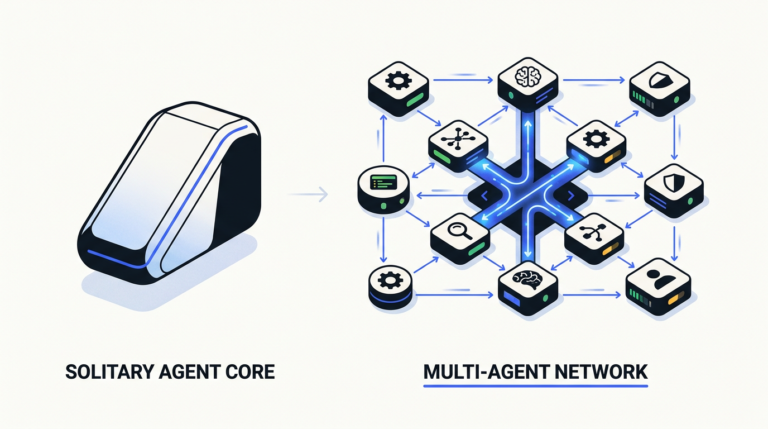
Single-Agent vs Multi-Agent Systems: A Clear Guide
A single-agent system uses one AI agent to handle a task end to end, while a multi-agent system…

AI assistants are evolving from reactive chatbots into autonomous agents that plan, act, and complete multi-step tasks for you. The future is agentic: software that doesn’t just answer questions but gets work done across your tools — with humans setting goals and guardrails.
We’ve all gotten used to AI assistants. You ask Siri for the weather, tell Alexa to set a timer, or ask ChatGPT to summarize an article. It’s a simple loop: you ask, it answers. This is useful, but it’s not the revolution. The real future of AI assistants is that they stop being mere assistants and start becoming autonomous agents.
This isn’t just a change in vocabulary. It’s a fundamental shift from a tool that answers your questions to a partner that completes your tasks. The automation of the future isn’t about better chatbots; it’s about a new layer of software that can reason, plan, and act on your behalf. This is the automation wave most people aren’t ready for, and it’s going to change how we think about work itself.
For the last decade, our relationship with AI has been transactional. We give it a command, and it performs a single, isolated action. “What’s the capital of Nebraska?” “Play my morning playlist.” “Convert 100 euros to dollars.”
These are reactive systems. They wait for your input, process it using natural language processing (NLP), and deliver a result. They are incredibly powerful pattern-matchers, trained on vast amounts of data, but they don’t have goals. They don’t have intent. They can’t string together multiple steps to achieve a broader objective.
The next wave is about proactive execution. Instead of asking the AI to tell you how to do something, you’ll ask the AI to just do it.
Imagine this:
The AI agent doesn’t just give you a list. It understands your goal, breaks it down into steps (search, filter, check availability, book), interacts with different applications (maps, review sites, booking systems), and completes the task. You just get a calendar invite with the confirmation. That’s the leap from answering questions to getting things done.
The terms “AI assistant” and “AI agent” are often used interchangeably, but they represent two different levels of capability. An assistant reacts to specific commands, while an agent autonomously pursues a goal.
Think of it this way: an AI assistant is like a calculator. You have to punch in every single number and operation. An AI agent is like hiring an accountant. You give them your documents and the goal—”file my taxes”—and they handle all the intermediate steps.
Here’s a clearer breakdown:
| Capability | AI Assistant (e.g., Siri, Alexa, basic ChatGPT) | AI Agent (The Future) |
|---|---|---|
| Core Function | Reacts to a single command. | Pursues a multi-step goal. |
| Scope | Single-turn interaction. Answers a question or performs one action. | Multi-turn, multi-app workflow. Can plan and execute a sequence of actions. |
| Initiative | Passive. Waits for your prompt. | Proactive. Can make decisions and take next steps to achieve the goal. |
| Example | “What’s on my calendar today?” | “Find a 30-minute slot on my calendar tomorrow for a meeting with Bob, email him some options, and add the confirmed time to both our calendars.” |
This shift from assistant to agent is the core of AI automation and the future of work.
To understand where we’re going, it helps to know how today’s virtual assistants work. It’s a three-step dance, powered by machine learning and huge datasets.
The magic is that this entire process feels instantaneous. But the limitation is clear: it’s a closed loop. The assistant can’t step outside of this “understand and respond” cycle to actually do something in another program.
The agentic shift is what happens when an AI can break out of that loop. An AI agent doesn’t just process language; it uses tools. These “tools” can be anything: your web browser, your email client, your CRM, or an API for another piece of software.
This is where the future of AI assistants gets really interesting. The AI becomes the user.
An agent operates with a new core loop:
This ability to plan, act, and self-correct is what makes an agent autonomous. The most powerful agents will live right inside your computer’s operating system, giving them full context of your files, applications, and permissions. The OS is the agent’s world, and the companies that integrate agents most deeply into it will have a massive advantage.
As AI agents become more common, they will split into two main categories: specialized and general-purpose. You’ll need both, and they will work together.
General-Purpose Agents are like a smart, capable intern. They can handle a wide variety of tasks but aren’t experts in any single domain. This is your “do-it-all” agent that can manage your calendar, draft emails, and search the web. They are great for broad productivity and connecting different parts of your digital life.
Specialized Agents are like a master craftsperson. They are trained to do one thing exceptionally well. Think of an agent built specifically for:
For most businesses, the real power won’t come from one giant, generic AI. The true unlock is using automation platforms to build your own team of small, specialized agents. This is the new SMB toolkit: creating focused, digital employees that solve one painful, specific problem. Prove one workflow with a simple, specialized agent before you try to build a complex, all-knowing system.
Today, we mostly interact with AI through text or voice. The future is multimodal, meaning agents will be able to perceive and understand information from multiple sources at once.
This integration of senses is what will make AI agents feel less like a program you’re using and more like a collaborator who shares your workspace. AI is becoming the new user interface for automation; instead of clicking through complex menus, you’ll just have a conversation.
AI agents will fundamentally change business processes and workflows, creating new roles and demanding new skills. This isn’t just about efficiency; it’s a complete rewiring of how work gets done.
The biggest impact will be on knowledge work. Repetitive digital tasks that currently take up hours of our days will be delegated to autonomous agents. This includes things like:
This shift will create a demand for a new kind of role: the AI Automation Engineer. This isn’t a traditional developer. It’s a specialist who understands business processes and knows how to design, build, and manage teams of AI agents using multi-agent frameworks and automation platforms. This is already becoming a real job title, signaling a major evolution in the automation field.
Furthermore, as agents become capable of transacting on our behalf, they will need their own economic infrastructure. We’re seeing the beginning of an “agent economy,” which will require its own financial plumbing—a secure network for agents to pay each other for services, creating a new, automated layer of economic activity.
The fear of AI is often centered on replacement. But the more realistic and productive future is one of collaboration. AI agents won’t replace strategic thinkers; they will become a force multiplier for them.
The new model of human-AI teaming looks like this:
This keeps the human in the driver’s seat for what matters most: judgment, creativity, and strategic direction. For mission-critical business processes, this model is essential. While a fully autonomous agent is exciting, real-world business requires reliability. Deterministic, human-defined workflows augmented with specific AI capabilities offer the best of both worlds. This controlled automation ensures that you get the power of AI without sacrificing the predictability your business needs.
The human’s role shifts from a “doer” to a “director” of a team of digital specialists.
As agents become more autonomous, questions of safety, ethics, and trust move to the forefront. An agent that can access your email, calendar, and bank account is incredibly powerful, but it also introduces significant risks. This is the biggest barrier to widespread adoption.
The key areas of concern are:
The road to a fully agentic future is not without its bumps. Several significant challenges remain, but the industry is actively working on solutions.
The future of AI assistants is bright, but it will be built on a foundation of solving these very real, very practical problems. The hype is about full autonomy; the reality will be a steady, deliberate march toward more capable and trustworthy AI partners.
What is the future of AI assistants?
The future of AI assistants is their evolution into autonomous AI agents. Instead of just answering questions, they will be proactive, goal-driven partners that can plan and execute complex, multi-step tasks across different applications to get work done for you.
How will AI agents change work?
AI agents will automate complex digital workflows, freeing up humans from repetitive tasks like data entry, report generation, and scheduling. This will shift the human role from “doer” to “strategist,” focusing on setting goals, making judgments, and overseeing teams of digital agents. It will also create new jobs, like the AI Automation Engineer.
Is “prompt engineering” a good career?
Prompt engineering is not a career. It’s a skill, like knowing keyboard shortcuts or how to use spreadsheet formulas. Being good at writing prompts is useful, but it will quickly become a baseline competency. The real value isn’t in the prompt itself, but in what you build with it—the workflow, the process, the specialized agent. Don’t build a career on it.
As a business owner, what’s the first step I should take?
Start small. Don’t try to automate your entire business at once. Identify one high-value, repetitive workflow that’s causing a bottleneck. It might be lead qualification, content production, or customer follow-up. Prove you can solve that one problem with a simple automation or a specialized agent. Strategy before software; prove one workflow before you build ten.

Part of the Thinker's Automation Labs content team. Researches with the SEO Blog Research Agent, drafts the piece, and routes it through review before publishing. Every claim is fact-checked against primary sources.
A single-agent system uses one AI agent to handle a task end to end, while a multi-agent system…
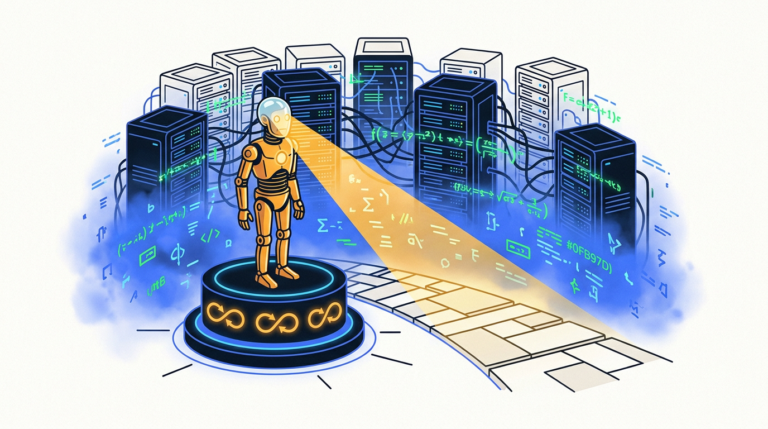
A learning agent is an AI agent that improves its own performance over time by learning from feedback.…
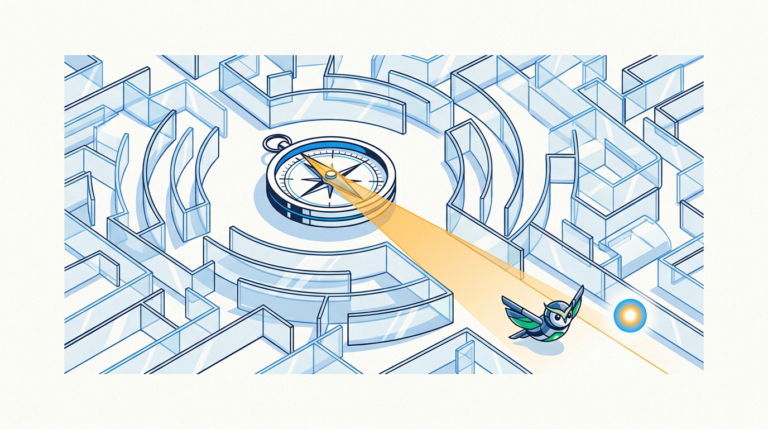
A goal-based agent is an AI agent that chooses actions by asking whether they move it closer to…