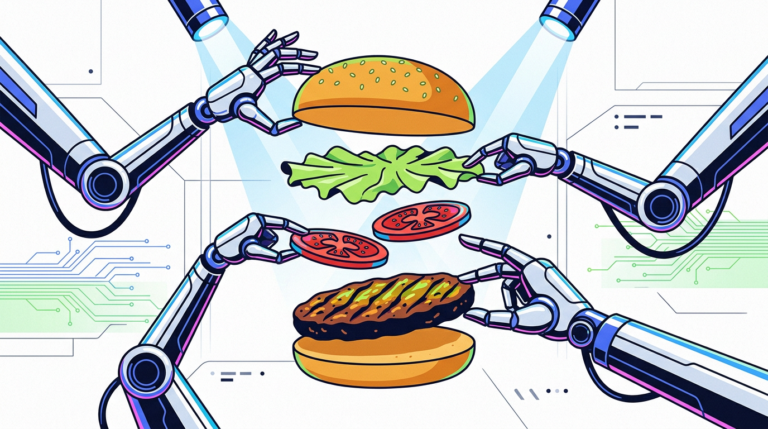
The Future of Fast Food: Will a Robot Make Your Next Burger?
The future of fast food will be shaped by AI-driven automation for efficiency, hyper-personalization through data, and a…
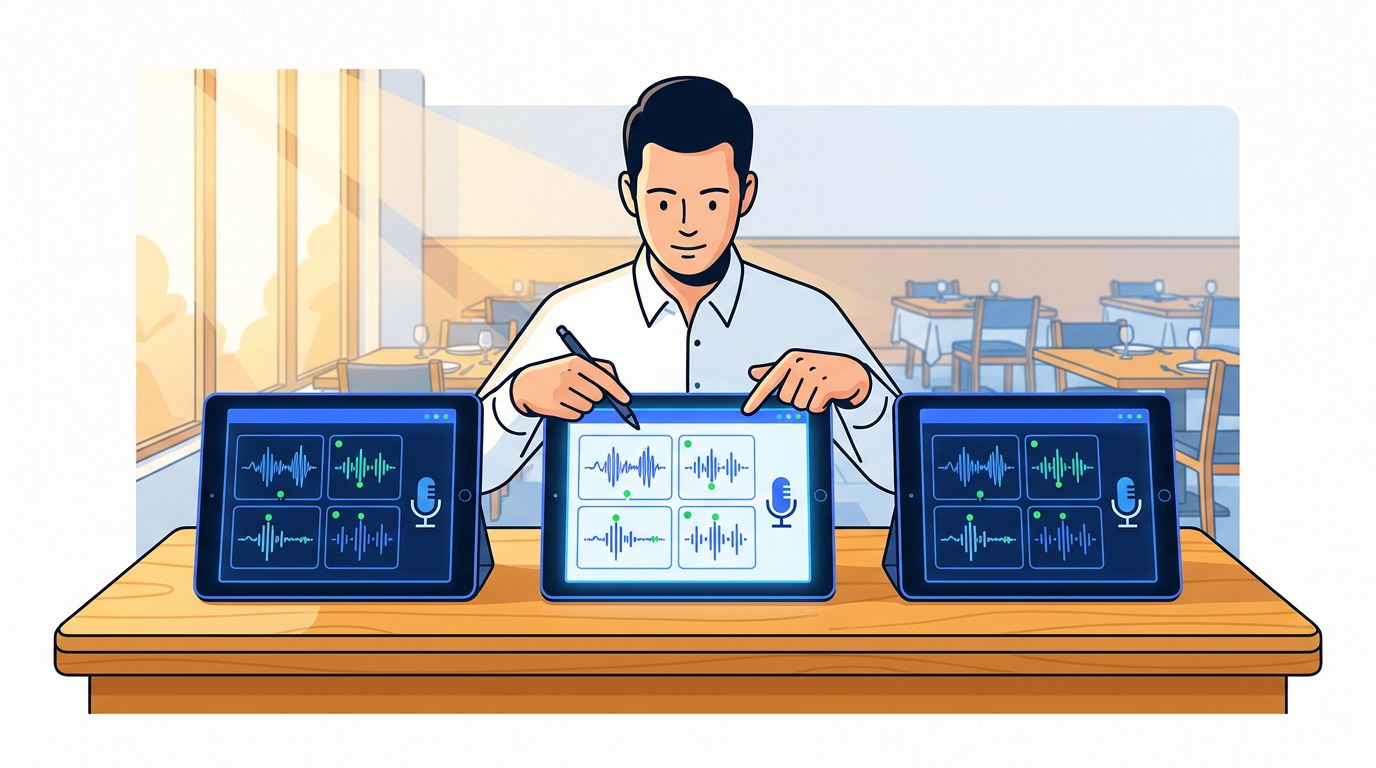
The best AI voice ordering systems for restaurants automatically handle phone and drive-thru orders, reducing missed calls and increasing efficiency. Top providers like ConverseNow, SoundHound for Restaurants, and Kea integrate with your POS system to improve order accuracy, upsell items, and provide 24/7 customer service.
Your phone is ringing off the hook during the dinner rush. Your front-of-house staff is juggling a line of in-person customers, managing delivery tablets, and trying to grab the phone before it goes to voicemail. Every call they miss is a potential order—and revenue—walking out the door.
This isn’t a new problem. But the old solution of “just hire more people” is getting harder and more expensive. The new solution is finally here, and it’s not a sci-fi fantasy. It’s an AI that answers the phone for you.
Forget the clunky, robotic phone trees that make everyone want to hang up. Modern AI voice ordering systems are surprisingly human-like. They’re designed to handle the entire order-taking process, from “Hello” to payment, freeing up your team to focus on the customers right in front of them. Let’s be clear: this isn’t about replacing your staff. It’s about giving them a powerful assistant that never calls in sick.
An AI voice ordering system is an automated software tool that uses conversational AI to answer restaurant phone calls or greet drive-thru customers. It understands natural speech, takes a customer’s order, intelligently upsells items, and sends the order directly to your restaurant’s Point of Sale (POS) system without human intervention.
You might be picturing a frustrating robot that keeps saying, “I’m sorry, I didn’t get that.” The reality is much smoother. The technology, often called conversational AI, is designed to understand how people actually talk.
Here’s the typical flow for a phone order:
upselling strategy that works.order accuracy.payment processing over the phone via credit card, or simply prepare the order for payment on pickup.The process for a drive-thru is nearly identical, just faster and happening through a speaker. The goal is to make the experience feel as natural as talking to a friendly, hyper-efficient employee.
So, why should a restaurant use AI for phone orders? The benefits go far beyond just answering the phone. When implemented correctly, these systems directly impact your revenue, your staff’s sanity, and your customers’ happiness.
The most immediate impact is capturing revenue you were previously losing. Every one of those missed calls during a rush is a lost sale. An AI answers 100% of the time, 24/7.
But the real money-maker is the automated upselling. Unlike a busy staff member who might forget, the AI always asks if the customer wants to add a drink, a side, or make it a combo. This consistency leads to a measurable increase in average order value. Providers often report a 15-25% bump in check size from AI-driven upselling alone.
Taking phone orders is disruptive. It pulls your most valuable team members away from revenue-generating tasks and in-person hospitality. Offloading this repetitive work to an AI system dramatically improves operational efficiency.
Your staff can now focus on providing a great customer experience for dine-in guests, expediting orders, and managing the floor. This reduces stress and burnout, which in turn helps with staff retention—a massive challenge in the restaurant industry. Lowering pressure on staffing and reducing labor costs are significant, tangible wins.
A busy signal or an endless ring is a terrible customer experience. An immediate, friendly answer is a great one. Customers get their orders placed quickly and accurately without waiting on hold.
While some worry about the lack of a human touch, a well-designed AI is often better than a rushed, stressed-out human who might make a mistake. The AI confirms every item, leading to higher order accuracy and fewer “this isn’t what I ordered” moments. For quick, transactional needs like placing a takeout order, efficiency and accuracy often define a positive customer satisfaction outcome.
How do you choose the right AI ordering system for your restaurant? Don’t just pick the one with the flashiest website. The best AI voice ordering systems for restaurants are the ones that fit your specific operation. Most of these tools are fine, but the right one for a national QSR chain is the wrong one for an independent pizza shop.
Use this checklist to find your perfect match.
| Decision Factor | What to Ask Yourself | Why It Matters |
|---|---|---|
| Restaurant Type | Are you a Quick-Service Restaurant (QSR), fast-casual, or a full-service establishment? Do you have a drive-thru? | Drive-thru systems like SoundHound are built for speed. Systems for full-service might need to handle more complex questions or even basic reservations. |
| Menu Complexity | Is your menu simple (e.g., pizza, burgers) or highly customizable (e.g., build-your-own bowls, complex modifiers)? | A complex menu requires a more sophisticated AI that can handle nuance. ConverseNow excels here. A simple menu might not need all the bells and whistles. |
| Primary Channel | Are you trying to solve for missed phone orders, a slow drive-thru, or both? |
Some providers specialize in one channel over the other. Choose a system that’s optimized for your biggest pain point. |
| POS Integration | What Point of Sale (POS) system do you use? (e.g., Toast, Square, Aloha) | This is non-negotiable. The AI must seamlessly integrate with your existing POS. Check the provider’s integration list before you even book a demo. Poor POS integration is a deal-breaker. |
| Human Handoff | How important is it to have a smooth escape hatch to a human employee if the AI gets stuck? | Some systems, like Kea, are built around a “human-in-the-loop” model for a seamless backup. Others are more fully automated. Decide what level of safety net you’re comfortable with. |
| Budget | What’s your budget for setup fees and ongoing monthly costs? | Pricing models vary wildly. Be clear about your budget to narrow down options quickly. We’ll break this down more later. |
We’ve tested, researched, and analyzed the major players. Here are our picks for the best AI voice ordering systems, who they’re for, and who should skip them.
If your menu has a thousand possible combinations and you want to maximize every single check, start your search with ConverseNow. Their AI is exceptionally good at navigating complex menus and executing sophisticated, context-aware upselling and add-ons. They focus heavily on increasing average order value, and their dashboard provides clear data to prove it.
Formerly known as “Houndify,” SoundHound is a giant in the voice AI space, and their restaurant product is built for one thing: speed. Their AI can process an entire order in the time it takes a customer to say it, even with multiple people talking at once in the car. It’s the main character of conversational AI for drive thru right now.
order accuracy under pressure.Kea takes a slightly different approach. They know that sometimes, AI gets stuck. Their big selling point is a seamless integration of AI and a remote team of human agents. The AI handles the vast majority of orders, but if it detects confusion or a particularly tricky request, it instantly and silently flags a human operator to take over. The customer never even knows a handoff occurred.
Independent restaurants or small chains that want the efficiency of AI but the security blanket of a human backup.Presto Automation (formerly Presto) has been in the restaurant tech game for a while. They offer a whole suite of tools, from tablets to computer vision, with their AI voice agents being a key part. Their solution, Presto Voice, is robust, tested, and built for scale, making it a popular choice for major multi-location brands.
The space is growing fast. Keep an eye on these emerging players:
AI phone answering for restaurants.The cost of AI restaurant ordering systems varies, but you can generally expect a one-time setup fee and an ongoing monthly subscription. Pricing models typically fall into a few categories: a flat monthly fee, a per-order fee, or a hybrid of both.
Let’s be honest: most providers are cagey about pricing on their websites. It’s almost always “contact us for a quote.” But here’s a general breakdown of what to expect:
menu integration, POS connection, and recording your custom greetings. This can range from a few hundred to several thousand dollars, depending on complexity.The price is driven by your call volume, menu complexity, and whether you need drive-thru capabilities. Always ask for a detailed pricing sheet and be wary of long-term contracts until you’ve proven the system’s value.
Seamless POS integration is table stakes. If a system can’t talk to your Toast or Square account, it’s a non-starter. But the best systems go further. True operational efficiency comes from connecting the AI to your entire tech stack.
When evaluating options, ask about these crucial integrations:
Let’s be real. These systems are not magic wands. Adopting an AI voice system comes with challenges, and any provider who says otherwise is selling you hype.
setup time and deployment process involves working closely with the provider to “train” the AI on your specific menu, including all its quirks, modifiers, and regional names for items. This takes time and effort from you or your manager.Ultimately, trust is the new frontier. You’re handing over a critical customer touchpoint to an algorithm. The best approach is to start small, perhaps by having the AI handle calls only during your busiest peak hours, and expand from there as you and your customers build confidence in the system.
Can AI voice ordering handle reservations?
Some of the more advanced systems can handle basic reservation requests (e.g., “a table for four at 7 PM”). However, most are optimized for order-taking. For complex reservation management, a dedicated tool is still your best bet.
What happens if the AI can’t understand a customer?
The best systems have a built-in “escape hatch.” If the AI fails to understand a request after one or two tries, it will automatically route the call to a human employee or, in the case of a service like Kea, to a remote human agent who takes over seamlessly.
Can the AI handle multiple languages?
Yes, many leading providers like SoundHound and ConverseNow offer multilingual capabilities. They can often detect the language the customer is speaking and switch automatically, making them a great fit for restaurants in diverse communities. Be sure to confirm which languages are supported.

Part of the Thinker's Automation Labs content team. Researches with the SEO Blog Research Agent, drafts the piece, and routes it through review before publishing. Every claim is fact-checked against primary sources.
The future of fast food will be shaped by AI-driven automation for efficiency, hyper-personalization through data, and a…

AI for restaurant marketing uses artificial intelligence tools to automate and enhance marketing efforts. This includes personalizing customer…

AI kitchen automation uses technologies like robotics, machine learning, and computer vision to handle tasks in commercial kitchens.…