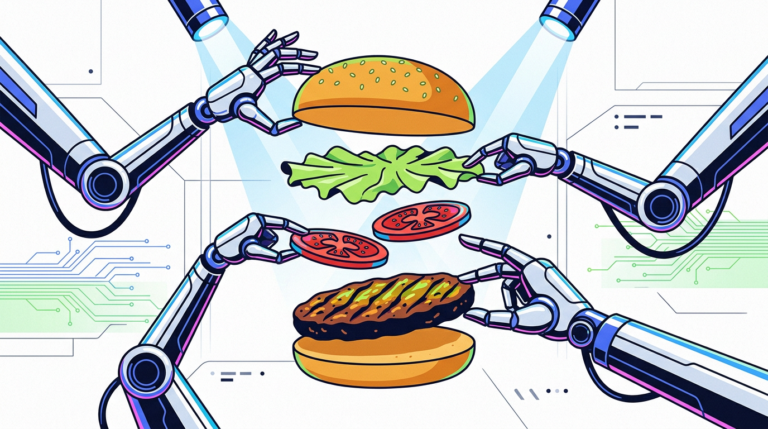
The Future of Fast Food: Will a Robot Make Your Next Burger?
The future of fast food will be shaped by AI-driven automation for efficiency, hyper-personalization through data, and a…
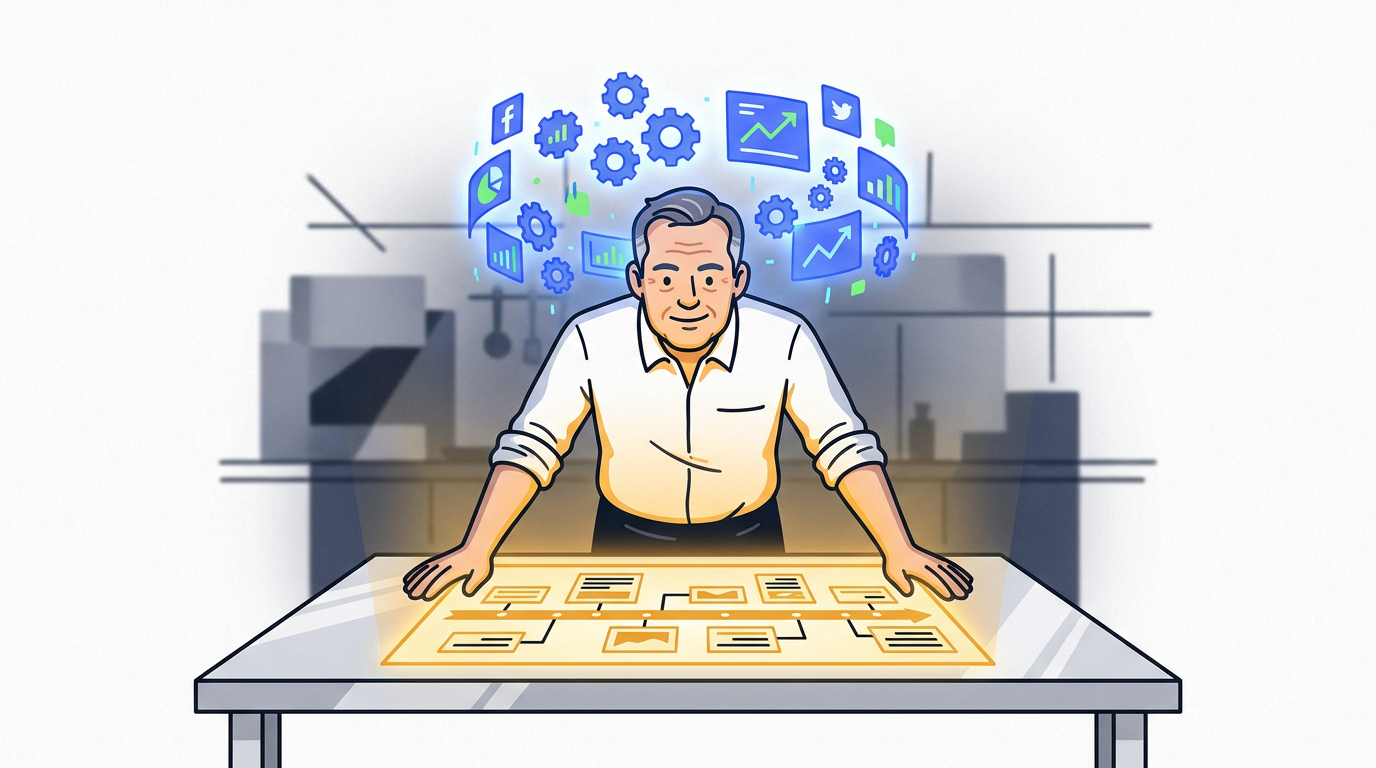
AI for restaurant marketing uses artificial intelligence tools to automate and enhance marketing efforts. This includes personalizing customer offers, managing social media content, analyzing guest data to predict trends, and optimizing online advertising, ultimately aiming to increase customer loyalty and revenue.
Let’s be honest. Most articles about AI in the restaurant world sound like they were written by a robot trying to sell you a different robot. They promise a revolution but offer zero practical advice, leaving you to wonder if you need a data science degree just to run a pizzeria.
Forget the hype. Using AI for restaurant marketing isn’t about installing a cyborg maître d’. It’s about getting a smart, tireless assistant—a digital sous-chef for your marketing—that handles the tedious work so you can focus on what you’re actually good at: hospitality and great food.
This guide will show you how to do it. We’ll skip the jargon and give you a clear, step-by-step plan to use AI in ways that actually help, from writing better social media posts to understanding what your customers really want.
Think of AI not as a single, scary technology, but as a category of smart software. Some of these tools are great at writing, others are brilliant with numbers, and some are experts at spotting patterns. The trick is to pick the right tool for the right job.
When we talk about AI for marketing, we’re really talking about using this software to do three things better: understand your guests, automate the repetitive stuff, and make smarter business decisions. It’s less The Terminator and more the world’s most efficient and insightful manager.
AI restaurant marketing uses smart software to automate, personalize, and analyze your marketing efforts. Instead of guessing what promotions might work or spending hours writing social media posts, AI tools use data to provide answers and handle the execution. It’s the difference between navigating with a paper map and using Google Maps; both can get you there, but one is a lot faster, more accurate, and can re-route you around traffic you didn’t know was there.
The real benefits aren’t futuristic fantasies. They’re practical solutions to the daily headaches of running a restaurant.
You know your regulars. But what about the other 95% of your customers? AI tools can analyze your sales data, reservation notes, and online reviews to uncover hidden patterns. It can tell you that customers who order the calamari on Fridays are 70% more likely to also order a specific bottle of wine. This level of personalization was once only available to giants like Amazon; now, it’s accessible to your neighborhood bistro.
How many hours do you or your staff spend answering the same questions? (“Are you open on Mondays?” “Do you have gluten-free options?”) How much time goes into drafting an Instagram post? This is the low-hanging fruit for restaurant marketing automation. AI can handle these repetitive tasks, freeing up your team to provide the warm, human service that actually creates customer loyalty.
Should you add a new vegan dish to the menu? Is Tuesday night really the best time for a “2-for-1” special? For too long, restaurants have run on gut feelings. AI introduces data analysis into the equation. By using predictive analytics, AI can forecast demand, help optimize your menu for profitability, and even suggest pricing adjustments to maximize revenue.
Jumping straight into a complex AI system is a recipe for disaster. The best approach is to start with small, manageable projects that deliver clear value, then build from there. Here’s a realistic timeline.
Goal: Get comfortable with AI and score an easy win.
Goal: Integrate AI into a core process like customer service or email marketing.
Goal: Use AI for strategic decisions about operations and revenue.
This is where AI marketing goes from generic to genuinely helpful.
Instead of just showing your whole menu online, an AI system can offer personalized menu recommendations. By looking at a customer’s past orders, it can suggest new items they’re likely to enjoy.
Traditional “punch card” loyalty programs are outdated. AI for customer loyalty programs makes them dynamic and personal. Instead of a generic “10th coffee free,” the program can generate unique offers based on individual behavior.
AI can improve your service even when you’re closed.
Basic chatbots are little more than interactive FAQ pages. Modern AI chatbots, using natural language processing, can understand complex questions and perform actions. They can integrate with your reservation software to book tables, answer questions about allergens, and even describe the vibe of your restaurant. This is a massive win for operational efficiency.
You can’t improve what you don’t measure. AI-powered reputation management tools use sentiment analysis to scan all your customer reviews from Google, Yelp, and other sites. They categorize feedback into topics (food, service, ambiance) and assign a sentiment (positive, neutral, negative). This gives you an at-a-glance dashboard of your restaurant’s strengths and weaknesses, straight from your customers’ mouths.
This is often the easiest place to start and see immediate time savings.
Staring at a blank page trying to think of a caption is a special kind of pain. Use generative AI to do the heavy lifting. Give it a simple prompt like, “Write three witty Instagram captions about our new brunch special, a mimosa flight,” and edit the results to fit your brand’s voice. This is perfect for AI social media for restaurants and creating variations for targeted advertising campaigns.
AI can take your email marketing from a weekly newsletter to a personalized communication channel. It helps you segment your audience automatically (e.g., brunch crowd vs. dinner crowd) and can even write subject lines and test them against each other to see which one gets more opens. This is a core part of modern restaurant marketing automation.
Smarter operations lead to better customer experiences, which is the best marketing of all.
Dynamic pricing AI for restaurants is a powerful but delicate tool. It’s not about surging prices on a Saturday night like a ride-share app. It’s about being strategic. You can use it to automatically offer discounts during slow periods to fill empty tables or slightly increase prices for peak time slots booked far in advance. When used ethically, it smooths out demand and boosts revenue.
Nothing hurts your reputation like an 86’d menu item or slow service because you’re understaffed. Predictive analytics tools analyze past sales data, local events, and even weather forecasts to predict customer demand with surprising accuracy. This allows you to optimize inventory to reduce food waste and schedule staff more effectively, ensuring a smooth service that keeps customers happy.
AI personalizes the dining experience by analyzing past order data to offer tailored menu recommendations, sending targeted promotions for favorite dishes, and remembering customer preferences to create a more bespoke service. This turns a generic transaction into a relationship, making guests feel recognized and valued. By using data from your POS and reservation systems, AI can anticipate what a customer might want, whether it’s suggesting a wine pairing they’ve enjoyed before or offering a special on their favorite dessert for their birthday.
For a small restaurant’s social media, the best AI tools are generative AI like ChatGPT for brainstorming ideas and writing captions, and scheduling tools with AI features like Buffer or Later for optimizing post times. ChatGPT is excellent for overcoming writer’s block and generating a high volume of creative content ideas quickly. Smart schedulers analyze your audience’s engagement patterns and suggest the best times to post for maximum visibility, automating a key part of your social media strategy.
AI helps with menu optimization by analyzing sales and profitability data to identify which dishes are stars (popular and profitable), puzzles (profitable but not popular), plowhorses (popular but not profitable), and dogs (unpopular and unprofitable). This data-driven insight allows you to redesign your menu to maximize profit. For pricing, AI enables dynamic models that can automatically adjust prices based on factors like demand, time of day, or ingredient costs, helping you capture more revenue without manual guesswork.
You don’t need a massive, all-in-one platform. You can assemble a powerful AI toolkit by picking the right tools for specific jobs.
| Tool | What It Is | Who It’s For | The Good & The Bad | Our Take |
|---|---|---|---|---|
| ChatGPT / Gemini | Generative AI Chatbots | Everyone. Seriously. | Pro: Incredibly versatile for writing, brainstorming, and summarizing. Free versions are very powerful. Con: Can produce generic or inaccurate content if your prompt isn’t specific enough. |
The best place to start. Use it to draft social posts, email newsletters, and ad copy. Don’t copy-paste; use it as a creative partner. |
| Tidio / Chatfuel | AI Chatbot Builders | Restaurants with high website traffic or frequent phone inquiries. | Pro: Can handle reservations and answer FAQs 24/7, freeing up staff. Con: Setup requires some initial effort to ‘train’ the bot on your restaurant’s info. |
A game-changer for reducing phone calls and capturing leads after hours. Start with FAQs, then integrate reservations. |
| Mailchimp (AI Features) | Email Marketing Platform | Any restaurant with an email list. | Pro: AI features help with subject lines, send-time optimization, and content personalization. Con: Can get pricey as your list grows. |
If you’re already doing email, using its AI features is a no-brainer for getting better results from the same effort. |
| Marvin | Customer Review Analysis | Restaurants serious about reputation management. | Pro: Aggregates reviews and uses sentiment analysis to show you exactly what to fix. Con: It’s a specialized tool focused only on review analysis. |
This is how you turn customer feedback into an actionable to-do list for improving your business. |
Buying a tool is easy. Getting it to work is hard. The biggest mistake restaurants make is treating AI as a magic wand. It’s not.
First, your technology needs to talk to each other. For an AI to personalize offers, it needs access to your POS data. For a chatbot to make reservations, it needs to connect to your booking system. This integration can be complex, so start with tools that explicitly advertise integrations with the systems you already use.
Second, your team needs to be on board. If your staff sees AI as a threat or just another annoying login, they won’t use it. Frame it as a tool to make their jobs easier. The chatbot handles annoying phone calls. The social media AI helps them get posts done in 10 minutes instead of an hour. The goal of automation is to make us more human, freeing up time for the personal touches that technology can’t replicate.
This isn’t theoretical. Real restaurants are seeing real results.
The line between “personalized” and “creepy” is all about transparency and value. Using AI to remember a guest’s favorite wine is great hospitality. Using it to track their location and send them an alert when they walk by your competitor is creepy.
Follow these rules to stay on the right side of the line:
Think of it like a great bartender: they remember your usual drink and ask how your vacation was. They don’t follow you home. Be the bartender.
The primary privacy risks of using AI in restaurant marketing are data breaches and misuse of personal information. Storing customer data like names, contact info, and order histories creates a target for hackers. Furthermore, using this data for hyper-personalization without clear consent can feel intrusive and erode customer trust, leading to a negative perception of your brand. Responsible AI use requires robust security measures and transparent communication with customers about how their data is used.
Do I need to be a tech expert to use AI?
Absolutely not. The best AI tools are designed for regular business owners, not engineers. If you can use Instagram or a modern POS system, you can use the tools mentioned in this guide. Start with the simplest ones, like ChatGPT.
How much does this cost?
It varies wildly. You can start for free with tools like ChatGPT’s free version. Basic plans for chatbots or email marketing might cost $20-$50/month. More advanced predictive analytics systems can run into the hundreds or thousands, but those are for larger operations. The key is to start small and only pay for tools once you’ve proven their value.
Will AI replace my restaurant staff?
No. It will make them better at their jobs. AI handles the repetitive, impersonal tasks (answering the phone, scheduling posts) so your human staff can focus on the things AI can’t do: providing warm hospitality, making personal connections, and solving unique customer problems. It’s about augmenting your team, not replacing it.

Part of the Thinker's Automation Labs content team. Researches with the SEO Blog Research Agent, drafts the piece, and routes it through review before publishing. Every claim is fact-checked against primary sources.
The future of fast food will be shaped by AI-driven automation for efficiency, hyper-personalization through data, and a…
AI kitchen automation uses technologies like robotics, machine learning, and computer vision to handle tasks in commercial kitchens.…
The best AI voice ordering systems for restaurants automatically handle phone and drive-thru orders, reducing missed calls and…