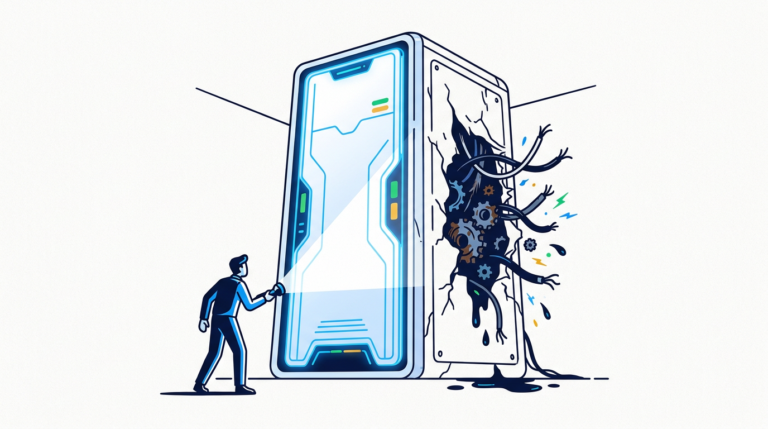
Limitations of Generative AI: The Awkward Truth of What’s Wrong
Generative AI’s primary limitations include producing factually incorrect information (hallucinations), inheriting biases from its training data, and posing…

An AI task environment is the problem space where an AI agent operates. It includes everything external to the agent itself, defined by its properties like observability, determinism, and number of agents. It’s specified by the PEAS framework: Performance measure, Environment, Actuators, and Sensors.
Let’s be honest. The conversation around AI is obsessed with the “brain”—the large language model, the neural network, the algorithm. But that’s like judging a Formula 1 driver without looking at the car, the track, or the other drivers. It’s a huge miss. The real secret to building effective AI isn’t just a smarter agent; it’s creating the perfect problem for it to solve. If you’re studying for an ai task environment mcq or just want to understand how AI actually works, this is the concept you need to nail.
The AI’s world—its task environment—is everything. It’s the digital gym where the agent trains, the battlefield where it competes, and the office where it does its work. Owning and understanding this “gym” is where the real strategic advantage is found.
This guide will break down everything you need to know about AI task environments in plain English. We’ll cover the essential PEAS framework, explain the six core properties that define any AI’s job, and give you some practice MCQs to make sure it all sticks.
Most AI explanations get lost in the weeds. They talk about models and algorithms until your eyes glaze over. But the most important concept is surprisingly simple: an AI agent doesn’t exist in a vacuum. It lives and breathes inside a specific task environment.
Think of it this way: a chess-playing AI has a simple, predictable world—the 8×8 board. A self-driving car’s world is a chaotic mess of roads, weather, and unpredictable humans. The AI’s design, its “smarts,” and its chances of success depend entirely on the world it’s built for. Understanding this world is step one.
An AI task environment is the complete “problem space” an AI agent operates within. It’s everything external to the agent itself. This includes the physical or virtual space, any rules that govern it, other agents it might interact with, and the criteria for success. It’s the stage on which the AI performs.
To properly define a task environment, AI researchers use a simple acronym: PEAS. It stands for Performance, Environment, Actuators, and Sensors. It’s a brilliant little tool for breaking down any AI’s job into four clear parts. If you can define the PEAS, you understand the problem the AI is trying to solve.
Let’s use a common example: a self-driving taxi.
This is the report card. How do you know if the AI is doing a good job? The performance measure defines success. It’s not just one thing; it’s usually a collection of metrics.
This is the world the agent lives in. The operating system is the agent’s world, providing the context for its actions. For a software bot, this might be a website or a database. For a robot, it’s the physical world.
Actuators are the parts the AI uses to do things in its environment. They are the agent’s “hands and feet.” If the agent is a piece of software, its actuators might be keyboard strokes or API calls.
Sensors are what the agent uses to see or perceive its environment. This is how it gets information about the current state of its world. This input is called a percept.
Once you have the PEAS defined, you can classify the environment based on six key properties. These pairings describe the nature of the problem. Is it simple or complex? Predictable or random? This is the core of understanding any ai task environment mcq you’ll come across.
Ready to test your knowledge? Here are a few common ai task environment mcq questions covering the concepts we just discussed. The answer and a simple explanation are below each one.
1. In the PEAS framework for a spam filter AI, what is the best example of a Performance Measure?
A) The email inbox
B) Marking an email as ‘spam’
C) The percentage of spam emails correctly identified
D) The words and headers within an email
Correct Answer: C. The performance measure is how you score the AI’s success. For a spam filter, that means accurately identifying spam while not flagging legitimate emails.
2. For a robot that plays table tennis, the camera system that tracks the ball is an example of a(n):
A) Actuator
B) Sensor
C) Environment
D) Performance Measure
Correct Answer: B. Sensors are what the agent uses to perceive the world. The camera is how the robot “sees” the ball’s position and velocity.
3. A game of chess is best described as what type of environment?
A) Partially Observable, Stochastic, and Sequential
B) Fully Observable, Stochastic, and Episodic
C) Fully Observable, Deterministic, and Sequential
D) Partially Observable, Deterministic, and Sequential
Correct Answer: C. Chess is fully observable (you see the whole board), deterministic (a move always has the same result), and sequential (past moves affect the future).
4. Which of the following is the best example of a dynamic environment?
A) An AI solving a Sudoku puzzle
B) An AI recommending a movie based on your watch history
C) An AI trading stocks on a live market
D) An AI identifying a part on a stationary assembly line
Correct Answer: C. A live stock market is constantly changing, even while the AI is deciding what to buy or sell. The other environments are static while the agent thinks.
5. An AI agent designed to diagnose diseases based on a patient’s symptoms operates in an environment that is primarily:
A) Fully Observable and Deterministic
B) Partially Observable and Stochastic
C) Fully Observable and Episodic
D) Static and Discrete
Correct Answer: B. Medical diagnosis is partially observable because the AI can’t see everything inside the patient and must rely on reported symptoms. It’s also stochastic because diseases can manifest differently in different people.
6. The task environment of a self-driving car is best described as:
A) Sequential, Dynamic, Continuous, and Multi-Agent
B) Episodic, Static, Discrete, and Single-Agent
C) Sequential, Static, Continuous, and Single-Agent
D) Episodic, Dynamic, Discrete, and Multi-Agent
Correct Answer: A. Driving is sequential (past actions matter), dynamic (traffic changes), continuous (steering/speed have infinite values), and multi-agent (other drivers exist).
Artificial Intelligence (AI) is a field of computer science focused on creating systems that can perform tasks that normally require human intelligence. This includes capabilities like learning, reasoning, problem-solving, perception, and understanding language. At its core, AI is the ultimate pattern-matching engine, capable of finding insights in data far beyond human scale.
AI is often broken down into different types based on its capabilities. The two main categories you’ll hear about are:
You’ll also hear terms like Machine Learning and Deep Learning, which are subsets of AI. Machine Learning is an approach where systems learn from data, while Deep Learning is a specialized type of machine learning that uses complex neural networks to achieve more advanced results.
The four components of an AI task environment, defined by the PEAS framework, are:
In a fully observable environment, the AI agent’s sensors can detect all aspects of the environment that are relevant to its decision-making at all times (e.g., a chess game). In a partially observable environment, the agent has incomplete information about the world, meaning it must make decisions based on what it can see and what it can remember or infer (e.g., a poker game where opponents’ cards are hidden).
A deterministic environment is completely predictable. If an agent performs an action in a certain state, the resulting state is guaranteed. There is no randomness (e.g., a calculator). A stochastic environment has an element of chance. An agent’s action can lead to one of several possible outcomes, and the agent can’t know for sure which one will occur (e.g., rolling dice or driving in traffic).
Task environments in AI are classified along six key dimensions:
Most real-world problems, like driving a car, are partially observable, stochastic, sequential, dynamic, continuous, and multi-agent, making them the most challenging to solve.

Part of the Thinker's Automation Labs content team. Researches with the SEO Blog Research Agent, drafts the piece, and routes it through review before publishing. Every claim is fact-checked against primary sources.
Generative AI’s primary limitations include producing factually incorrect information (hallucinations), inheriting biases from its training data, and posing…
Generative AI for business refers to artificial intelligence systems that create new, original content—like text, images, and code—from…
Generative AI examples include tools that create original content across various formats. Common applications are text generation with…