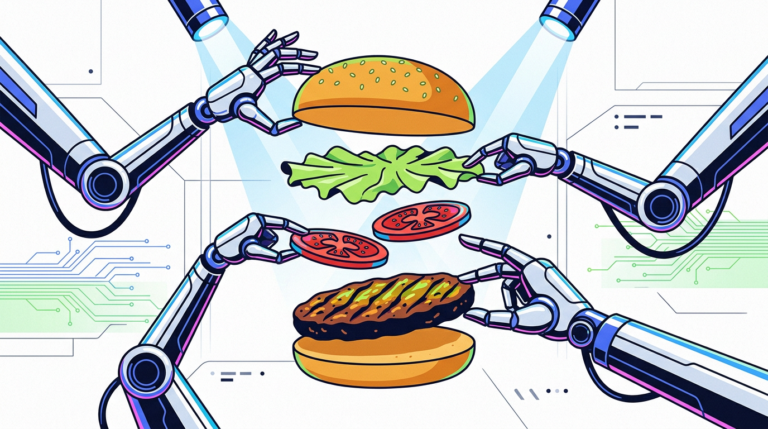
The Future of Fast Food: Will a Robot Make Your Next Burger?
The future of fast food will be shaped by AI-driven automation for efficiency, hyper-personalization through data, and a…

AI kitchen automation uses technologies like robotics, machine learning, and computer vision to handle tasks in commercial kitchens. This includes automated cooking, smart inventory management, demand forecasting, and food waste reduction, aiming to improve efficiency, consistency, and safety in food service operations.
Let’s be honest. When most people think about AI, they picture robot butlers or sentient chatbots plotting world domination. The reality is far less cinematic and a lot more practical. The most important AI revolution isn’t happening in a futuristic lab; it’s happening in the hot, greasy, and chaotic heart of the restaurant: the back of house.
While the hype cycle chases flashy demos, the real, workhorse AI is quietly taking over the most repetitive and grueling jobs in food service. This isn’t about replacing chefs with soulless machines. It’s about using smart technology to make commercial kitchens more efficient, less wasteful, and a little more sane. This is the world of AI kitchen automation, and it’s already here.
We’re going to break down the five key ways this technology is actually being used today, what’s real, what’s overhyped, and what you actually need to know.
AI kitchen automation is the use of smart hardware and software to handle tasks typically done by humans in a commercial kitchen. Think of it as giving the kitchen a central nervous system. Instead of relying solely on frantic human communication, you have a system of robots, sensors, and predictive software working together to cook food, track ingredients, and reduce waste.
It combines robotics for physical tasks (like flipping burgers), computer vision (digital eyes) to monitor quality, and machine learning (the “brain”) to predict customer demand and manage inventory. The goal isn’t to create a five-star meal from scratch, but to perfect the repetitive, high-volume tasks that cause the most bottlenecks and burnout in restaurant operations.
AI isn’t a single, monolithic thing. It’s a toolkit. In kitchens, that toolkit is being applied in a few very specific, high-impact ways. Here are the five you’ll see in the wild.
This is the one that gets all the press. We’re talking about robotic arms dedicated to a single, repetitive job. The most famous example is Flippy from Miso Robotics, a robotic arm that can operate a deep fryer and grill with relentless precision.
It’s not a general-purpose chef; it’s a specialist. These systems excel at tasks that are hot, dangerous, and mind-numbingly boring. They don’t take breaks, they don’t get burned, and they cook every single french fry for the exact same amount of time. This is the essence of back of house automation.
Manually counting every pickle jar and tomato box is a soul-crushing and error-prone job. Smart inventory systems use a combination of scales, cameras, and IoT sensors to track ingredients in real-time. This is the core of modern restaurant inventory management AI.
The system knows exactly how much cheese you have left. When it gets low, it can automatically place an order with your supplier, often timing it perfectly to reduce spoilage and storage costs. It turns inventory from a weekly nightmare into a background process.
A good kitchen manager develops a “gut feeling” for busy nights. AI-powered demand forecasting is that gut feeling, but supercharged with data. These systems analyze historical sales data, but also factor in external variables: Is it a holiday? What’s the weather forecast? Is there a big conference in town?
By processing all this information, the AI predicts what customers are likely to order, and when. This allows managers to schedule staff more effectively and tells the kitchen how much chicken to prep for the lunch rush, minimizing guesswork and waste.
This is one of the most financially and ethically compelling uses of AI in the kitchen. AI food waste reduction systems use a camera and a scale placed over the trash bin. Using computer vision, the AI identifies exactly what’s being thrown away—half-eaten bread rolls, untouched side salads, burnt steaks.
It logs every item, creating a detailed dashboard of your kitchen’s waste. This data is gold. It shows you if your portion sizes are too big, if a certain line cook is consistently burning food, or if a specific menu item is unpopular. You can then make targeted changes to stop throwing money in the bin.
Brand consistency is everything, especially for chains. AI uses computer vision to act as a tireless quality control inspector. It can check if a pizza has the right amount of pepperoni, if a sandwich has been assembled correctly, or if a plate is presented according to spec.
On the safety side, IoT sensors in refrigerators and freezers constantly monitor temperatures. If a fridge door is left open or a unit starts to fail, the system sends an immediate alert to a manager’s phone, preventing thousands of dollars in spoilage and averting a potential health crisis.
You don’t need to be an engineer to get the gist. The “AI” in kitchen automation is really a team of three different technologies working together.
This is the “brain.” Machine learning algorithms are pattern-matching engines. They sift through mountains of data (past sales, weather, time of day) to find connections a human would miss. This is what powers demand forecasting and helps inventory systems learn your restaurant’s unique rhythm.
This is the “eyes.” A camera connected to a smart computer can be trained to recognize objects. It learns what a “perfectly cooked burger patty” looks like versus a “burnt one,” or to tell the difference between a discarded slice of tomato and a piece of lettuce in a waste bin. This is the magic behind robotic cooking and waste tracking.
These are the “nerves.” IoT sensors are small, connected devices that measure the physical world—temperature, weight, motion. They are the simple, reliable data collectors that feed information to the brain. The thermometer in the freezer and the scale under the flour bin are the unsung heroes of the smart kitchen technology ecosystem.
AI automates a commercial kitchen by breaking down operations into specific tasks and assigning them to specialized technologies. Robotic arms handle repetitive physical jobs like frying or assembling. Computer vision systems act as digital eyes for quality control. IoT sensors monitor temperatures and ingredient levels, feeding data into a central system. Finally, machine learning algorithms analyze all this data to forecast demand, automate inventory orders, and identify sources of food waste, creating a more efficient and data-driven operation.
The most significant benefits are improved efficiency, consistency, and cost savings. Automation speeds up service and allows staff to handle more orders. Robotics ensure every dish is prepared the same way, protecting brand quality. AI-driven inventory and waste-tracking systems directly reduce food costs, while predictive analytics optimizes staffing, cutting labor expenses. Together, these benefits lead to a more profitable and smoothly run operation.
The biggest challenges are the high initial cost, the complexity of integrating new technology with existing systems, and the need for a new kind of skilled staff. Robotic systems are expensive, and making them work with your current point-of-sale or supply chain software can be a major headache. Furthermore, you can’t just drop in a robot and walk away; you need staff who can manage, troubleshoot, and maintain these sophisticated systems.
It’s not all perfectly fried potatoes and optimized orders. Adopting this tech is hard, and anyone who tells you otherwise is selling something.
A single robotic arm can cost tens of thousands of dollars. A full suite of inventory and waste-tracking software is a significant monthly expense. For a small, independent restaurant, the upfront cost can be prohibitive. Even for large chains, the challenge of integrating these new systems with decades-old legacy software for payroll and suppliers is a massive, expensive undertaking.
Kitchen AI systems collect a huge amount of data about your operations, sales, and customers. This makes you a target. A security breach could expose sensitive business information or, even worse, allow a bad actor to tamper with systems that control food safety equipment. Deciding who owns the data—you or the tech vendor—is a critical and often overlooked question.
The promise of automation is often “fewer staff,” but the reality is “different staff.” You might need fewer people on the fry station, but you now need someone with the technical skills to calibrate the robot, manage the software, and analyze the data dashboards. This “AI Automation Engineer” is a new role, and those skills don’t come cheap.
Vendors love to throw around impressive stats, but calculating the real return on investment (ROI) is tricky. It’s not just about cost savings.
Let’s imagine a fast-food franchise installs a Miso Robotics Flippy unit for $50,000. If that robot allows them to serve 20% more customers during the lunch rush and reduces oil-related food waste by 15%, you can start to do the math. The real win, however, might be that they can now retain staff who are no longer forced to work the most dangerous and unpleasant station in the kitchen.
The ROI for a waste-tracking system is more direct. If a system costs $300 a month but helps you identify and eliminate $1,000 a month in food waste, the decision is a no-brainer.
The key is to look beyond just one metric. The ROI comes from a combination of increased throughput, reduced waste, lower labor churn, and improved brand consistency.
No, AI kitchen automation will primarily change restaurant jobs, not eliminate them entirely. It automates the most repetitive, physically demanding, and undesirable tasks—like working a deep fryer for eight hours—freeing up human workers for more complex, creative, and customer-facing roles. The need will shift from manual laborers to technicians who can manage the automated systems, troubleshoot problems, and interpret the data the AI provides. Some low-skill roles may be reduced, but new, higher-skilled roles will be created.
This isn’t about a robot taking a job; it’s about a tool making a job better. It allows chefs to focus on creating new recipes instead of dicing onions for four hours. It lets managers focus on coaching staff instead of manually counting inventory. The human touch in hospitality—the creativity, the service, the problem-solving—becomes more valuable, not less.
We’re still in the early innings. The future of the automated kitchen is less about single-task robots and more about a fully integrated “kitchen operating system.”
Imagine a world where a customer’s online order is sent directly to an automated cooking system, the inventory is automatically depleted, a reorder is queued up, and a delivery drone is dispatched without any human intervention. This is the promise of the fully autonomous robotic kitchen, and it’s the model that will power the next generation of ghost kitchens and delivery-first food brands.
The tech will also get smarter and more personal. An AI might one day recognize a loyal customer and suggest a new menu item based on their past preferences, creating a level of personalization that’s impossible today. The kitchen won’t just be automated; it will be intelligent.
What’s the difference between automation and AI in a kitchen?
Automation is a machine doing a pre-programmed task, like a dishwasher running a cycle. AI is a system making a decision, like analyzing sales data to decide how much bread to bake. Simple automation follows orders; AI helps write the orders.
Is AI kitchen automation only for big chains like McDonald’s?
For now, the high cost of robotics means they are mostly adopted by large chains. However, software-based AI for inventory management, demand forecasting, and waste tracking is becoming more affordable and accessible for smaller, independent restaurants.
Can I get this kind of smart kitchen technology for my home?
Yes and no. You can buy many smart kitchen appliances—fridges that track contents, ovens you can preheat with your phone—but a fully integrated AI kitchen automation system like those in commercial kitchens is not yet a consumer product. For now, it remains focused on solving business problems at scale.

Part of the Thinker's Automation Labs content team. Researches with the SEO Blog Research Agent, drafts the piece, and routes it through review before publishing. Every claim is fact-checked against primary sources.
The future of fast food will be shaped by AI-driven automation for efficiency, hyper-personalization through data, and a…

AI for restaurant marketing uses artificial intelligence tools to automate and enhance marketing efforts. This includes personalizing customer…
The best AI voice ordering systems for restaurants automatically handle phone and drive-thru orders, reducing missed calls and…