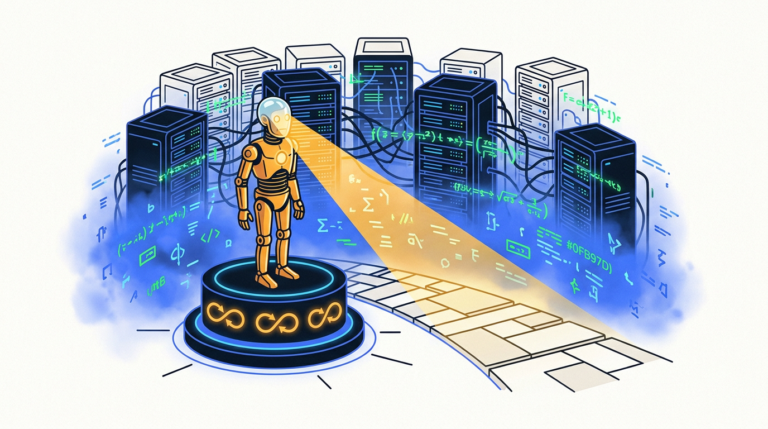
Learning Agent in AI: Components, How It Works & Examples
A learning agent is an AI agent that improves its own performance over time by learning from feedback.…
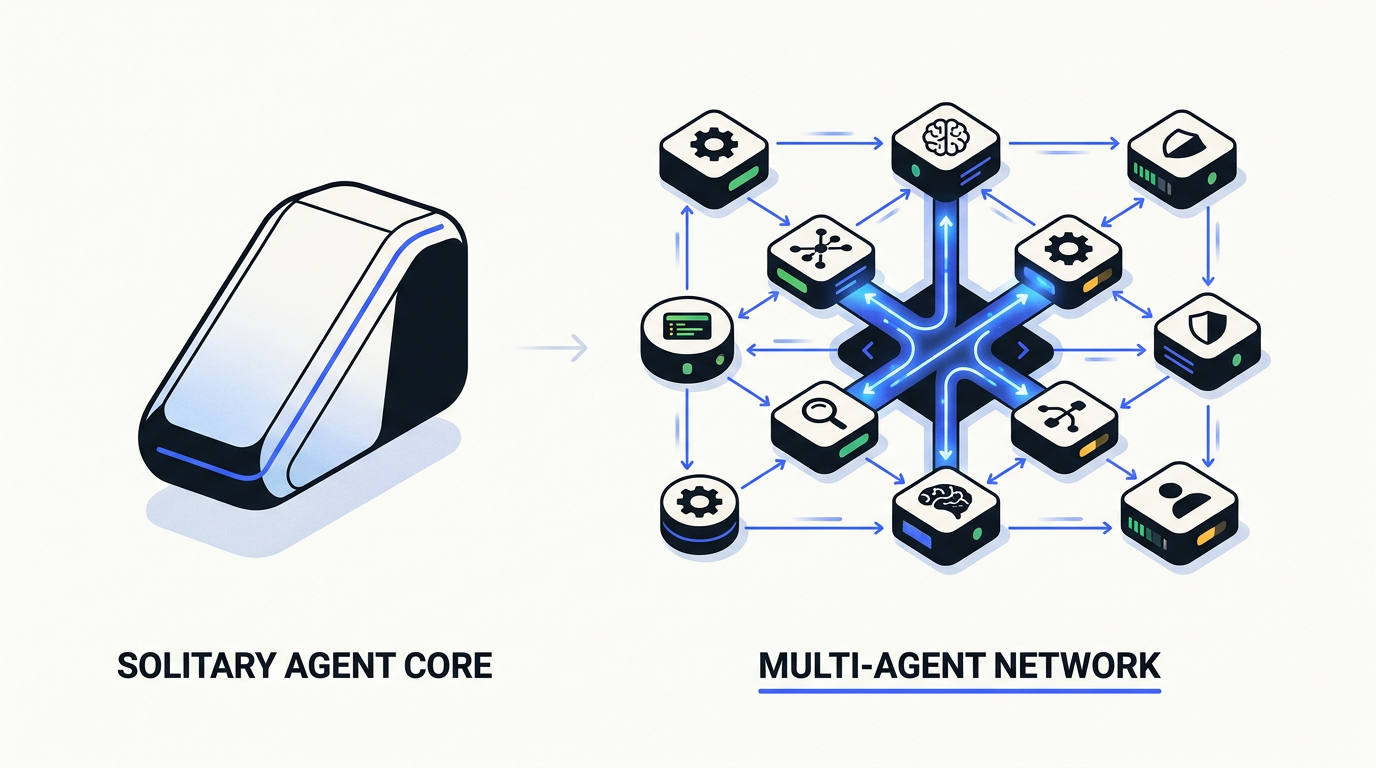
A single-agent system uses one AI agent to handle a task end to end, while a multi-agent system splits the work across several specialized agents that coordinate. Single-agent setups are simpler and cheaper; multi-agent systems scale to complex, parallel tasks but add coordination, cost, and control challenges.
The debate around AI agents often gets stuck on the model itself—is GPT-4 better than Claude 3? This is the wrong question. The real power isn’t just the engine; it’s the car you build around it. The most important architectural choice you’ll make when building an AI automation is whether to use one brilliant generalist or a whole team of specialists. This is the core of the single-agent vs multi-agent systems debate.
Most people should start with a single-agent system. It’s simpler, faster, and cheaper. But for complex, mission-critical work, building a “swarm” of coordinated, specialized agents is the only way to build something truly robust. Understanding the difference isn’t just academic—it determines whether your AI project succeeds or becomes a tangled, expensive mess.
Let’s make this simple.
Imagine you’re running a small bakery. In the beginning, it’s just you. You take the orders, bake the bread, manage the inventory, and sweep the floors. You are a single-agent system. You do everything from start to finish. It’s efficient for a small operation, but you can only do so much. If a huge order comes in while you’re also running low on flour, things start to break.
Now, imagine your bakery grows into a full-fledged company. You hire a cashier, a head baker, an inventory manager, and a cleaning crew. You’ve just created a multi-agent system. Each person is a specialized “agent” with a specific role. The cashier doesn’t need to know how to bake, and the baker doesn’t worry about inventory. The system can handle far more complexity and volume, but now you need something new: coordination. You need schedules, meetings, and a manager to make sure everyone is working together.
That’s the fundamental difference between single and multi-agent systems. It’s a trade-off between the simplicity of one and the power of many.
A single-agent system is an AI setup where one AI agent is responsible for completing an entire task or workflow by itself. It takes an input, processes it through a series of steps, and produces an output, all within a self-contained loop.
Think of a simple customer service chatbot on a website. It takes your question (input), searches its knowledge base, formulates an answer, and delivers it (output). The same, single AI brain handles every part of that process. It has a goal, a set of tools (like a search function), and some memory, but it works alone.
These systems are the backbone of many AI tools you use today. They are straightforward to design, relatively cheap to run, and quick to respond because there’s no communication overhead. The limitation is that they are a single point of failure and can be overwhelmed by tasks that require diverse, specialized skills.
A multi-agent system (MAS) is a setup where a task is broken down and distributed among multiple, autonomous AI agents. Each agent has a specialized role, its own set of tools, and the ability to communicate with the other agents to achieve a collective goal.
A great multi agent system example is an automated research team.
No single agent could do this as effectively. The magic is in the collaboration. By breaking the problem down, you can build a more robust and powerful system. This is why we say to build agent swarms, not a monolithic AI. The future of complex automation is a swarm of simple, coordinated bots.
This table breaks down the core difference between single and multi agent systems.
| Criterion | Single-Agent System | Multi-Agent System | The Bottom Line |
|---|---|---|---|
| Complexity | Low. Simple to design, build, and debug. | High. Requires complex coordination, communication, and management. | Single-agent wins for simplicity. Multi-agent introduces significant overhead. |
| Cost | Lower. Fewer model calls and less infrastructure. | Higher. Multiple agents mean multiple, simultaneous model calls, increasing costs. | Single-agent is much cheaper. Don’t use a multi-agent system if you’re on a tight budget. |
| Scalability | Limited. A single agent can only handle so much work. | High. You can add more specialized agents to handle increased load or new tasks. | Multi-agent is the clear winner for complex, growing tasks. |
| Fault Tolerance | Low. If the agent fails, the entire task fails. It’s a single point of failure. | High. If one agent fails, the system can often re-route the task to another agent. | Multi-agent systems are far more resilient and reliable for critical workflows. |
| Coordination | Not applicable. The agent only coordinates with itself. | Essential and difficult. Requires clear protocols for communication and negotiation. | This is the biggest challenge of multi-agent systems. Get it wrong, and you have chaos. |
| Speed (Latency) | Faster. No communication delays between agents. | Slower. The “chattiness” between agents adds time to the overall process. | For near-instant results, a single agent is usually faster. |
While a single-agent system is just a loop—prompt, tools, action—a multi-agent system is a society. And any society needs rules for how its members interact. This is where coordination mechanisms and architectural patterns come in.
This is how the agents talk to each other. Without clear rules, you don’t have a team; you have a crowd yelling at each other.
communication protocol. Think of it like a standardized JSON format they all agree to use for sending messages. One agent sends a message like {"task": "summarize", "source_url": "..."} and another agent knows exactly how to interpret it.orchestrator—that directs the workflow. It acts like a project manager, assigning tasks to the right specialized agents in the right order and collecting the results. It’s a top-down approach that provides control and predictability.How you structure your agent team is just as important as how they talk.
The primary benefits of a multi-agent system are scalability, fault tolerance, and specialization. By breaking a complex problem into smaller pieces, you can assign each piece to a specialized agent that is an expert at that one task, leading to a higher-quality outcome than a single generalist agent could achieve.
Here’s a breakdown of the key advantages:
It’s not all sunshine and rainbows. Multi-agent systems introduce serious challenges in cost, control, and complexity. Anyone who tells you otherwise is selling something.
Risk Mitigation: Start with a strong orchestrator and clear governance. Keep a human in the loop for final approvals. Log every agent’s decision and communication, creating a clear audit trail. Don’t let your agent swarm run wild without supervision.
You should use a multi-agent system when your task is too complex for a single agent, requires diverse and specialized skills, and can be broken down into parallel sub-tasks. For simpler, linear tasks where cost and speed are paramount, a single-agent system is the better choice.
Here’s a decision checklist to help you choose between multi agent vs single agent:
✅ Use a SINGLE-AGENT system if:
✅ Use a MULTI-AGENT system if:
Our advice: Start with a single agent. Get that working flawlessly. Only scale to a multi-agent system when you hit a clear wall that a single agent cannot overcome.
This isn’t just theory. Multi-agent systems are being built today with powerful frameworks.
Use Cases:
Frameworks:
LangGraph extension is explicitly designed for creating cyclical, agentic workflows. It allows you to define agents as “nodes” and control the flow of information between them, making it a powerful tool for building sophisticated multi-agent systems. It’s flexible but has a steep learning curve.What is the difference between single-agent and multi-agent systems?
A single-agent system uses one AI to perform a task from start to finish. A multi-agent system divides the task among several specialized AIs that collaborate. The key difference is a trade-off between the simplicity and low cost of a single agent versus the scalability and power of a coordinated team.
What is a multi-agent system with example?
A multi-agent system is a team of specialized AI agents working together. For example, an automated content creation team could have a “Topic Researcher” agent, a “Draft Writer” agent, and an “Editor” agent. The orchestrator passes the work from one agent to the next to produce a final article.
When should you use a multi-agent system?
You should use a multi-agent system for complex, multi-stage tasks that require different skills (like research, analysis, and writing) and where resilience is important. If one agent fails, the system can adapt, which is crucial for business-critical automations.
What’s the difference between single vs multi agent reinforcement learning?
In single vs multi agent reinforcement learning, the complexity skyrockets. In single-agent RL, the agent learns to optimize its behavior against a stable environment. In multi-agent RL, each agent is part of the environment for all the other agents. They are all learning and adapting simultaneously, which can lead to complex competitive or cooperative dynamics. It’s like going from playing chess against a computer to playing a team sport where everyone is constantly changing their strategy.
Is a multi-agent system always better?
Absolutely not. For many tasks, a multi-agent system is overkill. It’s more expensive, slower, and much harder to build and maintain. A simple, well-designed single-agent system is often the right choice. Don’t build a team when a single expert will do.

Part of the Thinker's Automation Labs content team. Researches with the SEO Blog Research Agent, drafts the piece, and routes it through review before publishing. Every claim is fact-checked against primary sources.
A learning agent is an AI agent that improves its own performance over time by learning from feedback.…
A goal-based agent is an AI agent that chooses actions by asking whether they move it closer to…
A utility-based agent is an AI agent that chooses actions to maximize a utility function, a score of…