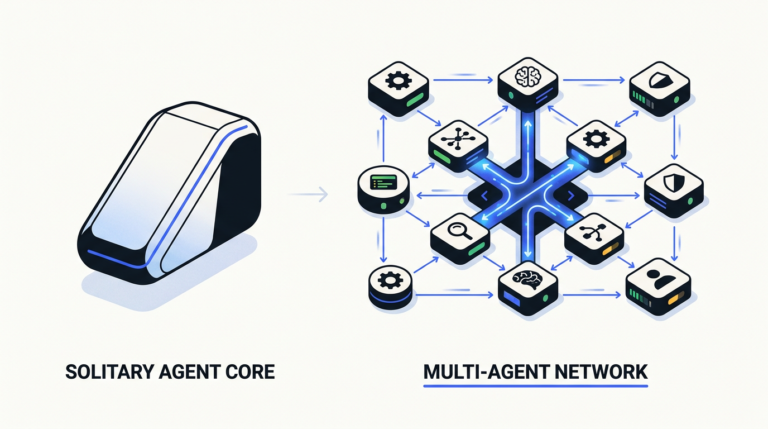
Single-Agent vs Multi-Agent Systems: A Clear Guide
A single-agent system uses one AI agent to handle a task end to end, while a multi-agent system…

A utility-based agent is an AI agent that chooses actions to maximize a utility function, a score of how desirable each outcome is. Unlike a goal-based agent that only asks ‘did I reach the goal?’, it weighs trade-offs and picks the best option even under uncertainty or conflicting goals.
Most of us think of AI goals as a simple checkbox: task complete, or task failed. But the real world is rarely that black and white. It’s a messy place full of trade-offs, conflicting priorities, and shades of grey. An AI that only sees “goal achieved” is like a GPS that gets you to your destination but takes you through a traffic nightmare, three toll booths, and a school zone at dismissal time. Technically, it succeeded. But was it the best way?
This is where a more sophisticated type of intelligent agent comes in: the utility-based agent. It doesn’t just ask if it won; it asks how well it won. It’s designed to navigate the complexities of real-world decisions, making it one of the most practical and powerful concepts in modern artificial intelligence and automation.
This guide will break down exactly what a utility-based agent is, how it makes decisions, and why it’s a huge step up from simpler AI. We’ll give you the real-world examples that matter and cut through the jargon to show you how they actually work.
Imagine you task an AI with booking you a flight from New York to Los Angeles.
A simple goal-based agent has one mission: find a flight that gets you from JFK to LAX. It will search and, upon finding the first available option, report “goal achieved.” It doesn’t care if the flight has three layovers, leaves at 3 AM, or costs a fortune. The goal was met. Done.
This is obviously not very helpful. You don’t just want a flight; you want a good flight.
You want a flight that is affordable, has a convenient departure time, minimizes layovers, and is on a reliable airline. These are all competing factors. The cheapest flight might leave at dawn. The fastest flight might be wildly expensive. This is a classic optimization problem with multiple, conflicting objectives.
A goal-based agent is brittle; it operates in a world of pass/fail. A utility-based agent operates in a world of “better” and “worse.” It’s designed to handle these trade-offs, making it fundamentally more useful for any task that involves nuance and preferences.
A utility-based agent is an intelligent agent that selects actions by evaluating the desirability of their outcomes. It uses a “utility function” to assign a numerical score—a measure of happiness or satisfaction—to every possible state of the world. Its one and only job is to choose the action that leads to the state with the highest expected utility score.
Think of it as an AI that has its own internal definition of “good.” Instead of just pursuing a binary goal (yes/no), it tries to maximize its “goodness” score.
This approach allows the agent to make rational decisions in complex situations:
This makes the utility-based agent a far more flexible and realistic model for decision-making in the messy, unpredictable real world.
The concept behind a utility-based agent isn’t new; it comes from a field of economics and psychology called utility theory. The core idea is simple: when people make choices, they implicitly try to maximize their own personal “utility,” or satisfaction.
A rational decision, in this context, is simply the choice that yields the highest possible utility for the decision-maker.
AI researchers borrowed this framework to create rational agents. By giving an AI a clear utility function, we are essentially defining its preferences and giving it a logical framework for making choices. The agent isn’t “thinking” or “feeling” in a human sense. It’s an ultimate pattern-matching engine, running calculations to find the action that best aligns with the preferences we’ve given it.
This process of finding the best possible choice is called optimization. The agent is constantly trying to optimize its actions to achieve the highest utility score.
A utility function in AI is a mathematical formula that maps a state of the world to a single number representing its “utility” or desirability. It’s the agent’s internal scorecard. The higher the number, the more the agent “wants” that state to happen.
This function is the heart and soul of a utility-based agent. It’s the explicit instruction set that defines what the agent cares about.
For example, a utility function for an autonomous delivery drone might look something like this:
Utility Score = (1.5 * On-Time Delivery) - (0.8 * Battery Used) - (5.0 * Risk of Collision)
With this function, the drone can evaluate different routes. A fast but risky route through a busy area might have a lower utility score than a slightly slower but safer and more energy-efficient route. The agent will choose the path that maximizes its final score, effectively balancing speed, efficiency, and safety based on the weights in its utility function.
So where does this magical formula come from? It’s not pulled out of thin air. Utility functions are created in a few key ways, and this is where the real work of building a useful agent happens.
1. Designed by a Human Expert:
The most straightforward method is for a person to define the function. A domain expert sits down and explicitly programs the agent’s preferences. For a financial trading agent, an economist might decide that profit has a weight of +1.0 and volatility has a weight of -0.5. This is common for systems where the rules of “good” are well-understood and need to be controlled, like in production-grade automation where resilience and predictability are key.
2. Learned Through Experience:
More advanced agents can learn their own utility function. Using a technique called reinforcement learning, an agent performs actions in a simulated environment—a “gym” where it can train safely. For every action, it receives a reward or penalty from the environment.
Over thousands or millions of trials, the agent learns to associate certain actions and states with high rewards. It effectively builds its own internal utility function based on what actions lead to successful outcomes. This is how AI agents have mastered complex games like Go and chess, discovering strategies far beyond what any human could design.
3. Updated in Real-Time:
A utility function shouldn’t be set in stone. The world changes, and so do preferences. A sophisticated agent can update its utility function based on new data. For example, a smart home agent might notice you consistently turn the thermostat down to 68 degrees at night. It can update its utility function to assign a higher value to maintaining that temperature, personalizing its behavior without you needing to program a rule. Connecting an AI directly to the source of data is critical for this kind of dynamic adaptation.
The real world is full of uncertainty. You can’t know for sure if a stock will go up, or if traffic will suddenly appear on your route. A utility-based agent handles this using the concept of expected utility.
Expected utility is a probabilistic calculation. The agent doesn’t just look at the utility of a potential outcome; it multiplies that utility by the probability of it actually happening.
Expected Utility = (Probability of Outcome A * Utility of A) + (Probability of Outcome B * Utility of B) + ...
Imagine an agent has two choices:
Even though Action 2 is risky, a rational agent will choose it because it has a higher expected utility. This is the mathematical basis for making smart bets in an unpredictable environment.
A utility-based agent is just one type of intelligent agent. Understanding how it compares to simpler models shows why it’s such a significant step up. The engine is not the car; the underlying model is just one piece. The real difference is in the agent’s framework for making decisions.
Here’s a quick breakdown:
| Agent Type | How It Decides | Best For… | Key Limitation |
|---|---|---|---|
| Simple Reflex Agent | Current perception only. (If this, then that). | Very simple, repetitive tasks like a thermostat. | No memory; can’t see beyond the immediate situation. |
| Model-Based Reflex Agent | Uses an internal model of the world to track state. | Navigating environments where current perception isn’t enough. | Has no concept of a future goal; just reacts to the current state. |
| Goal-Based Agent | Considers future actions to find a path to a specific goal state. | Problems with a clear destination, like route planning or solving a puzzle. | Sees success as binary (pass/fail). Can’t handle conflicting goals or “quality” of the solution. |
| Utility-Based Agent | Chooses the action that maximizes expected utility (a “happiness” score). | Complex problems with trade-offs, conflicting goals, and uncertainty. | Can be computationally expensive and defining the utility function can be difficult. |
The key difference between a goal-based agent and a utility-based agent is the difference between “did I succeed?” and “how well did I succeed?”. A goal-based agent stops once it finds a path to the goal. A utility-based agent evaluates all the paths to the goal (and even paths that don’t quite reach it) to find the one that is objectively the best according to its preferences.
This isn’t just theory. Utility-based agents are at the core of many of the AI systems you interact with every day. They are the go-to solution when you need specialized AI to solve a specific, painful business problem.
Here are a few clear examples:
For all their power, utility-based agents aren’t a silver bullet. Building and deploying them in the real world comes with significant challenges. It’s crucial to be honest about what’s hard.
Ultimately, a utility-based agent is a tool. Its effectiveness and safety depend entirely on the care, foresight, and wisdom with which we design its core preferences.
What is the main advantage of a utility-based agent?
Its main advantage is the ability to make rational decisions in the face of conflicting goals and uncertainty. Unlike a simple goal-based agent, it can weigh trade-offs and choose the option that is not just successful, but optimal.
Is a utility-based agent a type of learning agent?
Often, yes. While a utility function can be hard-coded by a human, the most powerful utility-based agents are also learning agents. They use techniques like reinforcement learning to refine and improve their utility functions over time based on the outcomes of their actions.
Are all AI agents rational?
The goal is to design them to be rational, meaning they always select the action that maximizes their expected performance measure. A utility-based agent is the very definition of a rational agent. However, if its perceptions are incomplete or its utility function is poorly designed, its decisions may appear irrational or lead to undesirable outcomes.

Part of the Thinker's Automation Labs content team. Researches with the SEO Blog Research Agent, drafts the piece, and routes it through review before publishing. Every claim is fact-checked against primary sources.
A single-agent system uses one AI agent to handle a task end to end, while a multi-agent system…
A learning agent is an AI agent that improves its own performance over time by learning from feedback.…
A goal-based agent is an AI agent that chooses actions by asking whether they move it closer to…