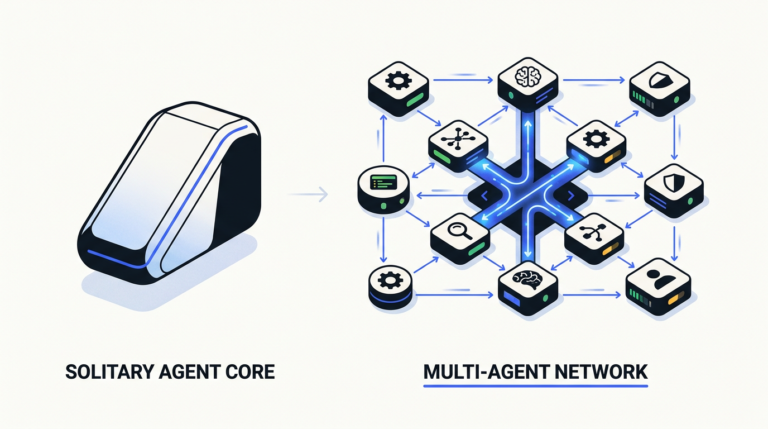
Single-Agent vs Multi-Agent Systems: A Clear Guide
A single-agent system uses one AI agent to handle a task end to end, while a multi-agent system…
An intelligent agent in AI is an autonomous entity that perceives its environment through sensors and acts upon that environment through actuators to achieve specific goals. The main types are simple reflex, model-based, goal-based, utility-based, and learning agents, each with increasing complexity and capability for making decisions.
The term “AI” is often used so broadly it becomes meaningless, describing everything from autocorrect to cinematic supervillains. To truly understand how AI systems function, you need to meet the workhorses of the field: intelligent agents.
An intelligent agent in AI is an entity that observes its surroundings and decides what to do next to achieve a goal. It’s a system with a purpose, not magic. Forget killer robots and think of a Roomba vacuum. It senses a dirty floor (its environment), and its goal is to clean it, so it moves around and vacuums (its actions).
That Roomba is an intelligent agent, as is a self-driving car or a spam filter. Understanding them is the key to cutting through the hype and seeing what AI is actually doing today.
An intelligent agent is any system that perceives its environment and takes autonomous actions to achieve its goals. It uses sensors to gather information—called a percept—about its surroundings and actuators to perform actions that change its environment. The objective is to act in a way that successfully completes its designated task.
Think of it like a cook in a kitchen. The goal is to make dinner. The environment is the kitchen. The cook’s senses (eyes, nose) are the sensors, and their hands are the actuators used to chop, stir, and serve. An intelligent agent is a digital or physical version of this process: a self-contained system that senses, thinks, and acts.
To make this concept concrete, AI researchers use the PEAS framework: Performance, Environment, Actuators, and Sensors. This provides a clear way to describe any intelligent agent.
Let’s use a self-driving car as an example:
Every intelligent agent in AI, from a simple thermostat to a complex trading bot, can be defined using the PEAS framework.
There are five main types of intelligent agents, ordered from simplest to most complex: simple reflex agents, model-based reflex agents, goal-based agents, utility-based agents, and learning agents. Each type builds on the capabilities of the one before it, allowing for more sophisticated behavior.
Let’s break down what each of these types of agents actually does.
This is the most basic agent. A simple reflex agent operates on a simple “if-this, then-that” rule. It observes the current percept and triggers a pre-programmed action without any memory of the past or consideration for the future.
reflex to pull your hand away.sensor detects the room is below the set temperature (the condition), it turns on the heat (the action). It only cares about right now.Simple reflex agents are fast and easy to implement, but they are limited. They only function effectively in simple environments where the correct action can be determined from a single snapshot in time.
A model-based agent is a significant step up. It maintains an internal “model” or representation of how the world works, allowing it to track the state of the environment even in parts it cannot currently see. This provides it with a form of memory.
These agents are much smarter and safer than simple reflex agents. Most moderately complex autonomous systems today use some form of internal model.
While model-based agents know what the world looks like, goal-based agents also know what they want the world to look like. They have a specific goal and consider the future consequences of their actions to find a sequence of steps to achieve it. This requires planning and search capabilities.
This is where agents begin to feel truly intelligent. They don’t just react; they plan, which is essential for any task involving multiple steps.
A goal-based agent is satisfied just to reach its goal. A utility-based agent aims to reach the goal in the best possible way. It uses a utility function, which assigns a numerical score to the “goodness” of an outcome, representing happiness, efficiency, or profit.
This is the most advanced type of rational agent. Sophisticated AI systems, from airline ticket pricing to personalized recommendations, are utility-based, constantly making trade-offs to find the optimal solution.
The agents discussed so far are programmed with fixed models. A learning agent can improve its own performance over time through experience. It contains a “learning element” that analyzes past actions and outcomes, then modifies its decision-making process to perform better in the future.
Learning agents are at the forefront of AI development. They can adapt to new situations and discover strategies that a human programmer could never have anticipated.
It’s also useful to distinguish between a single agent and a team of agents.
autonomous agents interact in a shared environment. They can be cooperative, like a fleet of delivery drones coordinating routes, or competitive, like bots in a stock market simulation. A multi-agent system adds a layer of complexity and power.A rational agent is an agent that acts to achieve the best expected outcome based on its current knowledge and percepts. “Rational” does not mean all-knowing; it means the agent makes the most logical choice to maximize its performance measure given the available information.
For example, a simple vacuum cleaner that turns away from a wall is acting rationally. However, if it gets stuck in a loop between two chairs, it is no longer acting rationally because it’s not making progress toward its goal of a clean floor. A utility-based agent is the epitome of a rational agent, as its entire purpose is to choose the action that leads to the highest utility.
A chatbot is a specific type of intelligent agent, but not all intelligent agents are chatbots. The key difference is their scope and how they interact with their environment. An agent is a broad concept, while a chatbot is an agent specialized exclusively in conversation.
A chatbot’s entire world is language, using a chat interface as its environment and text generation as its actuator. A self-driving car, by contrast, is a far more complex agent operating in the physical world.
| Characteristic | Intelligent Agent (General) | Chatbot (Specific Agent) |
|---|---|---|
| Definition | Any entity that perceives its environment and acts to achieve goals. | An agent that interacts with humans using natural language. |
| Environment | Can be physical (roads, rooms) or digital (the internet, a database). | A chat interface (text or voice). |
| Actuators | Wheels, robotic arms, software commands, screen output. Anything that performs an action. | Generating text or synthesized speech. |
| Example | Self-driving car, Roomba, spam filter, stock trading bot. | ChatGPT, a customer service bot on a website, Siri/Alexa. |
Are intelligent agents the same as AI?
Not exactly. Intelligent agents are a core concept within the field of AI. They are a framework for building systems that exhibit intelligent behavior. Most applications we call “AI” can be described as one or more intelligent agents.
Is Siri or Alexa an intelligent agent?
Yes, they are complex intelligent agents. They use a microphone (sensor) to perceive your voice commands (environment). They are utility-based (trying to give the most helpful answer) and are also learning agents (improving their understanding of you over time).
What is the simplest type of intelligent agent?
The simple reflex agent is the most basic form. It operates on a direct condition-action rule (if X, then do Y) with no memory of the past, making it suitable only for very straightforward tasks.

Part of the Thinker's Automation Labs content team. Researches with the SEO Blog Research Agent, drafts the piece, and routes it through review before publishing. Every claim is fact-checked against primary sources.
A single-agent system uses one AI agent to handle a task end to end, while a multi-agent system…
A learning agent is an AI agent that improves its own performance over time by learning from feedback.…
A goal-based agent is an AI agent that chooses actions by asking whether they move it closer to…