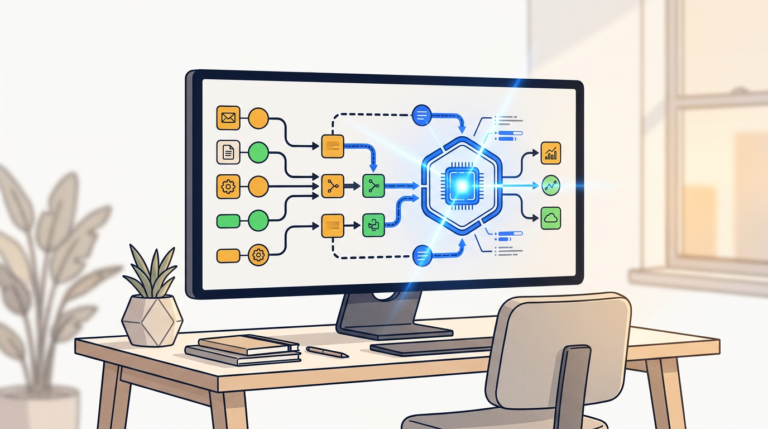
n8n AI Agent Tutorial: Build Your First AI Agent in 2024
An n8n AI agent tutorial is a step-by-step guide for building automated agents using n8n’s visual, no-code platform.…
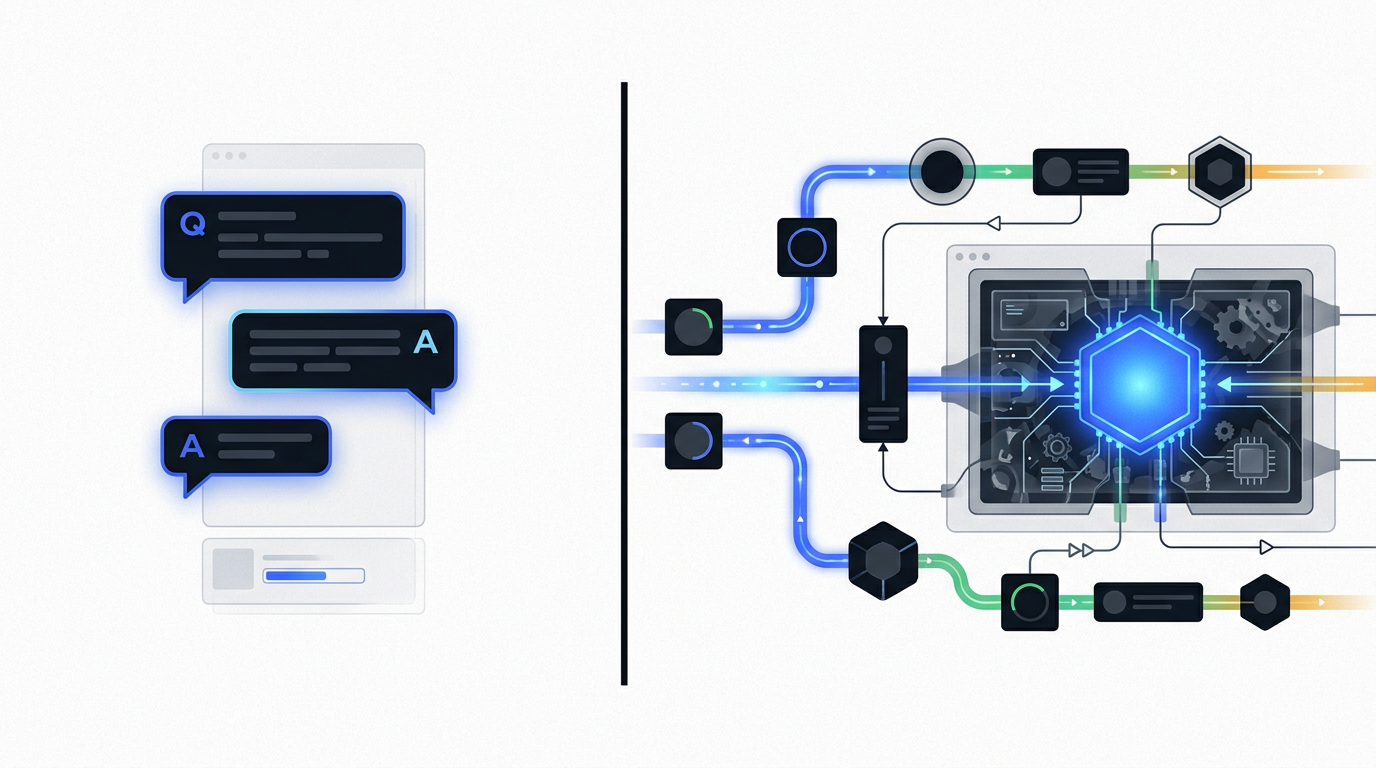
An AI chatbot follows conversational flows to answer questions and provide information. In contrast, an AI agent is more advanced, capable of autonomous decision-making, planning, and executing multi-step tasks across different systems to actively achieve a specific goal, not just hold a conversation.
Let’s cut right to it. The confusion around the terms AI chatbot vs AI agent is understandable, but the difference is simple and crucial. It’s the difference between a friendly librarian who can find a book for you and a personal assistant who can research, book, and pay for your entire vacation while you’re at lunch.
One is built for conversation. The other is built for action.
A chatbot is a reactive tool. You ask it something, and it pulls from its knowledge base to give you an answer. It’s a conversational interface—a better, smarter FAQ page. An AI agent, on the other hand, is a proactive problem-solver. You give it a goal, and it figures out the steps needed to get there, using different tools and systems to execute a plan.
This isn’t just a minor upgrade. It’s a fundamental shift from passive information retrieval to active task execution. Understanding this difference is the key to knowing which tool is right for your problem, and which one is just expensive hype.
An AI chatbot is a program designed to simulate human conversation. Think of the little pop-up on a website asking, “How can I help you today?” Its primary job is to understand your questions and provide answers based on a predefined set of information.
Most modern chatbots use conversational AI, often powered by a Large Language Model (LLM), to understand natural language. This makes them feel much more human than the old, clunky “if-this-then-that” bots. They can answer questions about order status, explain product features, or point you to the right help article.
But here’s the key: a chatbot’s world is limited. It lives inside the chat window. It can talk about your order, but it can’t go into your finance software, process a refund, update the inventory system, and email you a confirmation. It’s a communicator, not a doer.
An AI agent is a more sophisticated system designed to be goal-oriented and autonomous. You don’t just ask an agent a question; you give it a mission. For example: “Find me the best-priced flights to New York for the first week of December, book a window seat, and add it to my calendar.”
An agent takes that goal and breaks it down into a series of steps. It can:
This ability to plan, use tools, and act autonomously is the core of what makes agentic AI different. It’s not just a smarter conversation; it’s a digital employee that can execute complex, multi-step workflows.
To make it even clearer, let’s bring in a third term: the AI assistant (like Siri or Alexa). Assistants sit somewhere in the middle. They can do more than a chatbot but lack the full autonomy of an agent.
| Feature | AI Chatbot | AI Assistant | AI Agent |
|---|---|---|---|
| Primary Goal | Answer questions, provide information. | Perform simple, voice-activated tasks. | Achieve a complex, multi-step goal autonomously. |
| Core Function | Conversation | Command & Control | Planning & Execution |
| Autonomy | Low (Reactive, follows scripts) | Medium (Can perform pre-defined actions) | High (Proactive, makes decisions) |
| Scope | Single application or website. | Device ecosystem (phone, smart speaker). | Across multiple applications and systems. |
| Example Task | “What are your return policies?” | “Set a timer for 10 minutes.” | “Monitor my competitor’s prices and alert me if they drop below ours.” |
A chatbot is almost entirely reactive. It waits for you to say something. An AI agent is proactive. Once it has a goal, it works independently, initiating actions without needing a prompt for every single step. It thinks for itself to get the job done.
This is the main event in the AI chatbot vs AI agent debate. A chatbot’s output is text. An agent’s output is a completed task. The conversation is just a means to an end for the agent—a way to get the initial instructions or ask for clarification if it gets stuck. For a chatbot, the conversation is the end.
While modern chatbots have some short-term memory to understand the context of a single conversation, an AI agent’s memory is more robust. It needs to remember the overall goal, the plan it created, what steps it has already taken, and what the results were. This memory is essential for its long-term planning and decision-making capabilities.
A chatbot might integrate with one or two systems, like a knowledge base or a CRM, to pull information. An AI agent is built for deep integration. Its entire purpose is to connect to and operate many different tools (browsers, APIs, databases, files) to execute its plan. This makes agents far more complex to build and manage.
No. And thinking this way will lead you to make bad decisions.
An AI agent isn’t just a chatbot with a bigger brain or more data. It’s a fundamentally different architecture. The race for bigger and bigger LLMs is a distraction; the real innovation is happening at the agentic layer, where these models are given hands and feet.
Saying an agent is a “smarter chatbot” is like saying a car is a “faster bicycle.” Yes, they both have wheels and get you from A to B, but they are different machines designed for different purposes with entirely different engineering principles. A chatbot’s architecture is optimized for dialogue flow. An agent’s architecture is optimized for task decomposition and tool execution. It’s a difference in kind, not just degree.
You don’t need to be an engineer to grasp the basics, and it’s worth understanding what’s happening behind the curtain. An agent isn’t magic; it’s a clever system with a few key parts.
At the heart of most modern AI agents is a Large Language Model (LLM) like GPT-4. The LLM acts as the agent’s reasoning engine or “brain.” When you give the agent a goal, the LLM is what analyzes the request, breaks it down into a logical plan, and decides which tool to use next.
But here’s our core belief: the engine is not the car. The LLM is just one component. The real power comes from the framework built around it. You can swap out GPT-4 for Claude 3 or a new open-source model tomorrow. The agent’s framework—its tools, memory, and purpose—is what provides the lasting value.
An AI agent operates in a loop, often called a ReAct (Reason + Act) loop:
web_search("flights from SFO to JFK"), access_calendar(), or run_database_query().This loop continues until the agent observes that the final goal has been accomplished. This architecture, combining an LLM brain with a set of available actions, is what gives an agent its power.
The choice between a chatbot and an agent comes down to your goal. Are you trying to communicate or accomplish?
Chatbots excel at providing information and answering repetitive questions at scale. They are perfect for:
In all these cases, the goal is to have a conversation that delivers information.
Agents are for when you need to get things done. Their ability to handle multi-step workflows makes them ideal for complex automation.
Here, the goal is a completed, tangible outcome.
The main difference is action. An AI chatbot is designed for conversation; it answers your questions and provides information. An AI agent is designed for execution; it takes a goal, makes a plan, and uses various tools and applications to autonomously complete multi-step tasks. A chatbot talks; an agent does.
You should use an AI agent when your objective is to complete a task or a complex workflow that involves multiple steps and applications. If you just need to answer questions or provide information from a set knowledge base, a chatbot is the more efficient and appropriate tool. Choose an agent for automation, a chatbot for information.
No, an AI assistant like Siri or Alexa is not the same as a true AI agent, though it’s a step up from a simple chatbot. Assistants can perform a limited set of pre-programmed actions (“set a timer,” “play a song”). An AI agent has greater autonomy; it can create its own plans and use a wide range of tools to achieve novel, complex goals it wasn’t explicitly programmed to handle.
An AI agent uses a core “brain,” typically a Large Language Model (LLM), to reason about a goal. It operates in a loop: 1) It plans the next logical step. 2) It selects a tool (like a web browser or an API) to take an action. 3) It observes the result of that action. This new information is fed back into its brain, and the loop repeats until the overall goal is achieved.
Still not sure? Don’t look for a new tool until you’ve clarified your strategy. A different platform can’t fix a broken process.
Ask yourself these questions:
What is the primary success metric?
Does the task require accessing multiple, separate systems?
Is the workflow dynamic and unpredictable?
Is the goal to inform or to execute?
Resist the urge to over-engineer. Sometimes, a simpler, well-designed chatbot is all you really need to solve your problem. Start there.
The hype around intelligent agents in AI often glosses over the messy reality: building and deploying them is hard.
Measuring the success of a chatbot is straightforward: Did it answer the user’s question? Did it reduce support ticket volume?
Measuring the ROI of an AI agent is more complex but also more impactful. You’re measuring the automation of an entire business process.
The goal isn’t to get a “wow” demo. The goal is to see a measurable impact on one of these core business metrics.
The goal of automation isn’t to remove humans from the process. It’s to augment their abilities.
Even the most advanced AI agent will encounter situations it doesn’t understand or face a decision that requires human judgment. The smartest implementations of agentic AI don’t aim for 100% autonomy. They build systems where the agent handles 90% of the repetitive grunt work and then intelligently escalates to a human for the final, critical step.
Let the agent do the research, fill out the forms, and draft the email. But have a person press the final “send” button. This approach combines the speed and scale of machines with the irreplaceable nuance and accountability of a human expert. It’s the most powerful and responsible way to deploy these systems today.

Part of the Thinker's Automation Labs content team. Researches with the SEO Blog Research Agent, drafts the piece, and routes it through review before publishing. Every claim is fact-checked against primary sources.
An n8n AI agent tutorial is a step-by-step guide for building automated agents using n8n’s visual, no-code platform.…
November 2026 in AI is focused on significant updates rather than entirely new model launches. Key events include…
To start an AI automation agency, first identify a specific niche and a high-value problem to solve. Develop…