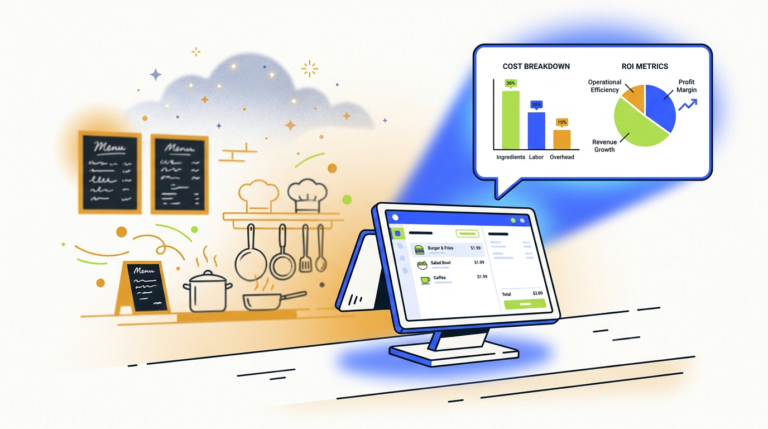
Restaurant Order Automation AI: A Guide to Costs & How It Works
Restaurant order automation AI uses artificial intelligence, like voice AI and natural language processing, to take customer orders…
AI automation agency pricing varies widely, from under $5,000 for a simple project to over $25,000 per month for enterprise retainers. Costs depend on the pricing model—such as project-based, retainer, or performance-based—the complexity of the AI solution, and the scope of services provided by the agency.
Everyone wants to know the price. It’s the first question out of the gate when looking at AI automation agency pricing. But asking “how much does an AI agency cost?” is like asking “how much does a car cost?” Are you buying a used hatchback or a brand-new truck?
The real question isn’t what you’ll pay, but how you’ll pay. The pricing model an agency uses tells you everything about their confidence, their process, and the kind of relationship they want to have with you.
Some agencies want to sell you a one-off project and wave goodbye. Others want to become a long-term partner, tying their success directly to yours. A few will even bet on their own performance, only getting paid when they deliver measurable results.
This guide will break down the different pricing models you’ll encounter, explain the factors that actually drive the cost, and show you the hidden expenses no one likes to talk about. Forget the vague ranges. Let’s talk about how this actually works, so you can choose the right approach for your business.
Let’s clear this up. An AI automation agency isn’t a group of wizards chanting over a crystal ball. They are a team of specialists who use artificial intelligence tools to build and manage systems that handle repetitive business tasks.
Think of them as expert plumbers for the flow of information in your company. Instead of just connecting pipes, they connect software, data, and decision-making logic. Their job is to find the bottlenecks in your business—the tedious data entry, the manual report generation, the slow customer responses—and build an intelligent, automated workflow to fix it.
A good agency doesn’t just sell you a tool. A tool is not a strategy. They help you define the strategy first, then build the system to execute it. They combine business process knowledge with technical skill in AI models and automation platforms to create solutions that save you time, reduce errors, and free up your team to do more important work.
When you partner with an agency, you’re not just buying “AI.” You’re buying specific outcomes delivered through a set of services. While every agency has its own flavor, the menu usually includes these core offerings.
Understanding the different pricing models is the key to finding the right partner. Each model is suited for different types of projects, budgets, and business goals.
This is the most straightforward model. You have a specific, well-defined task, like “build an AI chatbot for our website.” The agency quotes you a single, fixed price to complete that project.
With a retainer, you pay a fixed fee each month for ongoing access to the agency’s team and services. This is less about a single project and more about a continuous partnership.
Some agencies package their most common solutions into a “product” with a fixed price and a defined outcome. Think “AI-Powered Lead Nurturing Setup” for a flat fee of $7,500.
Just need advice? You can hire an agency or an AI consultant by the hour for strategic guidance, troubleshooting, or training.
Many agencies are flexible and will combine models to fit your needs. A common hybrid is a one-time project fee to build the initial system, followed by a smaller monthly retainer for maintenance and support.
This is the most interesting—and the rarest—model. Instead of paying for time or tasks, you pay for results. The agency’s fee is tied directly to the value they create for your business.
Choosing the right AI agency pricing model depends on your project’s clarity, your budget’s flexibility, and your desire for a long-term partnership. For a well-defined, one-time task, a project-based fee is best. For ongoing support and development, a monthly retainer is ideal. If you want to directly tie cost to results and share risk, pursue a performance-based model.
Feeling stuck? Use this matrix to find the model that best fits your situation.
| Your Situation | Best Pricing Model | Why It Works |
|---|---|---|
| “I have a single, well-defined project and a fixed budget.” | Project-Based | Provides cost certainty and a clear deliverable. No surprises. |
| “I need a common, standard solution and want to move fast.” | Productized Service | The fastest and most transparent option for proven solutions. |
| “We have multiple AI initiatives and need ongoing expert support.” | Monthly Retainer | Acts like an outsourced AI team, providing flexibility and continuous improvement. |
| “I want to build a system and have it managed long-term.” | Hybrid (Project + Retainer) | Combines the best of both worlds: a fixed cost for the build and predictable cost for support. |
| “I just need some strategic advice before I commit.” | Hourly Consulting | Get expert guidance without a long-term commitment. Pay only for what you need. |
| “I only want to pay for measurable business results and improved ROI.” | Performance/Value-Based | The ultimate alignment of interests. The agency shares the risk and is rewarded for success. |
Regardless of the pricing model, your final cost will be influenced by three core factors.
This is the biggest driver. A simple workflow that connects two applications is cheap. A complex system of agentic systems that integrates with a dozen proprietary tools, requires custom AI model tuning, and involves significant logic is expensive. The more features, integrations, and custom development required, the higher the price.
You get what you pay for. A top-tier agency with a team of experienced AI automation engineers and a portfolio of successful enterprise projects will charge more than a solo freelancer just starting out. Their expertise, strategic insight, and ability to avoid common pitfalls are what you’re paying a premium for.
Using AI isn’t free. The underlying Large Language Models (LLMs) from companies like OpenAI, Anthropic, or Google charge for usage based on “tokens” (roughly, pieces of words). A high-volume automation can rack up significant token costs. While the agency’s efficiency can minimize this, it’s a real, ongoing expense. Furthermore, a huge portion of the cost is still skilled human labor—the strategy, design, development, and testing that goes into building a robust system.
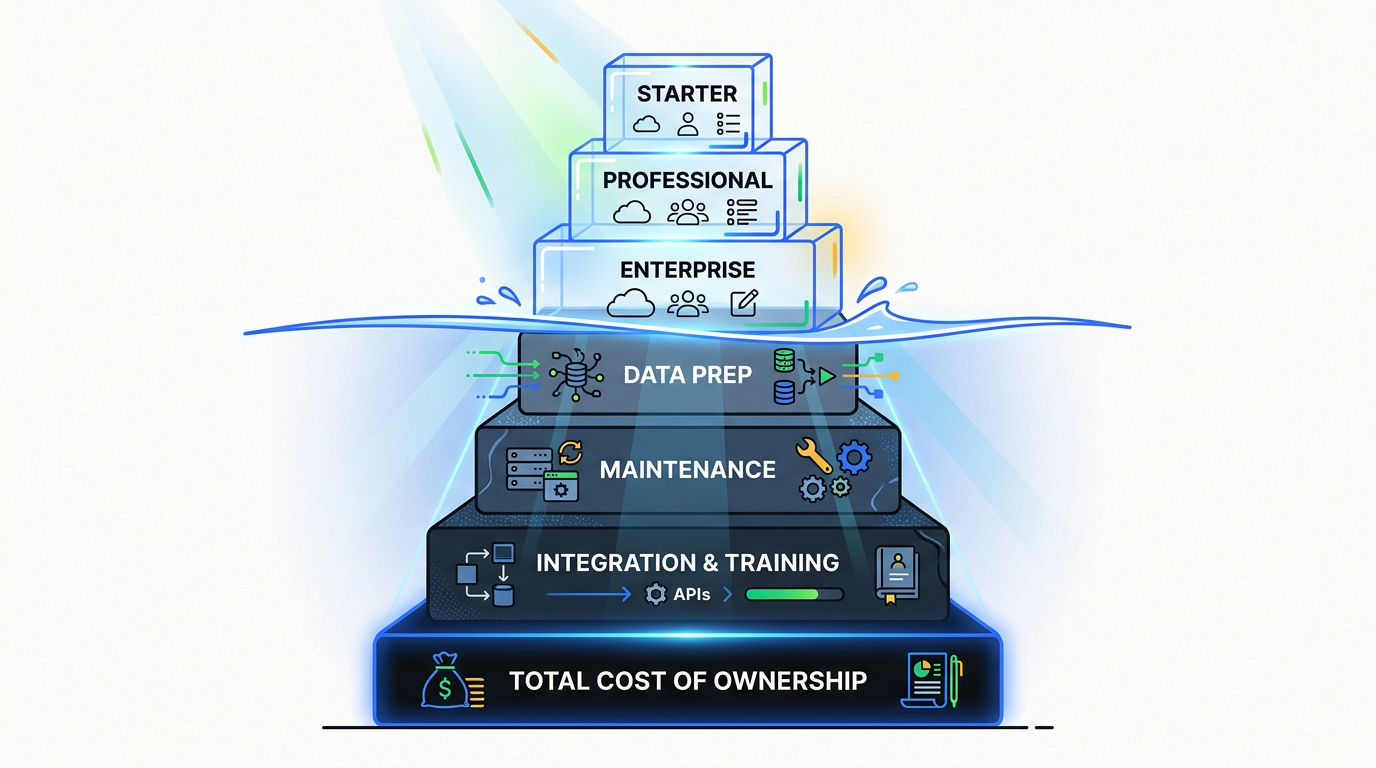
The hidden costs of hiring an AI automation agency often exceed the initial project fee. These include the unglamorous but critical work of data preparation and cleaning, the internal staff time required for training and adoption, and the recurring fees for ongoing system maintenance, monitoring, and AI model usage (token costs).
The sticker price is never the full story. The total cost of ownership for an AI solution includes several “hidden” expenses that can catch you by surprise.
AI is only as good as the data it’s trained on. If your data is a mess—inconsistent, incomplete, or spread across a dozen disconnected spreadsheets—the agency will have to spend significant time cleaning and structuring it before they can even begin to build. This is often the most underestimated part of any AI project.
An automation doesn’t work if your team doesn’t use it. You must invest time in training your staff on the new workflows. There will be a learning curve and a period of adjustment. A good agency will help with this, but it still requires a time commitment from your team. Remember: automation doesn’t replace thinking; it amplifies what you’re already doing. If your internal process is broken, automating it just makes it break faster.
AI systems are not static. The software they connect to will have API updates, the AI models will evolve, and unforeseen edge cases will pop up that cause the automation to fail. You need a plan for ongoing maintenance and monitoring. This could be a monthly retainer with the agency or a dedicated internal resource, but it’s not optional if you want your system to remain reliable.
The proposal looks great, but the devil is in the details of the technology and the contract.
Ask every potential agency: “What tools do you build with?” Their answer has huge implications for your long-term cost and flexibility.
Don’t skim the contract. Pay close attention to these three clauses:
For most businesses, hiring an AI agency is significantly cheaper and faster than building an in-house team, at least initially. An agency gives you immediate access to a full team of experts for a single project fee or retainer, avoiding the high costs and long timelines of recruiting, hiring, and training specialized AI engineers.
The knee-jerk reaction for a big company might be to just hire someone. Let’s run the numbers on that.
Hiring an In-House “AI Automation Engineer”:
Hiring an AI Automation Agency:
For most small and mid-market businesses, the choice is clear. An agency provides a faster, more flexible, and more cost-effective path to getting ROI from AI automation. You can always build an in-house team later, once the value has been proven and the systems are in place.
What is a typical monthly retainer for AI automation services?
A typical monthly retainer for AI automation services ranges from $3,000 for basic monitoring and maintenance to over $25,000 for enterprise-level clients requiring continuous development, strategy, and a dedicated team. Most mid-market businesses should expect to pay between $5,000 and $15,000 per month for a meaningful partnership.
What is the difference between performance-based and value-based pricing?
Performance-based and value-based pricing are often used interchangeably, but there’s a slight difference. Performance-based pricing is typically tied to specific, direct metrics (e.g., number of leads generated). Value-based pricing is broader and tied to the overall business impact or ROI (e.g., a percentage of the total cost savings or revenue increase), which can be harder to measure but more aligned with high-level business goals.
Do I need an agency if I can just use ChatGPT?
Using ChatGPT for simple tasks is like having a hammer. An AI automation agency gives you the entire construction crew. They build the strategic blueprint, integrate the hammer with your power drills and saws (other software), and build a complete, reliable structure (a robust business process) that works while you sleep. A tool is not a strategy.

Part of the Thinker's Automation Labs content team. Researches with the SEO Blog Research Agent, drafts the piece, and routes it through review before publishing. Every claim is fact-checked against primary sources.
Restaurant order automation AI uses artificial intelligence, like voice AI and natural language processing, to take customer orders…
The latest AI tools released in October 2026 include new proprietary models from major labs like OpenAI and…
Playwright is a browser automation library used for web scraping by controlling real browser engines like Chromium, Firefox,…