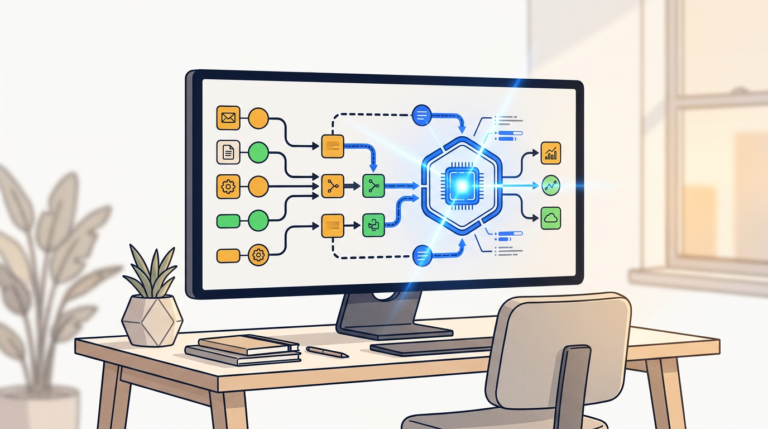
n8n AI Agent Tutorial: Build Your First AI Agent in 2024
An n8n AI agent tutorial is a step-by-step guide for building automated agents using n8n’s visual, no-code platform.…
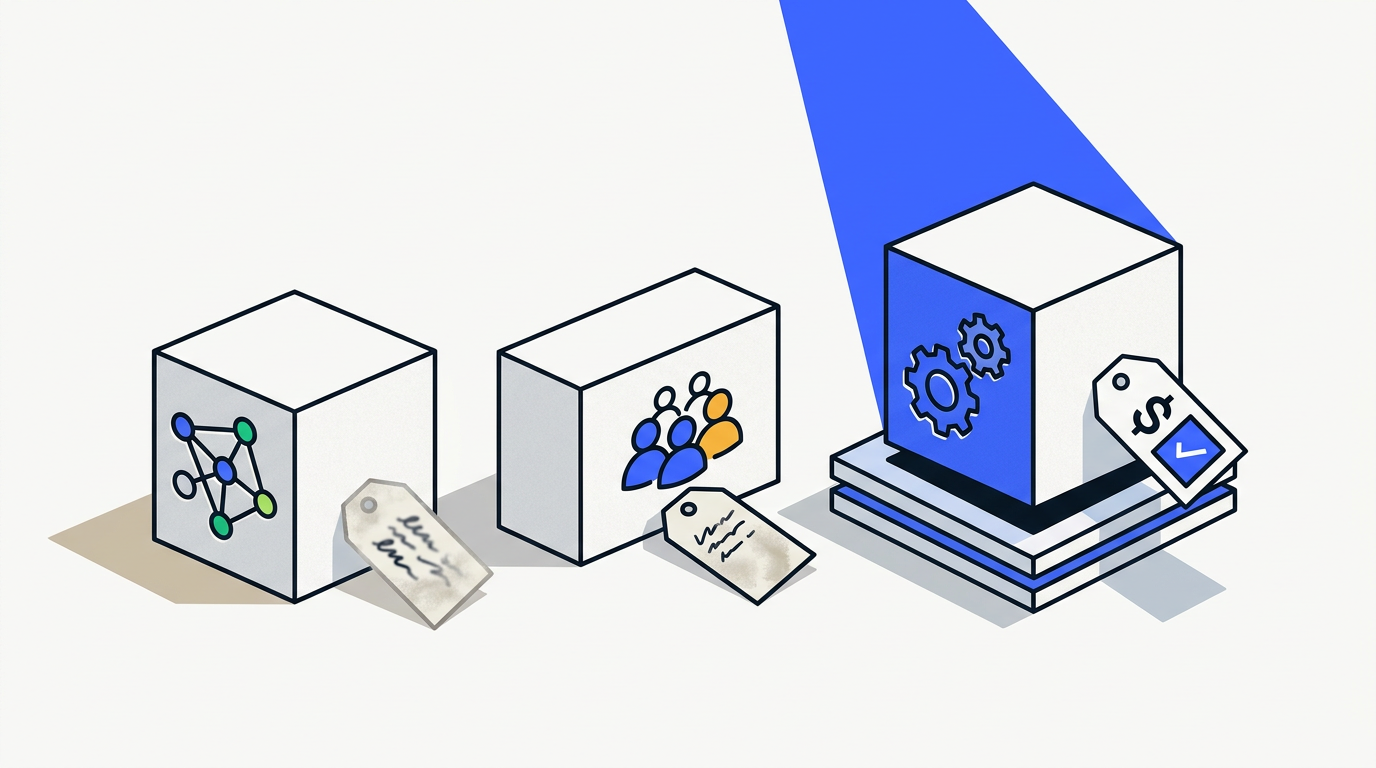
Comparing AI agent frameworks involves choosing between control, ease of use, and complexity. LangGraph offers maximum control for production systems, CrewAI provides a simple, role-based approach for rapid prototyping, and AutoGen specializes in complex, multi-agent conversations. The best choice depends on your technical skill and project goals.
Let’s be honest. The term “AI agent” is everywhere, and it’s usually followed by a tidal wave of hype. You’re told these autonomous bots will run your business while you sleep. The reality is a bit more complicated and a lot more interesting. Building a useful AI agent isn’t magic; it’s an engineering problem. And the first, most important choice you’ll make is the framework you build it on.
This is where most guides lose their way, drowning you in a sea of features and GitHub stars. We’re not going to do that. This is a guide with an opinion. We’ve spent the time in the trenches with these tools so you don’t have to. We’re going to make a clear call on which of the big three—LangGraph, CrewAI, and AutoGen—is right for you.
This AI agent frameworks compared guide is for the curious business owner, the creator, or the marketer who wants to understand what’s actually possible today. We’ll tell you what’s great, what’s overhyped, and what to ignore, all in plain English.
In a hurry? Here’s the bottom line.
Start with CrewAI. If you’re new to AI agents or want to build a proof-of-concept quickly, this is your tool. Its role-based approach is brilliantly simple and the fastest way to get a multi-agent system running.
Graduate to LangGraph. If you’re building a real product that needs to be reliable, scalable, and have a human in the loop, LangGraph is the professional’s choice. It gives you maximum control, but has a much steeper learning curve.
Use AutoGen for research. If your goal is to explore the frontiers of agent-to-agent communication and you’re comfortable with a more academic, complex tool, AutoGen is a powerful research lab. Most business users should skip this one for now.
Choosing a framework is about managing trade-offs. We call it the Builder’s Triangle, and it has three points: Simplicity, Control, and Complexity. You can usually pick two.
Simplicity (CrewAI): This is about speed and ease of use. A simple framework lets you get from idea to working prototype fast. It’s like an IKEA kit: the instructions are clear, the parts fit together, and you get a functional result without needing to be a master carpenter.
Control (LangGraph): This is about precision and reliability. A framework built for control lets you define every single step, handle any error, and see exactly what’s happening. It’s like building with raw lumber. You have the power to build a skyscraper, but you need to draw the blueprints and cut every piece yourself.
Complexity (AutoGen): This refers to the intricacy of the agent interactions the framework is designed to handle. A framework that embraces complexity allows for emergent, unpredictable conversations between many agents. It’s like a box of advanced LEGO Technic parts—you can build self-operating machines, but understanding how they all interact is a challenge in itself.
No framework is the best at all three. Your job is to decide which corner of the triangle is most important for your project.
| Criteria | LangGraph | CrewAI | AutoGen |
|---|---|---|---|
| Primary Use Case | Production-grade, stateful agentic applications. | Rapid prototyping and straightforward multi-agent workflows. | Research and complex, conversational agent systems. |
| Ease of Use / Learning Curve | High. Requires understanding of graphs and state machines. | Low. Intuitive, role-based concepts are easy to grasp. | High. Can be complex to configure and control conversations. |
| Control & Flexibility | Maximum. Explicit control over every step and transition. | Medium. High-level abstraction makes it less granular. | Medium. Control is focused on conversation flow, not workflow state. |
| Human-in-the-Loop | Excellent. Natively supports waiting for human input. | Possible, but requires more custom work. Not a core feature. | Possible via user proxy agents, but not its main focus. |
| State Management | Core feature. Explicitly passes state between nodes. | Abstracted away. Agents share context, but state is less explicit. | Managed within the context of the conversation. |
| Production Readiness | High. Built for resilience, observability, and debugging. | Medium. Great for MVPs, but may need refactoring for scale. | Low. More suited for experimentation than production deployment. |
LangGraph is a library from the creators of LangChain, the popular toolkit for building with large language models. It was specifically designed to address a major limitation of early agent systems: they were hard to control. LangGraph is for building applications that are stateful, reliable, and ready for production.
The key idea in LangGraph is to represent your agent’s workflow as a graph—a collection of nodes and edges.
Imagine you’re building a flowchart for your business process. That’s essentially what you do in LangGraph. This gives you explicit control and makes it easy to visualize and debug your agent’s “thinking” process. This robust state management is its killer feature.
Strengths:
observability and resilience. It’s easier to add logging, retries, and error handling.Weaknesses:
You should use LangGraph when you are building a system that other people (or your business) will rely on. If you need your agent to be predictable, auditable, and capable of handling complex, multi-step tasks with potential human intervention, LangGraph is the correct, professional choice.
Skip it if you’re just trying to understand what an AI agent is or want to build a simple demo in an afternoon. The boilerplate will slow you down.
CrewAI is an open-source framework designed for orchestrating role-playing autonomous AI agents. Its core philosophy is that complex tasks can be broken down and solved by a “crew” of specialized agents working together. It prioritizes simplicity and speed, making it incredibly popular.
Using CrewAI feels less like programming and more like hiring. You define a few key components:
role (e.g., “Expert Market Researcher”) and a goal (e.g., “Find the latest trends in AI”).When you kick off the crew, the agents get to work, passing information between each other to accomplish the overall objective. It’s a powerful and intuitive metaphor that abstracts away much of the underlying complexity of building multi-agent AI systems.
Strengths:
Python code.Weaknesses:
Almost everyone interested in AI agents should start here. If you’re a business owner, marketer, or creator who wants to experiment with automating research, content creation, or email campaigns, CrewAI is your best friend. It provides the “Aha!” moment of seeing agents work together without demanding a degree in computer science.
AutoGen is a framework from Microsoft Research designed to simplify the orchestration and automation of complex LLM workflows. Its main focus is on enabling rich, automated conversations between multiple agents to solve tasks.
The core concept in AutoGen is the “conversable agent.” You set up different types of agents, such as an AssistantAgent (the LLM-powered worker) and a UserProxyAgent (which can execute code or solicit human feedback). You then put them in a “room” together and give them a problem.
The agents then chat back and forth, proposing solutions, writing code, debugging it, and refining their approach until the problem is solved. It’s a fascinating model for exploring how AI can achieve complex goals through dialogue.
Strengths:
Weaknesses:
AutoGen is for researchers, academics, and developers who are pushing the boundaries of what’s possible with agent collaboration. If your goal is to publish a paper on agent interaction or to build a system that can autonomously solve coding challenges, AutoGen is a fantastic tool.
For most business applications, its open-ended nature is more of a liability than a feature. You want predictable outcomes, not surprising conversations.
The key differences lie in their core metaphors and primary goals. LangGraph uses a graph-based structure for maximum control and reliability in production. CrewAI uses a simple role-playing team metaphor for rapid prototyping and ease of use. AutoGen uses a conversational model to enable complex, automated dialogues between agents for research and open-ended problem-solving.
CrewAI is unequivocally the best AI agent framework for beginners and non-engineers. Its intuitive, role-based approach allows you to think in terms of team members and tasks, not complex code structures. You can achieve impressive results quickly, making it the most accessible and rewarding entry point into the world of multi-agent AI systems.
The sticker price of these open-source frameworks is zero, but running them is anything but free. The Total Cost of Ownership (TCO) is a critical factor that’s often ignored in the initial excitement.
observability) to detect these failures and the skills to debug them. This is a real human cost in time and expertise. As we say, there is no such thing as a free lunch in automation.Giving an AI agent tools and access to your data is like giving a new, very literal-minded intern the company credit card and a system password. You need guardrails.
Our take: Security is a process, not a feature. LangGraph gives you more of the knobs and levers needed to build a secure process, but no framework is secure out of the box. Guardrails are not optional.
Let’s make this concrete. Here’s how you’d conceptually approach a simple task in each framework.
This is CrewAI’s sweet spot. You’d define two agents:
ResearcherAgent: Role: “Senior Research Analyst.” Goal: “Find the top 3 AI agent frameworks.” Tool: A web search tool.WriterAgent: Role: “Tech Blogger.” Goal: “Summarize the findings in a concise blog post.”You’d then create a Task for the researcher to find the data, and a Task for the writer to summarize it, making the writer’s task dependent on the researcher’s. The crew handles the handoff automatically.
For the same task, you’d build a graph:
SEARCH: Calls a search tool to find frameworks.ANALYZE: An LLM call to read the search results and extract the top 3.SUMMARIZE: Another LLM call to take the list of 3 and write a summary.SEARCH -> ANALYZE: The flow is linear.ANALYZE -> SUMMARIZE: The output of analysis becomes the input for the summary.It’s more work, but you can inspect the data at each step, and you could add a HUMAN_APPROVAL node after ANALYZE if you wanted.
Here, you’d frame it as a conversation:
AssistantAgent: A general-purpose AI assistant.UserProxyAgent: Represents you, but can also execute code, like running a web search function you provide.You’d give the chat an initial prompt: “Find the top 3 AI agent frameworks and summarize them.” The AssistantAgent might say, “I need to search the web. Can I do that?” The UserProxyAgent would execute the search, return the results, and the conversation would continue until the summary is complete.
You should use LangGraph instead of CrewAI when your project’s priority shifts from speed to reliability. Choose LangGraph if you need fine-grained control over the agent’s workflow, require explicit human-in-the-loop approval steps, or are building a production-ready application where scalability, debugging, and predictable behavior are more important than initial development speed.
For a production-ready application, your choice should be driven by resilience and control. Prioritize a framework that offers excellent observability (so you can see what’s happening), robust state management (so you can handle failures and retries), and native support for human-in-the-loop interventions. This almost always points to LangGraph, as it is explicitly designed for building durable, auditable, and scalable agentic systems.
An open-source tool is only as good as the community around it.
Where are these tools headed?
observability), and features for enterprise-grade deployments. It’s being built for the long haul.The good news is that the core concepts—agents, tools, orchestration—are transferable. The skills you learn on CrewAI will make you better prepared to tackle LangGraph when the time comes.
After comparing them on control, simplicity, and practical application, our verdict is clear.
For most people—beginners, marketers, entrepreneurs, and anyone who wants to quickly understand and leverage AI agents—the best framework to start with is CrewAI.
It hits the sweet spot. It’s powerful enough to build genuinely useful automations and simple enough that you won’t get bogged down in technical details. It teaches the fundamental principles of multi-agent systems in a way that’s both fun and productive. You will get from zero to a working “agent swarm” faster with CrewAI than with anything else.
Our advice:
Don’t start with the most powerful tool. Start with the most effective one. For getting things done with AI agents today, that tool is CrewAI.
Can I use these frameworks without knowing Python?
For the most part, no. LangGraph, CrewAI, and AutoGen are all Python libraries. While there are some no-code platforms that use similar concepts, to use these specific frameworks directly, you’ll need a basic understanding of Python.
Do these frameworks work with any LLM?
Yes. All three are model-agnostic, meaning you can plug in models from OpenAI (GPT-4, etc.), Anthropic (Claude), Google (Gemini), or even open-source models you run yourself. You are not locked into a specific LLM provider.
What’s the difference between LangChain and these frameworks?
LangChain is a general-purpose, open-source library for building applications with LLMs. It contains modules for many different tasks. LangGraph is a specific part of the LangChain ecosystem, focused on building stateful agents. CrewAI and AutoGen are more specialized, standalone AI agent frameworks focused entirely on orchestrating agents.
Is building a RAG (Retrieval-Augmented Generation) system the same as building an agent?
Not quite, but they are related. A RAG system is a specific pattern where you retrieve relevant documents and add them to the prompt to give the LLM context. An AI agent might use a RAG system as one of its tools to answer a question, but the agent itself is the broader orchestrator that decides when and how to use that tool.

Part of the Thinker's Automation Labs content team. Researches with the SEO Blog Research Agent, drafts the piece, and routes it through review before publishing. Every claim is fact-checked against primary sources.
An n8n AI agent tutorial is a step-by-step guide for building automated agents using n8n’s visual, no-code platform.…
November 2026 in AI is focused on significant updates rather than entirely new model launches. Key events include…
To start an AI automation agency, first identify a specific niche and a high-value problem to solve. Develop…