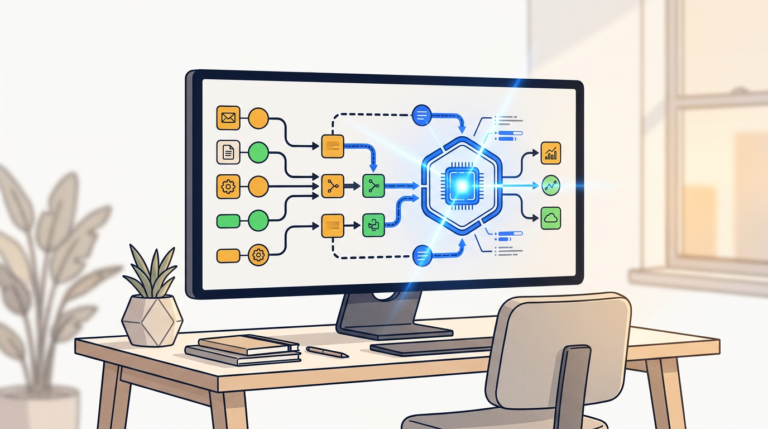
n8n AI Agent Tutorial: Build Your First AI Agent in 2024
An n8n AI agent tutorial is a step-by-step guide for building automated agents using n8n’s visual, no-code platform.…

To start an AI automation agency, first identify a specific niche and a high-value problem to solve. Develop a simple, repeatable service offer, such as automating a specific business workflow. Secure your first client by demonstrating clear ROI, then build your tech stack and scale operations.
The internet is overflowing with people yelling about how to start an AI automation agency. Most of it is noise — vague promises of easy money wrapped in impenetrable jargon. They make it sound like you just need to pick a name, buy a subscription to a tool, and wait for clients to materialize. That’s a fantasy.
Let’s be honest. Starting any real business is hard work. Starting one in a field as new and fast-moving as AI automation requires focus. The good news is, you don’t need to be a genius developer or have a massive budget. You just need a practical plan.
This is that plan. We’re not going to talk about “unleashing the power of AI.” We’re going to give you a framework for getting your first offer, landing your first client, and understanding the honest numbers behind a successful one-person or small-team operation. Forget the hype. Let’s build something that actually works.
First things first: stop calling yourself an “AI agency.” At least in your own head. The label is meaningless and intimidating to the clients you actually want. Nobody wakes up thinking, “I need to hire an AI agency today.”
They wake up thinking, “I’m drowning in customer support emails,” or “Why does it take three people to process one invoice?” or “We get all these leads from our website but half of them are junk.”
Your job isn’t to sell “AI.” Your job is to find one of those painful, expensive problems and sell the solution. The fact that you use AI and automation tools to deliver that solution is your method, not your product. The product is the solved problem. It’s the time saved, the costs cut, the revenue captured. An artificial intelligence agency that lasts is one that focuses on business outcomes, not buzzwords.
This mindset shift is everything. It forces you to be specific, to deliver tangible value, and to speak your client’s language.
An AI automation agency sells systems that handle repetitive, rules-based tasks, freeing up human employees for more valuable work. This typically involves connecting a business’s existing software (like their CRM, email, and accounting tools) and using AI to handle decision-making, data entry, and communication.
The best services are specific, repeatable, and solve a clear financial pain point. You aren’t building a sprawling, all-knowing AI; you’re building a reliable digital employee that does one job perfectly.
Forget the useless chatbots you’ve argued with on major websites. A modern AI-powered chatbot can be incredibly effective when given a narrow, well-defined job. It can be trained on a company’s actual knowledge base—support docs, past tickets, product info—to provide instant, accurate answers to the most common 80% of customer questions.
This is a classic and highly valuable service. You build a system that automatically captures leads from all sources (website forms, social media, ads), enriches them with public data, qualifies them based on predefined criteria using an LLM, and then routes them to the correct salesperson in the CRM with a full summary.
This is a massive, underserved market. Every business is bogged down by internal processes that are slow, manual, and prone to error. Automating these workflows provides immediate, measurable ROI. Think about automating employee onboarding, expense report processing, or invoice management.
The biggest mistake new founders make is trying to do everything for everyone. The path to your first paying client is paved with extreme focus. You need one niche, one offer, and one price.
You cannot be the AI automation expert for “small businesses.” That’s not a niche; it’s the entire economy. You need to get painfully specific. The more specific your target market, the easier it is to find them, speak their language, and create an offer they can’t refuse.
Good examples:
Don’t pick a niche you know nothing about. Start with an industry you’ve worked in or have a deep interest in. You already know the jargon, the key players, and most importantly, the specific, annoying problems that keep managers up at night.
Once you have your niche, define a single, repeatable service package. This is your “foot-in-the-door” offer. It should be simple enough for you to deliver reliably and valuable enough for the client to see immediate ROI.
Your offer should have a clear name and a concrete deliverable.
See the difference? The second one is a product. You know exactly what you’re getting. You can already imagine it working. That’s what you’re aiming for.
Pricing paralyzes people. Don’t let it. For your first few clients, the goal is to get case studies and experience, not to maximize profit. A simple, effective model is a one-time setup fee plus a smaller monthly retainer.
The exact numbers are less important than the structure. For a much deeper dive into pricing models and what to charge, you should read our complete guide on AI automation agency pricing. For now, just pick a number that feels fair and focus on closing the deal.
To get your first client, start with your existing network of colleagues and contacts, as they are most likely to trust you. If you’re starting fresh, use a highly targeted and personalized LinkedIn outreach strategy focused on solving a specific problem for a well-defined niche.
Your first client is almost always someone who already knows, likes, and trusts you. This could be a former employer, a past colleague, or a friend who owns a business.
Don’t send a mass email pitching your new business. Instead, reach out individually.
The Script:
“Hey [Name], hope you’re well. I’m starting a new venture focused on helping [their industry] with [the specific problem you solve]. I’m not trying to sell you anything, but since you’re an expert in this space, I was hoping I could get 15 minutes of your time to get your feedback on my service idea. Would you be open to a quick chat next week?”
This approach is non-threatening and positions them as the expert. In the meeting, you explain the problem and your proposed solution. More often than not, if the problem is real, they’ll say, “Wow, I need that. Can we be your first customer?”
If your network doesn’t yield a client, it’s time for cold outreach. But not the spammy kind.
That’s it. You’re not asking for a meeting. You’re not pushing a link. You’re planting a seed. The ones who feel the pain will respond. This is how professional client acquisition works.
You don’t need a complex or expensive set of tools to start. The goal is to stay lean and use platforms that are powerful but easy to learn. Remember: a tool is not a strategy. The best tech stack is the one that allows you to deliver on your offer efficiently.
These are the engines of your agency. They are visual platforms that let you connect different applications and build complex workflows without writing code.
An LLM (Large Language Model) is the “AI brain” you can call upon to perform tasks that require understanding or generating language. Think of OpenAI’s GPT-4 or Anthropic’s Claude.
You don’t need to build your own AI. You just need an API key. You use your automation platform (like n8n) to send data to the LLM API and get a result back. For example, you could send a lead’s inquiry from a form to the LLM and ask it to “summarize this in 50 words and determine if the budget is over $5,000.”
Start without LLMs. Build your first few automations just by connecting apps. Only add an LLM API when you have a specific task that requires nuanced text analysis, summarization, or classification that simple rules can’t handle.
The best business model for a new AI automation agency is a hybrid approach. It combines a one-time setup fee for the initial project build with a recurring monthly retainer for maintenance, support, and hosting. This model provides upfront cash flow while building a stable base of predictable monthly recurring revenue (MRR). As the agency matures, this can evolve into fully productized, subscription-based services.
The initial cost to start an AI automation agency can be very low, often under $500. Your primary expenses are software and basic business setup. Most essential automation and AI tools offer generous free tiers to start. Your main costs will be a domain name ($15), a simple website ($20/month), business registration (varies by state, ~$100-$300), and a subscription to a core automation tool like n8n once you exceed the free plan. The biggest investment is your time.
Once you land a client, you’re no longer a freelancer; you’re a business owner. That means you need to understand your numbers. Don’t just track revenue; track profitability.
For an agency, your Gross Margin is key. It’s calculated as:
(Revenue - Cost of Goods Sold) / Revenue
What are your “Cost of Goods Sold” (COGS)?
A healthy service business should aim for a gross margin of 60-70% or higher. If you charge a client $5,000 for a project and it costs you $2,000 in software and contractor fees, your gross profit is $3,000, and your margin is 60%. Tracking this tells you which services are profitable and which are a drain on your resources.
Handling client data is a massive responsibility. Simply saying “we’re secure” isn’t enough. While many guides mention HIPAA for healthcare, the legal landscape is far broader.
This is not legal advice. This is a bright red flag telling you to budget for a consultation with a lawyer who specializes in technology and data privacy before you sign your first major client.
Many AI agencies start as a solo founder, but quickly hit a ceiling. You can’t be the lead salesperson, the lead marketer, and the lead builder all at once. The “Solo Founder Ceiling” is the point where your business’s growth is limited by your personal bandwidth.
Your first hire should almost always be a contractor, not an employee, to maintain flexibility. You’re likely looking for a “builder” – someone who is an expert in your chosen automation platform (like n8n).
Landing the client is only the beginning. Keeping them happy and paying is how you build a real business with predictable MRR. This requires a proactive client success framework, not just reactive support.
As you grow, the complexity of your builds will increase. Amateurs build workflows that work on a sunny day. Professionals build robust systems that anticipate failure.
Do I need to know how to code to start an AI automation agency?
No. The entire premise of the modern AI automation agency is built on no-code and low-code platforms like n8n, Make, and Zapier. You need to be technically literate and a good logical thinker, but you don’t need to be a software developer.
Is the market for AI automation agencies saturated?
No. The market for generic, low-value “AI agencies” is saturated. The market for specialized agencies that solve specific, expensive problems for a defined niche is wide open. The more specific you are, the less competition you have.
What’s the difference between an AI agency and a marketing agency?
A traditional marketing agency focuses on top-of-funnel activities like advertising, content, and lead generation. An AI automation agency focuses on operational efficiency across the entire business, including marketing, sales, finance, and HR. Often, an automation agency will be hired by a marketing agency to automate their internal processes or client fulfillment.

Part of the Thinker's Automation Labs content team. Researches with the SEO Blog Research Agent, drafts the piece, and routes it through review before publishing. Every claim is fact-checked against primary sources.
An n8n AI agent tutorial is a step-by-step guide for building automated agents using n8n’s visual, no-code platform.…
November 2026 in AI is focused on significant updates rather than entirely new model launches. Key events include…
Comparing AI agent frameworks involves choosing between control, ease of use, and complexity. LangGraph offers maximum control for…