
Restaurant Order Automation AI: A Guide to Costs & How It Works
Restaurant order automation AI uses artificial intelligence, like voice AI and natural language processing, to take customer orders…
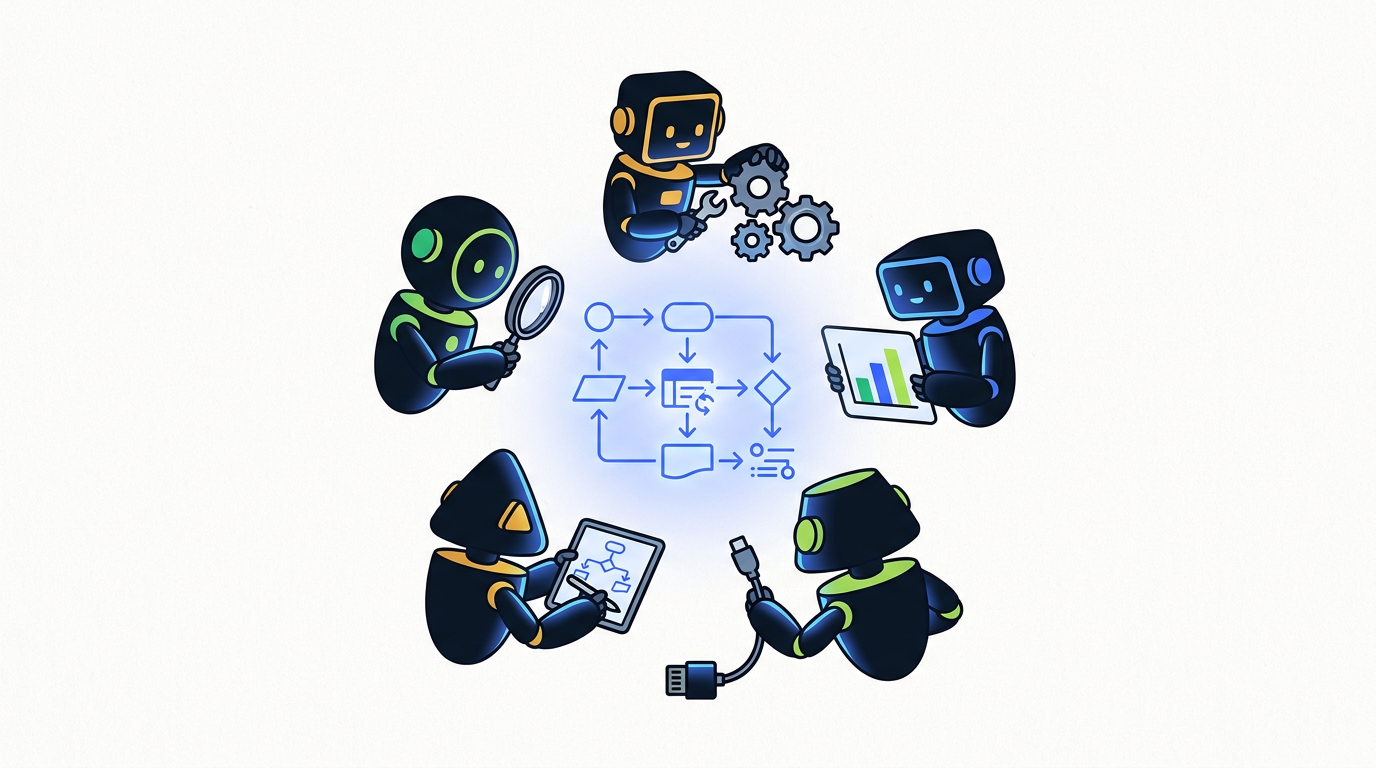
An AI agent swarm is a system where multiple autonomous AI agents collaborate to solve complex problems. Instead of relying on one large model, the swarm divides tasks among specialized agents. This decentralized approach allows for greater adaptability, resilience, and the ability to tackle multifaceted challenges through collective intelligence.
Let’s get one thing straight: the race to build one single, giant, all-knowing AI is a distraction. It’s the wrong goal. Why try to build one lone genius when you can build a whole team of specialists? That’s the simple, powerful idea behind the ai agent swarm.
Instead of betting everything on a monolithic model that’s expensive to run and a nightmare to update, you build a crew. A research agent, a writing agent, a coding agent, a fact-checking agent. Each one is good at its specific job, and together, they can tackle problems far more complex than any single agent could alone. This is how real, productive automation gets done. It’s not about building a god-in-a-box; it’s about building a digital workforce.
Imagine you need to launch a new product. You could hire one ridiculously brilliant, incredibly expensive consultant (the “genius”) to do everything: market research, financial modeling, writing the marketing copy, and designing the website. They might do a great job, but they’ll be slow, costly, and if they get sick, your entire project grinds to a halt.
Or, you could hire a team: a market researcher, a financial analyst, a copywriter, and a web designer. Each is an expert in their field. They work in parallel, communicate with each other, and deliver the final project faster and more robustly. If the copywriter gets stuck, the researcher can feed them more data. This team approach is more resilient and often more effective.
That’s the core concept of an ai agent swarm. We’re moving away from relying on a single, massive Large Language Model (LLM) to do everything. Instead, we’re building swarms of smaller, more specialized autonomous agents that work together. This is a fundamental shift in thinking. The future of complex automation isn’t a single, monolithic AI; it’s a swarm of simple, coordinated bots.
An AI agent swarm is a system where multiple independent AI agents work in a coordinated way to achieve a common goal. Think of it as a digital project team. Each agent is a program given a specific role, a set of tools (like access to the internet or a database), and the ability to make decisions on its own.
The magic happens when they start interacting. This collective behavior allows the swarm to exhibit emergent intelligence—capabilities that are greater than the sum of its parts. No single agent has the full picture, but through collaboration and coordination, the group solves the problem. It’s a decentralized approach, meaning there’s often no single boss; the intelligence is distributed across the network of agents.
So, how does a swarm actually get something done? It’s less like magic and more like a well-run project workflow. The process generally follows a few key steps.
A complex task—like “analyze our top three competitors and create a report on their marketing strategies”—is given to the system. An “orchestrator” agent, or the swarm itself, then performs task division, breaking that big goal into smaller, manageable sub-tasks:
These sub-tasks are then assigned to agents with specialized roles. A “Researcher Agent” might handle steps 2 and 3, while a “Writer Agent” handles steps 4 and 6, and a “Critic Agent” handles step 7. They often work using parallel processing, meaning multiple agents can research different competitors at the same time, dramatically speeding things up.
Not all swarms are organized the same way. The implementation patterns usually fall into a few common categories:
workflow automation, like processing an invoice: one agent extracts the data, another enters it into the accounting system, and a third sends a confirmation email.decentralized model.The power of a swarm comes from its specialists. You can design agents for almost any function. For example, a content creation swarm might include:
While some agents have fixed roles, more advanced systems feature agent role flexibility. This means an agent can adapt its function based on the immediate needs of the task, making the swarm even more dynamic. This modularity is key; you can find more detail in our guide to the main types of AI agents.
You don’t need to be an engineer to grasp the basic structure. Think of it in four layers:
LLM (like GPT-4 or Claude 3), but the model itself is just the engine. The agent’s role, tools, and instructions are what define it. This proves a core belief of ours: the engine is not the car.The terms ai agent swarm and multi-agent system are often used interchangeably, but there’s a subtle and important difference. Think of it this way: all swarms are multi-agent systems, but not all multi-agent systems are swarms.
A multi-agent system is any system with more than one autonomous agent. These agents could be competing (like in a game), co-existing (like self-driving cars navigating the same road), or collaborating.
An ai agents swarm is a specific type of collaborative multi-agent system. Its defining characteristic is the focus on emergent intelligence to solve a single, unified problem. The individual agents in a swarm are often simpler and work in a more tightly coordinated fashion than agents in a broader multi-agent system. The goal is collective behavior, not just individual action. For a deeper dive, see our explainer on multi-agent AI systems.
Building a swarm sounds complicated, so why not just use one big model? Because the swarm approach offers serious advantages, especially for complex, real-world problems.
single point of failure. In a swarm, if one agent crashes, the orchestrator can simply reassign its task to another agent. The system can degrade gracefully instead of failing completely.horizontal scaling). This is often far cheaper and easier than trying to scale up a single, gigantic AI model.workflow and the roles, swapping agents in and out like Lego bricks.It’s not all sunshine and roses. Building and managing an agent swarm is hard, and anyone who tells you otherwise is selling something.
orchestration.autonomy creates blind spots that make troubleshooting incredibly difficult.collective behavior that emerges isn’t intelligent—it’s just chaotic. Agents can get locked into “death spirals” of repeating the same failed action or work against each other without careful design and robust guardrails.This isn’t just theory. AI agent swarms are being used today to solve real problems.
| Example Use Case | How the Swarm Works |
| :— | :— |
| Complex Research & Reporting | A “Planner” agent creates a research plan. Multiple “Researcher” agents scrape websites and academic papers in parallel. A “Summarizer” agent condenses the findings. Finally, a “Writer” agent compiles everything into a coherent report, which a “Critic” agent reviews for errors. |
| Automated Software Development | A “Product Manager” agent writes user stories. A “Developer” agent writes the code. A “Tester” agent writes and runs tests to find bugs. A “Debugger” agent then attempts to fix the code automatically. This shows how AI agents are now fixing their own code. |
| Personalized Travel Planning | A “User Interface” agent chats with you to understand your trip preferences. A “Flight Research” agent and a “Hotel Research” agent find the best options based on your budget and dates. An “Itinerary” agent then pieces it all together into a day-by-day plan. |
| Scientific Discovery | In fields like drug discovery, a swarm can be used to analyze massive datasets of molecular compounds. One agent proposes a hypothesis, other agents test it against data, and another agent refines the hypothesis based on the results, accelerating the pace of research exponentially. |
To make a swarm reliable, you have to solve two big problems: how do the agents talk to each other, and how do they all stay on the same page?
Agents need a way to pass information and instructions back and forth. This isn’t just idle chatter; it’s the lifeblood of the swarm.
State management is just a fancy term for tracking the project’s progress. Without it, you’d have chaos. An agent might start writing the final report before the research is even finished.
The orchestrator is typically responsible for this. It keeps a log of which tasks are pending, in progress, and complete. This “state” allows the swarm to be paused and resumed, and it’s critical for recovering from errors. If an agent crashes mid-task, the orchestrator knows the task needs to be restarted or reassigned, ensuring the workflow can continue without manual intervention.
Because of their decentralized nature, finding out why a swarm failed is tough. You can’t just read a single error log. This is why observability is non-negotiable.
multi agent swarm frameworks often include a visual dashboard. This shows you a real-time graph of the agents, the tasks they are working on, and the messages flowing between them. It turns an invisible process into something you can actually see.Are AI agent swarms expensive? Yes and no. The initial development and orchestration logic can be complex and costly to build. However, the operational costs can be lower than using a single, massive LLM for everything.
The real return on investment (ROI) comes from automating complex, high-value workflow automation that was previously impossible to automate. Think about a process that currently takes a team of five people two weeks to complete. If a swarm can do it in two hours, the upfront investment pays for itself very quickly.
So, when is it worth it?
Remember the 80/20 rule of automation value: focus on simple, reliable automation for the easy 80% of tasks. Reserve swarms for the complex 20% where their power is truly needed.
As we give swarms more autonomy, we run into thorny ethical questions. If an autonomous swarm of agents manipulates a stock price or leaks private data while pursuing a goal, who is responsible?
This is where governance becomes critical. Deploying an ai agent swarm without robust constraints is irresponsible. These guardrails are not optional. The system’s objectives must be crystal clear, and its operational boundaries—what it is and is not allowed to do—must be strictly enforced by the orchestration layer.
Accountability requires traceability. The centralized logging mentioned earlier isn’t just for debugging; it’s for auditing. In the event of a failure or a harmful outcome, you must be able to trace the chain of decisions back through the swarm to understand what went wrong. The law is just beginning to grapple with these issues, but it’s clear that as automation gets more powerful, the legal and ethical frameworks must evolve alongside it.
How do AI agent swarms actually work together?
AI agent swarms work together through a process of task decomposition and communication. A central orchestrator or the agents themselves break a large problem into smaller sub-tasks. Specialized agents then tackle these sub-tasks, often in parallel, and communicate their results through a shared system, like a digital “blackboard” or a message queue, until the final goal is achieved.
What are the real-world examples of AI agent swarms?
Real-world examples include complex research and reporting, where different agents handle planning, web scraping, and summarizing. They are also used in software development for coding, testing, and debugging, as well as in scientific research to analyze vast datasets and accelerate discovery.
What’s the difference between an AI agent swarm and a multi-agent system?
An AI agent swarm is a specific type of multi-agent system. While a multi-agent system is any system with multiple agents (who could be competing or co-existing), a swarm is specifically designed for collaboration. Its agents work together in a tightly coordinated way to solve a single, complex problem, often exhibiting emergent intelligence.
Are AI agent swarms expensive to build and run?
Building an AI agent swarm can have a high initial development cost due to its complexity. However, running a swarm can be more cost-effective than using a single, large AI model, as it uses smaller, specialized agents for each task. The return on investment is highest for automating complex, multi-step business processes.

Part of the Thinker's Automation Labs content team. Researches with the SEO Blog Research Agent, drafts the piece, and routes it through review before publishing. Every claim is fact-checked against primary sources.
Restaurant order automation AI uses artificial intelligence, like voice AI and natural language processing, to take customer orders…
The latest AI tools released in October 2026 include new proprietary models from major labs like OpenAI and…

Playwright is a browser automation library used for web scraping by controlling real browser engines like Chromium, Firefox,…