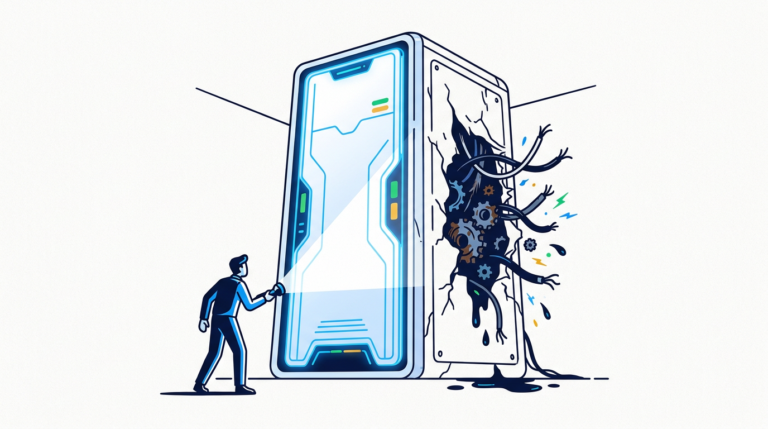
Limitations of Generative AI: The Awkward Truth of What’s Wrong
Generative AI’s primary limitations include producing factually incorrect information (hallucinations), inheriting biases from its training data, and posing…

Generative AI examples include tools that create original content across various formats. Common applications are text generation with chatbots like ChatGPT, image creation from prompts using Midjourney, automated code writing with GitHub Copilot, and synthesizing audio or video for creative projects and business tasks.
Let’s be honest: most articles about generative AI examples are a mess. They’re either a laundry list of venture-backed startups you’ll never use or a vague description of “AI in healthcare” that tells you nothing. They promise a revolution but deliver a footnote. (And yes, we know this is another list. But it’s the one that respects your time.)
We’re here to cut through the noise. The real power of AI isn’t in the hype, but in the specific, useful tools that can solve a real problem for you today. We’ve sorted through dozens of generative AI applications to find the 10 that represent what’s actually working and worth your attention. These are the tools that define their categories and give you a genuine glimpse of the future, minus the marketing fluff.
Generative AI is a type of artificial intelligence that creates new, original content—like text, images, music, or code—instead of just analyzing or processing existing data. It works by learning patterns from massive datasets. After training on billions of examples (like all the public text on the internet), it can generate statistically probable, novel outputs based on a user’s request, known as a prompt.
Think of it like a musician who has listened to every piece of jazz ever recorded. They haven’t memorized every song, but they’ve deeply internalized the rules, patterns, and “feel” of jazz. When you ask them to improvise a new solo, they can create something entirely new that still sounds authentically like jazz. That’s what generative AI does, but for data.
Here are 10 real-world generative AI examples that showcase the breadth of what these tools can do, from writing your emails to discovering new medicines.
| Category | Example Tools | Primary Use Case | Best For |
|---|---|---|---|
| Text | ChatGPT, Claude | Writing, summarizing, brainstorming | Everyone |
| Image | Midjourney, DALL-E 3 | Creating original art and illustrations | Creatives & Marketers |
| Code | GitHub Copilot | Autocompleting and writing code | Software Developers |
| Audio | ElevenLabs, Suno | Voice synthesis and music creation | Podcasters & Musicians |
| Video | Pika, Runway | Generating and editing video clips | Filmmakers & Social Media |
| Data | Notably | Summarizing research data | Researchers & UX Teams |
| Marketing | Anyword | Writing and optimizing ad copy | Marketers |
| Science | Insilico Medicine | Drug discovery and development | Scientists |
| Service | Intercom’s Fin | Automating customer support | Support Teams |
| Search | Perplexity | Answering questions with citations | Students & Researchers |
What it is: These are large language models (LLMs) packaged in a simple chat interface. You give them a prompt, and they generate human-like text to answer questions, write emails, summarize documents, and brainstorm ideas. They are the foundation of many other AI tools.
Who it’s for: Literally everyone. Writers, marketers, students, developers, and curious people use them for everything from drafting difficult emails to learning new topics.
The Standout: ChatGPT is the main character of AI right now. It’s the most well-known, has a massive user base, and its latest models are powerful and multi-talented. Start here.
What it is: These tools turn text prompts into stunningly detailed and creative images. You describe a scene, a style, and a subject—”a photorealistic image of an astronaut riding a horse on Mars, cinematic lighting”—and the AI generates original pictures in seconds.
Who it’s for: Artists, designers, marketers, and content creators who need custom visuals without hiring a photographer or illustrator.
The Standout: Midjourney (which runs on the chat app Discord) consistently produces the most artistic, coherent, and aesthetically pleasing images. While DALL-E 3 is easier to access (it’s built into ChatGPT Plus), Midjourney is the tool the pros use.
What it is: An “AI pair programmer” that lives inside a developer’s code editor. It suggests entire lines or blocks of code as you type, turning a simple comment into a functional piece of software. It’s a powerful example of generative AI applications in software development.
Who it’s for: Software developers, from beginners to seasoned experts.
The Standout: GitHub Copilot is the undisputed leader. It’s built by GitHub and Microsoft, trained on a massive corpus of code, and deeply integrated into the developer workflow. No notes. This one just works.
What it is: This category covers two exciting areas. Voice generation tools like ElevenLabs can clone your voice from a short sample or create realistic synthetic voices for narration. Music generation tools like Suno can create a full, radio-ready song—complete with lyrics and vocals—from a simple text prompt.
Who it’s for: Podcasters, video creators, musicians, and game developers.
The Standout: For voice, it’s ElevenLabs. For music, Suno is so far ahead of the competition it’s almost comical.
What it is: The next frontier. These tools generate short video clips from text prompts or still images. While still in its early days, the technology is improving at a startling pace, allowing for the creation of short animations, b-roll, and surreal video art.
Who it’s for: Experimental filmmakers, social media managers, and artists pushing the boundaries of creative AI examples.
The Standout: Both Pika and Runway are leading the pack, each with slightly different strengths in style and control. It’s worth trying both to see which fits your aesthetic.
What it is: Instead of just generating creative content, some AI is built to synthesize complex information. Tools like Notably are designed for researchers to upload interviews, surveys, and notes. The AI then helps identify key themes, pull out important quotes, and generate summaries.
Who it’s for: UX researchers, market researchers, academics, and anyone who has to sift through mountains of qualitative data.
The Standout: Notably is a prime example of a purpose-built AI tool that solves a very specific, very painful problem for a professional audience.
What it is: This is generative AI applied directly to business results. Anyword generates and optimizes marketing copy (for ads, emails, landing pages) and predicts its performance before you spend a dollar. It analyzes your brand voice and past performance to create new copy that is more likely to convert.
Who it’s for: Marketing teams, advertisers, and e-commerce businesses.
The Standout: Anyword is a great example of how generative AI is being used in business to do more than just write blog posts; it’s being used to fine-tune the engines of commerce.
What it is: This is one of the most profound generative AI use cases. Companies like Insilico Medicine use AI to design novel drug candidates from scratch. The AI can analyze biological data to identify disease targets and then generate molecular structures that are likely to be effective, dramatically speeding up the pre-clinical phase of drug development.
Who it’s for: Pharmaceutical companies, biochemists, and medical researchers.
The Standout: Insilico Medicine has already moved AI-designed drugs into human clinical trials, proving this is no longer science fiction.
What it is: You’ve probably interacted with terrible chatbots. This is not that. Modern AI agents like Intercom’s Fin are built on large language models, allowing them to understand user intent, access a company’s knowledge base, and provide genuinely helpful, conversational answers—not just canned responses.
Who it’s for: Businesses of all sizes that want to provide instant, 24/7 customer support.
The Standout: Intercom’s Fin is a leader in this space, showing how AI can make customer service more efficient and, paradoxically, more human by handling the machine work.
What it is: What if Google and ChatGPT had a baby? You’d get an answer engine like Perplexity. Instead of just giving you a list of links, it scours the web, reads the top sources, and synthesizes a direct answer to your question, complete with citations.
Who it’s for: Students, researchers, professionals—anyone who needs reliable, sourced answers quickly.
The Standout: Perplexity is building a genuinely new and useful way to find information online. It feels like the first real evolution of search in a decade.
You don’t need a PhD in machine learning to get the gist. At its core, generative AI is a very sophisticated pattern-matching machine.
Imagine you gave a computer a library containing every book ever written. You then ask it to write a new sentence about a dog. The computer looks at all the sentences about dogs it has ever seen. It learns that the word “dog” is often followed by words like “barks,” “runs,” or “wags.” It learns that “wags” is often followed by “its” and then “tail.”
Based on these statistical patterns, it predicts the most likely sequence of words to form a coherent sentence: “The dog wags its tail.” Now, scale that up to the entire internet and a much more complex task, and you have generative AI. It’s not “thinking” or “understanding” in the human sense; it’s just an incredibly powerful predictor of the next logical piece of data (a word, a pixel, a note of music) in a sequence.
The main types of generative AI are categorized by the kind of content they create. The five most prominent types are:
Don’t try to use everything at once. A tool is not a strategy. Pick one that solves a problem you actually have.
Resist the urge to automate your entire life on day one. The best way to learn is by doing one small thing.
The key is to treat it like an intern: smart and fast, but needs specific direction and supervision.
It’s not all sunshine and robot-generated art. Using these tools responsibly means being aware of their significant downsides.
In business and marketing, generative AI is used to increase efficiency, personalize customer experiences, and create content at scale. Key applications include:
The goal is to automate repetitive tasks, allowing human teams to focus on strategy, creativity, and building relationships.
The race for bigger models is a distraction. The real innovation is happening at the agentic layer, where these AI models are given tools, goals, and the ability to act on their own.
The future isn’t just a better chatbot. It’s a team of specialized AI agents that you can delegate complex tasks to. Imagine an agent that can not only research travel options but also browse the web like a human, compare prices across sites that don’t have APIs, and book the entire trip for you based on your preferences.
This is where the true power lies: not in demonstrating raw intelligence, but in delivering practical, automated outcomes. The shift is from asking AI to write about doing something to telling it to just go do it.
The primary limitations and risks of generative AI include its potential for inaccuracy, bias, and misuse.
What is the difference between AI and generative AI?
Think of “AI” as the broad field of making computers smart. “Generative AI” is a specific subfield within AI that focuses on creating new, original content (text, images, etc.), rather than just analyzing or categorizing existing data. All generative AI is AI, but not all AI is generative.
Is generative AI free to use?
Many generative AI tools offer a free tier, but it’s often limited. For example, you might get a certain number of free queries per month or access to an older, less powerful model. The most capable versions of tools like ChatGPT, Midjourney, and ElevenLabs require a paid subscription.
Can I trust the information from generative AI?
No, not blindly. Generative AI is notorious for “hallucinating”—making up facts, sources, and figures that sound plausible but are completely false. Always treat its output as a starting point and verify any critical information with reliable sources.
Will generative AI take my job?
It’s unlikely to replace you, but it will almost certainly change how you work. AI is poised to become a powerful tool, much like the computer or the internet. The people who learn to use AI to augment their skills will have a significant advantage over those who ignore it. It’s less about AI replacing writers and more about writers who use AI replacing writers who don’t.

Part of the Thinker's Automation Labs content team. Researches with the SEO Blog Research Agent, drafts the piece, and routes it through review before publishing. Every claim is fact-checked against primary sources.
Generative AI’s primary limitations include producing factually incorrect information (hallucinations), inheriting biases from its training data, and posing…

Generative AI for business refers to artificial intelligence systems that create new, original content—like text, images, and code—from…

Generative AI creates Multiple Choice Questions (MCQs) by analyzing source material with a large language model to produce…