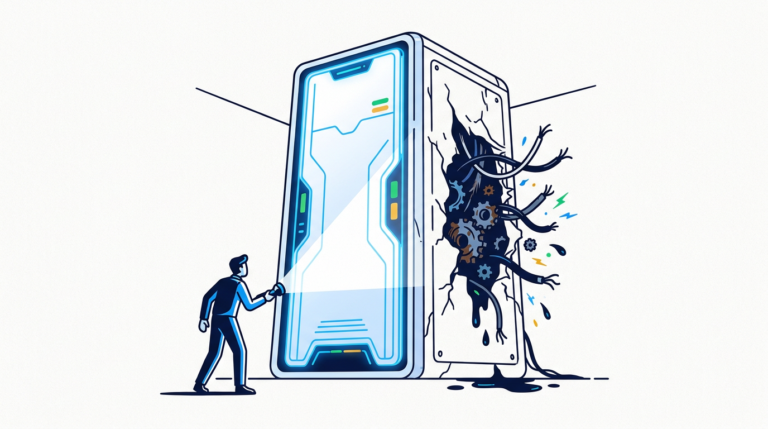
Limitations of Generative AI: The Awkward Truth of What’s Wrong
Generative AI’s primary limitations include producing factually incorrect information (hallucinations), inheriting biases from its training data, and posing…

The PEAS framework is a model used in Artificial Intelligence to define the task environment for an intelligent agent. PEAS stands for Performance Measure, Environment, Actuators, and Sensors. It provides a structured way to design rational agents by specifying the problem’s goal, context, available actions, and perceptual inputs.
Before you get excited about building a futuristic AI agent, you need a blueprint. A plan. Most people skip this part, and it’s why most AI projects fizzle out into expensive, confusing messes. The PEAS framework is that blueprint. It’s the boring-but-essential first step that separates working systems from failed science projects.
Think of it this way: you wouldn’t build a car by just throwing an engine on a pile of parts. You’d design the whole vehicle first. What’s its purpose? Where will it drive? How will it move? How will it know where to go? That’s PEAS in a nutshell. It’s the design document for any intelligent agent, forcing you to think through the problem before you write a single line of code or connect a single API.
In this guide, we’ll break down exactly what the PEAS model is, how to use it, and walk through clear examples—including the classic automated taxi driver. We’ll even give you a few multiple-choice questions (MCQs) to make sure it all sticks.
At its core, the PEAS framework is just a simple checklist for defining an AI agent’s job. It’s a problem formulation tool that makes you answer four fundamental questions:
Answering these forces clarity. It turns a vague idea like “an AI to help with sales” into a concrete plan for a rational agent that has a specific goal, a defined workspace, a set of tools, and a way to perceive its surroundings.
The PEAS model is a design pattern in Artificial Intelligence used to structure the definition of an intelligent agent and its task environment. By specifying the Performance measure, Environment, Actuators, and Sensors, the model provides a complete description of the problem the agent is meant to solve, which is the first step in designing a rational agent.
Let’s break down the four parts. Getting this right is the foundation for building any kind of useful AI, from a simple spam filter to a complex self-driving car.
The Performance Measure is the scorecard for your agent. It’s how you objectively measure if it’s doing a good job. This is the most important step—if you don’t know what “winning” looks like, your agent will just wander around aimlessly.
A good performance measure is specific and multi-faceted. For an automated taxi, “getting the passenger to the destination” is a start, but it’s not enough. A better measure would include:
This isn’t just theory. Defining these metrics is how you train the AI. The agent will learn to optimize its actions to get the highest possible score on these measures.
The Environment is the world where the agent operates. Describing it properly tells you how difficult the agent’s job will be. Is it playing chess on a digital board or driving in a chaotic city? The environment for a chess AI is simple, predictable, and fully observable. The environment for a self-driving car is the exact opposite.
Key questions to ask about the environment:
Actuators are the parts of the agent that allow it to perform actions and affect its environment. They are the agent’s “muscles”—its hands, legs, wheels, or voice.
The list of actuators defines the complete set of actions an agent can possibly take.
Sensors are how the agent perceives its environment. They are the inputs that feed the agent information about the state of the world. Without sensors, an agent is blind and deaf.
The quality and variety of an agent’s sensors determine how much it can know about its environment. Better sensors lead to better decisions.
To write a PEAS description, follow a four-step process. First, define the Performance Measure by identifying the specific, measurable criteria for success. Second, characterize the Environment where the agent will operate. Third, list all the Actuators the agent can use to act. Finally, list all the Sensors it uses to perceive the environment.
This isn’t just an academic exercise. Following these steps is how you build a practical specification for an AI automation project.
Start with the end goal. What does success look like, and how will you measure it? Be ruthless and specific. Vague goals like “improve efficiency” are useless. A good goal is “reduce the time to process an invoice from 3 days to 4 hours while maintaining a 99.5% accuracy rate.”
Describe the agent’s workspace. Is it a physical space like a warehouse, or a digital one like a CRM system? Is it static or dynamic? Is the agent working alone or with other people and bots? This helps you understand the complexity and choose the right kind of agent design.
What can your agent actually do? List every possible action. For a software bot, this might be “click a button,” “enter text into a field,” “call an API,” or “send an email.” Be exhaustive. This defines the agent’s toolkit.
How will the agent get information? What are its inputs? For a software bot, this could be “read text from a screen,” “get data from a spreadsheet,” or “receive an API response.” This defines what the agent knows about its world at any given moment.
Theory is fine, but examples make it click. Here are three PEAS descriptions for different types of AI agents.
This is the classic example used in AI courses, and for good reason. It’s complex and easy to understand. It’s a great illustration of how you can apply the PEAS framework to a real-world problem in robotics and automation.
The PEAS description for an automated taxi driver is: Performance Measure: Safety, speed, legality, comfort, and profit. Environment: Public roads, traffic, pedestrians, weather. Actuators: Steering wheel, accelerator, brakes, signals, horn. Sensors: Cameras, LiDAR, GPS, radar, speedometer, odometer.
Now for a software-based agent. This shows how the PEAS model applies even when there’s no physical robot involved.
Yes. For a medical diagnosis AI, the PEAS description is: Performance Measure: Health of the patient, accuracy of diagnosis, minimizing treatment costs. Environment: Patient data, electronic health records, medical knowledge base. Actuators: Displaying questions, diagnoses, and treatment recommendations. Sensors: Keyboard entry for symptoms, patient history, and test results.
Here’s an everyday intelligent agent most of us use without thinking about it.
Let’s see if you’ve got it. Here are a few multiple-choice questions to test your understanding of the PEAS description concept.
Question: For an automated taxi driver, which of the following is best described as an Actuator?
A) GPS
B) Camera
C) Steering Wheel
D) Pedestrian
Answer: C) Steering Wheel.
Question: In a PEAS description for an AI medical diagnosis system, what would the “Environment” primarily consist of?
A) The hospital building
B) The patient’s symptoms, test results, and medical history
C) The computer screen displaying the diagnosis
D) The AI’s internal programming code
Answer: B) The patient’s symptoms, test results, and medical history.
Question: You are creating a PEAS description for a robot vacuum cleaner. Which of the following would be part of its Performance Measure?
A) The layout of the room
B) The wheels and brushes
C) The amount of dirt collected and battery life used
D) The infrared sensors that detect walls
Answer: C) The amount of dirt collected and battery life used.
Defining the PEAS framework is the first, most crucial step in any AI project. It’s the strategic work that comes before the software. It forces you to define what you’re actually trying to accomplish, turning a vague wish into a solvable problem. Skip it at your own peril.
What are the 4 components of the PEAS framework?
The four components of the PEAS framework are Performance Measure (the criteria for success), Environment (the context where the agent operates), Actuators (the tools the agent uses to act), and Sensors (the tools the agent uses to perceive its surroundings).
Why is the PEAS framework important for AI?
The PEAS framework is important because it provides a structured and formal way to define the problem an AI agent is meant to solve. It forces designers to think clearly about the agent’s goal, its limitations, and its operating context, which is an essential first step before any development can begin. It turns a vague idea into a specific engineering problem.
Is the PEAS framework only for robotics?
No, not at all. While classic examples like self-driving cars and robots are common, the PEAS framework applies to any type of intelligent agent, including pure software agents. An email spam filter, a stock-trading bot, or a medical diagnosis system can all be clearly defined using PEAS.
What’s the difference between a rational agent and a goal-based agent?
A rational agent is any agent that acts to achieve the best possible outcome, according to its performance measures. A goal-based agent is a specific type of rational agent that has an explicit goal to achieve. Its decision-making is based on how its actions will move it closer to that goal. Most agents described with PEAS are designed to be rational agents, and many of them are goal-based.

Part of the Thinker's Automation Labs content team. Researches with the SEO Blog Research Agent, drafts the piece, and routes it through review before publishing. Every claim is fact-checked against primary sources.
Generative AI’s primary limitations include producing factually incorrect information (hallucinations), inheriting biases from its training data, and posing…

Generative AI for business refers to artificial intelligence systems that create new, original content—like text, images, and code—from…

Generative AI examples include tools that create original content across various formats. Common applications are text generation with…