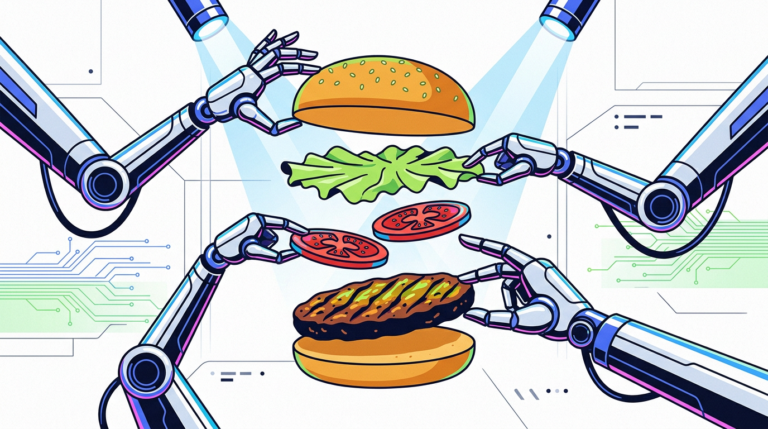
The Future of Fast Food: Will a Robot Make Your Next Burger?
The future of fast food will be shaped by AI-driven automation for efficiency, hyper-personalization through data, and a…
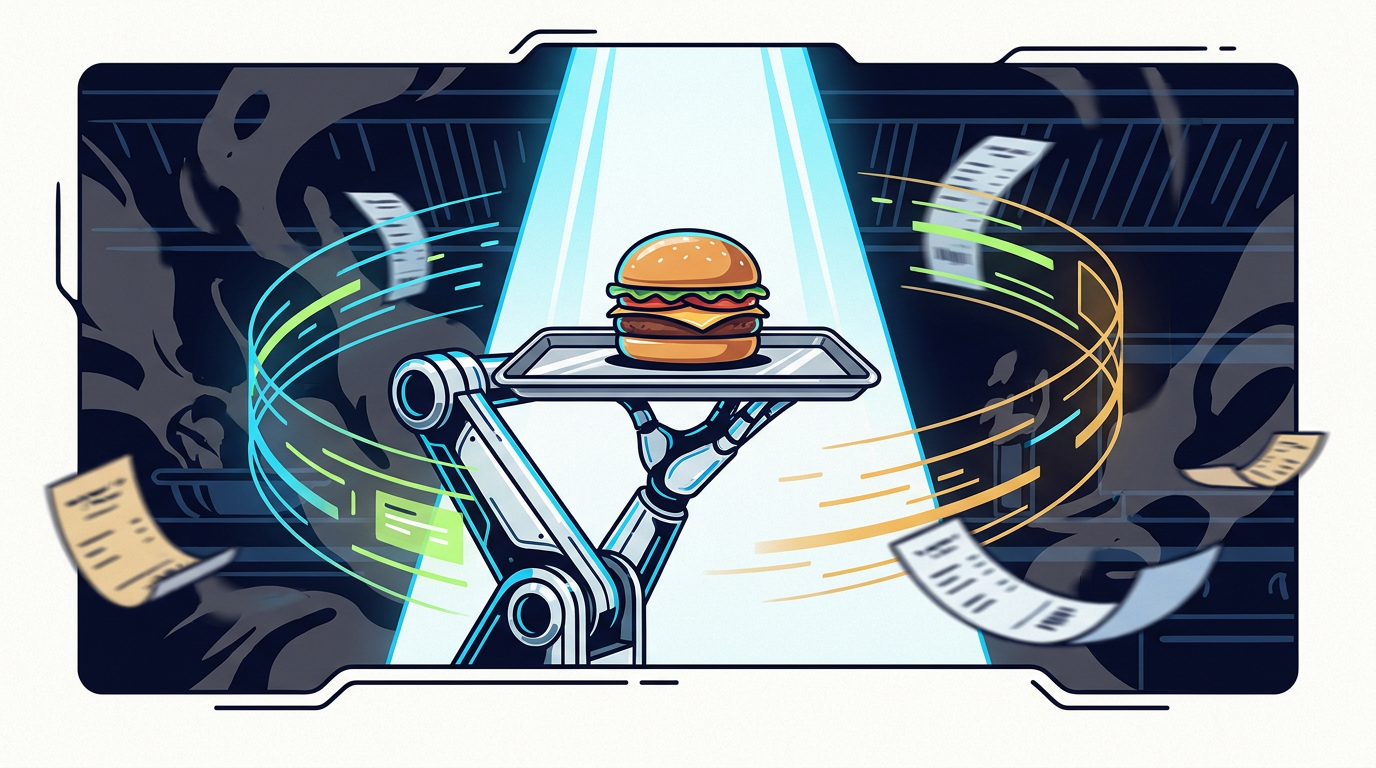
McDonald’s ended its AI drive-thru partnership with IBM after inconsistent performance. The company is now testing a new system, ‘Archy,’ developed with Google. This updated voice ordering AI is currently live in over 100 locations as part of its ‘McDonald’s Next’ innovation strategy, showing improved accuracy.
You probably saw the videos. A confused AI adding bacon to an ice cream cone. A woman in a drive-thru lane laughing as she tries, and fails, to order a vanilla cone and a water, only to have the system add multiple hash browns and ketchup packets. For a couple of years, the McDonald’s AI drive-thru was a reliable source of internet comedy.
Then, in mid-2024, the news broke: McDonald’s was ending its partnership with IBM, the company behind the tech.
The easy conclusion is that the whole experiment was a failure. A corporate giant tried to replace people with a robot, the robot embarrassed itself on TikTok, and the plug was pulled. But that’s not the whole story. Not even close.
McDonald’s didn’t give up on AI. They just switched partners.
This is the real story of the McDonald’s AI drive-thru. We’ll cover what went wrong with the first attempt, what’s different about their new system built with Google, and our honest take on whether this is the actual future of fast food.
No, McDonald’s has not given up on AI. The company simply concluded its initial test with IBM’s technology in July 2024. It has already begun a new, more advanced trial with a different partner, Google, signaling a deeper commitment to drive-thru automation.
The initial plan, announced in 2021, seemed straightforward. McDonald’s acquired a company called Apprente (which it later sold to IBM) and partnered with the tech giant to build an automated order-taking system. The goal was simple: use AI to take drive-thru orders, freeing up employees to focus on preparing food and serving customers, thereby speeding up the line.
The system was rolled out to around 100 restaurants for a real-world test. And the real world, it turns out, is a messy place.
The problems with the IBM system became a viral sensation. Customers shared their frustrating—and often hilarious—experiences on platforms like TikTok.
Orders were frequently misunderstood. A request for water might become a mountain of ketchup packets. An order for one large sweet tea could be interpreted as nine separate teas. The AI struggled with accents, background noise from traffic or kids, and even simple modifications. The viral videos of the AI adding unwanted items, like butter or bacon to an ice cream sundae, became legendary.
For customers, it was a funny gimmick. For McDonald’s, it was a serious problem. The core promise of fast food is speed and accuracy. The AI was delivering neither. Employees frequently had to intervene to correct orders, defeating the entire purpose of the automation.
The viral fails were just a symptom of a deeper issue. According to reports, the IBM technology only achieved around 85% order accuracy. For a family ordering a few Happy Meals, a one-in-seven chance of a mistake is simply too high. For a business built on consistency and volume, it was an operational nightmare.
Think of it this way: production-grade automation is all about resilience. Anyone can build a demo that works in a quiet lab. The real challenge is building a system that can handle the chaos of reality—engine noise, overlapping speakers, and a million different ways to say “large fries.” The IBM system wasn’t resilient enough.
So, in June 2024, McDonald’s announced it would be “ending its current partnership with IBM” and would switch off the technology in the test restaurants by the end of July. It wasn’t an admission of defeat, but a strategic pivot. The first test taught them what didn’t work. Now, they were ready to try again with a new approach.
Almost immediately after the IBM news, the real plan emerged. McDonald’s wasn’t retreating; it was doubling down, this time with Google.
The new system is part of a broader strategic partnership with the tech giant. While the AI doesn’t have an official public-facing name, internally it’s often referred to as ‘Archy,’ a nod to the golden arches. This new voice ordering AI is built on a foundation of Google’s more advanced AI and cloud technology.
Giving the AI a name like ‘Archy’ is a classic move. We have a deep need to see ourselves in our tools. Personification makes technology feel less like a cold system and more like a partner, making us more likely to trust and engage with it.
So, what makes this new system different? It comes down to where and how the AI thinks.
The old system likely relied on sending audio recordings of your order to a distant data center for processing. This creates latency—a slight delay that can make the conversation feel unnatural and lead to errors.
The new Google-powered system, reportedly built on a platform called ArchIQ, uses a more sophisticated approach with Google Edge Cloud. Instead of sending your voice on a long trip across the internet, the AI processing happens right there in the restaurant on small, powerful servers known as Google Edge Cloud blades.
Think of it as the difference between having a conversation with someone in the same room versus someone on a laggy international phone call. By processing the audio locally, the AI can respond faster and more accurately. It’s better equipped to filter out background noise and understand complex orders because it has more processing power closer to the source. This is the key technological shift that makes ‘Archy’ a more serious contender.
The difference between the two tests isn’t just a simple software update. It’s a fundamental change in technology and strategy.
| Feature | The Old System (IBM) | The New System (‘Archy’ with Google) |
|---|---|---|
| Primary Partner | IBM | |
| Core Technology | Automated Order Taking (AOT) via IBM Watson | Google Cloud AI & Google Edge Cloud |
| Key Weakness | Inconsistent performance (~85% accuracy), struggled with noise and accents | Still in testing; long-term scalability is unproven |
| Standout Feature | One of the first large-scale public tests of drive-thru AI | On-premise processing (“edge computing”) for lower latency and higher accuracy |
| Our Take | A necessary, if clumsy, public experiment. A proof-of-concept. | A production-grade attempt at scalable automation. This is the one to watch. |
The McDonald’s AI drive-thru with IBM failed primarily due to inconsistent performance and low accuracy. The system reportedly struggled to correctly process orders about 15% of the time, leading to frequent errors that required human intervention, defeating the purpose of the automation and creating a poor customer experience.
The big question is whether the Google-powered ‘Archy’ can succeed where the IBM system failed. Early signs are promising.
The new AI is currently being tested in over 100 McDonald’s locations, primarily as part of the company’s ‘McDonald’s Next’ innovation strategy. This is a much more integrated and serious test.
According to recent reports, the results are dramatically better. The system has already handled over a million orders, with a completion rate of over 90% without any human help. That’s a massive leap from the ~85% accuracy of the previous system and is approaching the level of reliability needed for a full-scale rollout.
While there are no large-scale public sentiment studies yet, the lack of new viral fail videos is, in itself, a good sign. The goal of good automation is for it to be so seamless you don’t even notice it.
The customer experience with ‘Archy’ seems to be less of a novelty and more of a straightforward, efficient transaction. The conversation is faster, the AI understands modifications better, and the order on the screen is far more likely to match what was actually said. The frustration is being replaced by a quiet sense of efficiency. It’s not perfect, but it’s no longer a joke.
McDonald’s new AI voice ordering system, developed in partnership with Google, is known internally as ‘Archy.’ It is built on a technology platform called ArchIQ, which leverages Google’s advanced AI and cloud infrastructure to improve order accuracy and speed in the drive-thru.
This isn’t just a McDonald’s story. It’s a preview of a massive shift happening across the entire service industry.
Absolutely. In fact, it’s already happening. Wendy’s has been testing its own system, Wendy’s FreshAI, which is also—you guessed it—powered by the Google Cloud Platform. Other chains like Carl’s Jr., Hardee’s, and Popeyes are all running their own tests.
The reason is simple: the drive-thru is the economic engine of fast food, accounting for over 70% of sales for most major chains. But it’s also a major bottleneck and source of stress for employees. Automating the order-taking process is the single biggest lever these companies can pull to improve speed and efficiency. The race is on, and Google has positioned itself as the key technology provider for the industry.
The immediate fear is that this technology is designed to replace human workers. But that’s a fundamental misreading of the situation. The real AI revolution, especially in services, is about augmenting human capability, not just eliminating jobs.
Fast-food restaurants are often chronically understaffed. The work is demanding, and turnover is high. By handing the repetitive, high-pressure task of taking orders to an AI, you don’t necessarily fire the person who was doing it. Instead, you free them up to focus on more valuable tasks: expediting orders, ensuring food quality, or providing better customer service at the window.
The goal isn’t a restaurant with no people; it’s a restaurant where people and AI work together, each doing what they do best. The AI handles the predictable, repetitive data entry, and the humans manage the complex, physical world of the kitchen and the final customer interaction.
The new McDonald’s AI, ‘Archy,’ is fundamentally different from the old IBM system in its core technology. It uses Google’s more advanced AI models and, crucially, processes voice data locally within the restaurant using “edge computing.” This dramatically reduces lag and improves accuracy compared to the old system, which sent data to remote servers.
So, is this the real deal? Yes, we think it is.
The IBM partnership wasn’t a failure. It was a very public, very expensive, but very necessary research and development project. It taught McDonald’s an invaluable lesson: lab-tested AI doesn’t survive contact with the real world. You need a system built for resilience and scale from the ground up.
The new partnership with Google is that system. It’s a production-grade attempt built on more mature technology. It’s not just about demonstrating a capability; it’s about delivering a reliable, scalable business process.
Most AI “breakthroughs” are just incremental improvements. This, however, feels different. It’s a direct application of powerful AI to the core of a massive global business. The path forward won’t be perfectly smooth, but the direction is clear. An AI is going to take your fast-food order. It’s no longer a question of if, but when.
Based on early results, the new McDonald’s AI drive-thru powered by Google is proving to be much more successful than the previous version. In its current test phase across over 100 restaurants, the system has achieved a 90% order completion rate without human assistance, a significant improvement in accuracy and reliability.
Why did McDonald’s stop using the IBM AI?
McDonald’s ended its test with IBM because the technology was not consistently accurate enough for a wide rollout. It struggled with accents, background noise, and complex orders, leading to frequent errors and a poor customer experience.
What company is McDonald’s using for AI now?
McDonald’s is now partnering with Google. The new voice ordering system uses Google’s Cloud AI and edge computing technology to power its drive-thrus.
Is the McDonald’s AI taking jobs?
The primary goal of the AI is to improve speed and efficiency, not to replace employees. The fast-food industry often faces labor shortages, and automating order-taking allows staff to focus on other critical tasks like food preparation, quality control, and customer service.
When will the AI be in all McDonald’s drive-thrus?
McDonald’s has not announced a specific timeline for a full rollout. The company is still in the testing phase with the Google-powered system. A broader deployment will depend on the continued success and performance of these tests.

Part of the Thinker's Automation Labs content team. Researches with the SEO Blog Research Agent, drafts the piece, and routes it through review before publishing. Every claim is fact-checked against primary sources.
The future of fast food will be shaped by AI-driven automation for efficiency, hyper-personalization through data, and a…

AI for restaurant marketing uses artificial intelligence tools to automate and enhance marketing efforts. This includes personalizing customer…
AI kitchen automation uses technologies like robotics, machine learning, and computer vision to handle tasks in commercial kitchens.…