
AI Workflow Automation: A Complete Guide for Business (2024)
AI workflow automation uses artificial intelligence to manage and execute complex, multi-step business processes. It goes beyond simple…
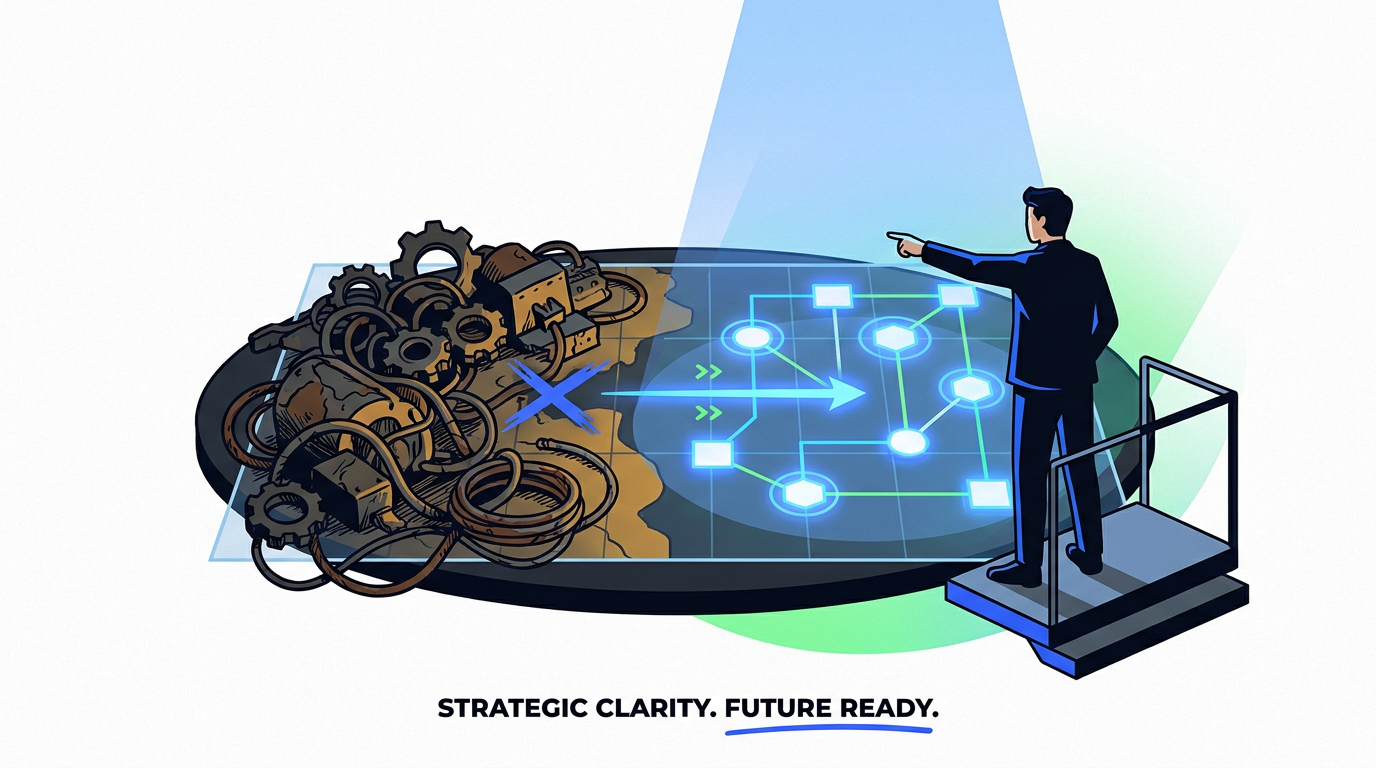
API-first automation is a modern approach where business processes are automated by directly integrating with application programming interfaces (APIs) instead of relying on user interface (UI) interactions. This method prioritizes stable, scalable, and secure connections, treating APIs as the primary building blocks for creating robust automation workflows.
Your RPA bots are breaking again, aren’t they? That little automation you built to copy data from a website just failed because a developer changed a button’s color. Now you have to stop everything, record the process all over again, and pray it doesn’t break tomorrow. This isn’t progress; it’s digital duct tape.
For years, Robotic Process Automation (RPA) was sold as the answer. It promised to automate any task by simply mimicking what a human does on screen. But that mimicry is its greatest weakness. Building your business processes on UI automation is like building a skyscraper on sand. The first gentle breeze—a website update, a new software version—and the whole thing starts to lean.
It’s time to stop thinking like a screen-scraper and start thinking like a software company. The future of reliable, scalable automation isn’t about mimicking clicks; it’s about speaking the language of software directly. That language is the API, and embracing an API-first automation strategy is the only way to build something that lasts.
The fundamental problem with traditional RPA is that it operates on the most fragile layer of any application: the user interface. The UI is designed for human eyes, not for machine precision. It changes constantly for branding, user experience, or a designer’s whim. Every time it changes, your RPA bot breaks.
This creates a cycle of endless maintenance. Your automation team spends more time fixing broken bots than building new value. It’s a reactive, brittle, and expensive way to run a core business function.
An API-first approach flips the model. It ignores the cosmetic UI layer and connects directly to the stable, structured data layer underneath. It’s the difference between asking a waiter to read the entire menu out loud every time versus just ordering “number 12.” One is inefficient and error-prone; the other is direct, fast, and reliable.
API-first automation is a strategy where you build automated workflows by prioritizing Application Programming Interfaces (APIs) as the primary method of integration. Instead of recording mouse clicks and keystrokes on a screen (UI automation), you connect directly to the backend systems of your software applications.
Think of an API as a controlled, documented doorway into a software application, designed specifically for other programs to use. It’s a set of rules that lets different applications talk to each other in a structured, predictable way.
An API-first strategy means that when you need to automate a process, your first question is always: “Is there an API for that?” You treat the visual interface as a last resort, used only when a system is so old or locked down that no API exists. This approach treats automation not as a fragile script, but as a piece of resilient, modern software.
Moving to API-first automation is more than a technical switch; it’s a shift in mindset. It borrows principles from modern software development to build automations that are more like products than disposable scripts.
The most mature API-first organizations adopt an ‘API as a product’ mindset. This means they treat their internal and external APIs with the same care they would a customer-facing product.
An API “product” has:
When you treat your key automations and their underlying APIs as products, you create a library of reliable, deployable services that the entire organization can use as building blocks. This is the key to escaping the “brittle bot” trap and creating true operational assets.
The shift away from UI-based RPA is happening for one simple reason: the old way is too fragile and expensive to maintain at scale. The new way is built for the reality of modern business.
Imagine your process is to take customer information from an email, find their account in Salesforce, and update their status in a separate project management tool.
A traditional RPA bot would:
If the Salesforce login page changes, the bot breaks. If the “Status” field is moved, the bot breaks. If the email format is different, the bot breaks. It’s a house of cards.
An API-first automation workflow for the same process looks completely different:
GET /customers?email=customer@email.com.UPDATE /customers/{customer_id} with the new status.This workflow is invisible. It happens in milliseconds, in the background. It doesn’t care if Salesforce redesigns their entire website. As long as the API contract remains the same, the automation works. It’s stable, fast, and infinitely more reliable. This resilience is the core of production-grade automation.
An API-first architecture dramatically improves scalability and governance by treating automation like modern software development, moving away from fragile, siloed bots. This approach introduces structure and control that is impossible with UI-based methods.
For scalability, an API-first approach allows you to:
For governance and security, this architecture provides:
Having a library of great API connections is only half the battle. The real power comes from orchestration—the process of combining these individual API calls into a coherent, end-to-end business workflow.
Orchestration is the brain of your automation system. It defines the logic: “When a new invoice arrives in this inbox (Step 1), extract the data (Step 2), validate it against our ERP system via API (Step 3), and if it’s approved, send it to the payment system API (Step 4).”
This is where modern automation platforms shine. They provide a visual canvas where you can chain together these API-based actions, handle complex logic (if/then, loops), manage errors, and monitor the entire process from a central location. Effective AI is a system, not a monolith, and orchestration is what turns a collection of simple bots into a powerful, coordinated system.
Without a strong orchestration layer, your API-first strategy devolves into a series of disconnected scripts. With it, you can build complex, resilient, and observable business processes that truly transform how your company operates.
The benefits of API-first automation become clear when you look at concrete examples. Competitors talk in hypotheticals; let’s look at the actual ROI.
API-first isn’t the only game in town. Knowing when to use it—and when not to—is key. A tool is not a strategy, and picking the right one for the job is half the battle.
| Method | What It Is | Best For | Our Take |
|---|---|---|---|
| API-First Automation | Connecting directly to application backends using structured API calls. | Core business processes, high-volume transactions, and building scalable, reusable automation assets. | This is the default you should strive for. It’s the most robust, scalable, and secure method for any process where APIs are available. |
| Traditional RPA | Mimicking human clicks and keystrokes on a user interface (UI). | Automating tasks in legacy systems that have no APIs, or for quick, temporary automations where stability isn’t critical. | Use this as a last resort. It’s a necessary evil for dealing with the past, not a foundation for building the future. Every RPA bot should have a retirement plan. |
| iPaaS (Integration Platform as a Service) | Cloud platforms focused solely on connecting SaaS applications and synchronizing data between them (e.g., Zapier, Workato). | Simple, linear data syncs between well-known cloud apps (“When this happens in App A, do that in App B”). | Great for simple point-to-point integrations, but often lacks the complex logic, orchestration, and customizability of a true API-first automation platform. They are a subset of the API-first world. |
This is the core comparison. API-first is about building resilient systems; RPA is about mimicking surface-level actions. API-first is proactive and architectural; RPA is reactive and tactical. You use API-first for the 80% of foundational processes that need to be rock-solid. You reserve RPA for the 20% of legacy edge cases you can’t avoid.
This is a more nuanced distinction. Most iPaaS platforms are, by definition, API-first. Their entire business is connecting APIs. However, they are often optimized for simple, trigger-action recipes.
A comprehensive API-first automation strategy goes beyond simple data syncs. It involves complex orchestration, custom logic, human-in-the-loop workflows, and the ability to interact with on-premise systems or even run code. Think of iPaaS as a great starting point for API integration, but a true automation platform gives you the full toolbox for building complex, end-to-end processes.
The real world is messy. You will inevitably face a process that involves a modern SaaS app (with a great API), a 20-year-old mainframe system (with no API), and a human decision point.
This is where a hybrid approach is necessary. The best automation platforms allow you to orchestrate all three methods within a single workflow:
The key is to use RPA sparingly and strategically, as a bridge to the past, while building the core of your workflow on a stable API-first foundation.
Moving from a brittle RPA ecosystem to a robust API-first model is a journey. You can’t just flip a switch. A phased approach is the only way to modernize legacy RPA without disrupting the business.
Audit and Triage: First, get a clear picture of your existing RPA bots. Catalog every single one. For each bot, identify what systems it touches and what business process it serves. Then, classify them:
Prioritize the High-Impact Candidates: Don’t try to boil the ocean. Start with the bots that are causing the most pain or offer the biggest reward for migration. Your best candidates are at the intersection of “High-Risk” and “API-Ready.” Fixing these delivers immediate stability and proves the value of the new approach.
Build the API-First Pilot: Choose one high-impact process and rebuild it using an API-first automation platform. This isn’t just a technical exercise; it’s about demonstrating the difference. Document everything: the development time, the performance improvement, and the reduction in errors. The goal is a clear before-and-after story.
Scale and Decommission: Once the pilot is successful, use it as a blueprint. Systematically work through your prioritized list, rebuilding brittle RPA bots as resilient API workflows. Crucially, for every new API workflow you launch, you must decommission the old RPA bot. This prevents “automation sprawl” and ensures you are actively reducing your technical debt.
A successful transition to API-first automation is as much about people and process as it is about technology. Your current team of “RPA Developers” focused on fixing screen-scrapers needs to evolve.
The new model requires a shift towards a Center of Excellence (CoE) or a Platform Team that thinks like a software engineering group. Their job isn’t to build every automation themselves, but to enable the rest of the organization.
This team’s responsibilities include:
This creates a federated model where the central team provides the stable foundation (the API connections and platform), and the business units have the freedom to assemble those building blocks into workflows that solve their specific problems. You move from a bottleneck of a few developers to an empowered organization of many builders.
While API-first automation is a superior model, it’s not without challenges. Adopting this approach requires a clear-eyed view of the potential hurdles and a strategy to overcome them.
The biggest challenges are:
You should only use RPA when there is no other viable, stable integration method available. It’s a tool of last resort, but a necessary one in a world filled with legacy technology.
Specifically, RPA is the right choice in these situations:
The guiding principle should be: always try the API first. Only when you have confirmed that no stable API, database connection, or other backend integration exists should you turn to RPA.
Choosing the right platform is critical. You need a tool that treats APIs as first-class citizens, not as an afterthought.
Look for a platform with:
Every automation platform has its center of gravity. Some are built for simple data syncs, others for heavy AI processing. Find the one whose core strength aligns with building complex, resilient, orchestrated workflows.
The move to API-first is not the end of the story; it’s the beginning. This stable, structured foundation is what will enable the next wave of automation, which is all about agentic AI.
Today, people talk about integrating AI by calling a model like GPT-4 via an API to generate text or analyze data. This is just the start. The future is about autonomous AI agents that can reason, plan, and take action to achieve a goal.
These agents will need a world to act upon. A purely conversational AI is a brain in a jar. To be useful, it needs hands and feet. The robust, well-documented, and secure APIs you build today will become the nervous system for the agentic AI of tomorrow. An AI agent tasked with “booking my travel for the conference in Lisbon” won’t be clicking around on Expedia’s website. It will be making a series of API calls to the airline, hotel, and calendar systems—the very infrastructure you’re building with an API-first strategy.
The internet is evolving from a human-to-machine network into a machine-to-machine ecosystem. An API-first architecture is how you build for this future, creating systems that are ready for the coming wave of autonomous AI agents to interact with.
What are the main differences between RPA and API automation?
The main difference is the layer of technology they interact with. RPA automates the User Interface (UI), mimicking human clicks and keystrokes on the screen. API automation integrates directly with the Application Programming Interface (API), the stable backend layer designed for machine-to-machine communication. RPA is visual and brittle; API automation is invisible and robust.
What is the ‘API as a product’ concept?
‘API as a product’ is a mindset where you treat your key APIs (and the automations they enable) with the same care as a commercial product. This means they have clear ownership, good documentation, reliability standards, and support, turning them into reusable, trusted assets for the entire organization.
Is API-first automation only for developers?
No. While the underlying technology is more technical, modern low-code automation platforms provide visual interfaces that allow non-developers to build API-first workflows. They turn complex API calls into simple, drag-and-drop blocks, democratizing the ability to build robust automations without needing to write code.
Can I start with API-first automation if my company is new to automation?
Absolutely. In fact, starting with an API-first strategy is the best way to avoid the technical debt and maintenance nightmare that comes from a purely RPA-based approach. It sets you on a path to build scalable and resilient automation from day one.
META: API-First Automation: Replacing Brittle RPA Bots for

Part of the Thinker's Automation Labs content team. Researches with the SEO Blog Research Agent, drafts the piece, and routes it through review before publishing. Every claim is fact-checked against primary sources.
AI workflow automation uses artificial intelligence to manage and execute complex, multi-step business processes. It goes beyond simple…

Event-driven workflow orchestration is a system where a central service manages and coordinates tasks. Unlike scheduled jobs, these…

Playwright is a modern browser automation framework ideal for enterprise web scraping. It excels at reliably extracting data…