Can AI Predict the Future? What It Can (and Can’t) Do
AI can’t see the future — it forecasts probabilities from patterns in past data. It’s remarkably good at…
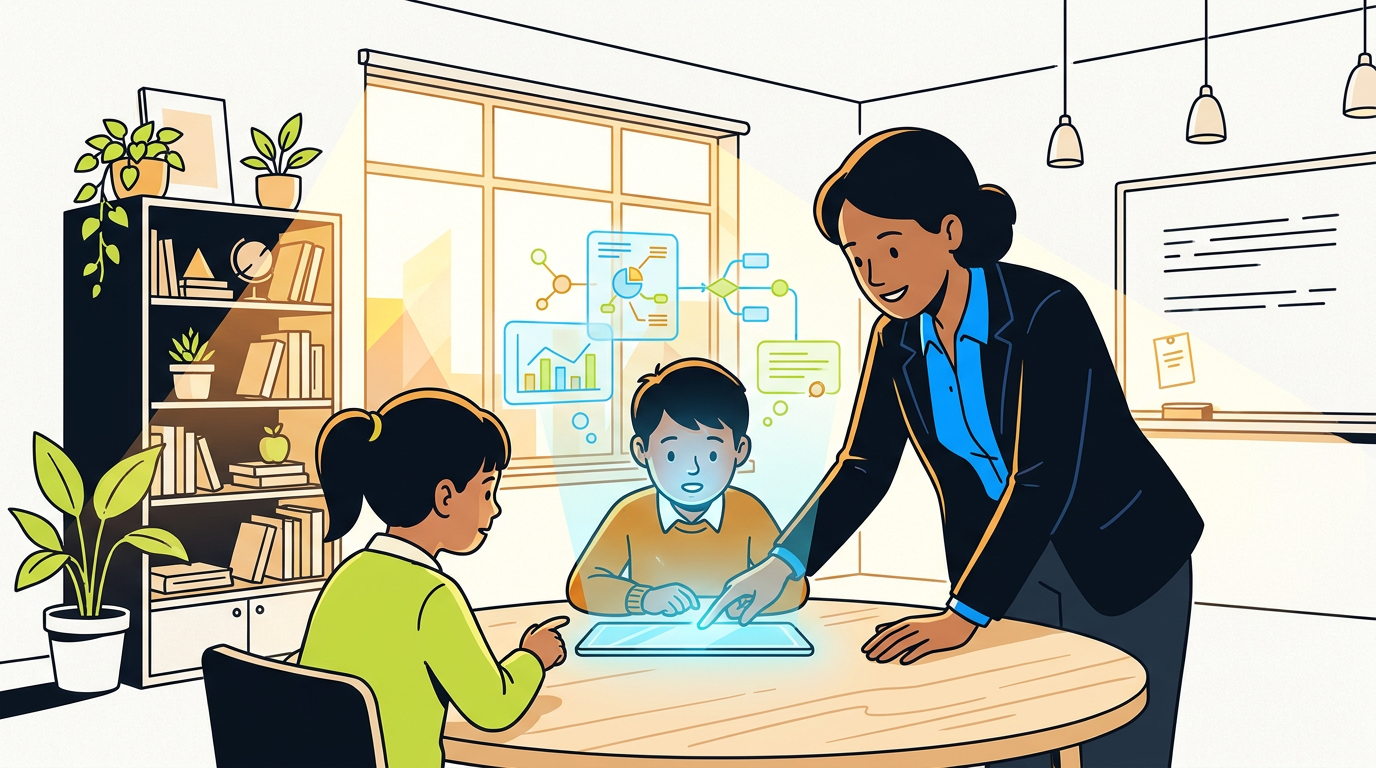
AI in education means personalized learning, instant feedback, and automated admin — but the future classroom still needs teachers. The winning model uses AI to handle repetition so educators can focus on mentorship, critical thinking, and the skills AI can’t replace.
The moment ChatGPT went mainstream, a collective panic rippled through education. Suddenly, every essay was suspect, every student a potential plagiarist, and every teacher was wondering if their job was about to be automated away. It was… a lot.
Now that the initial dust has settled, we can have a more honest conversation. The future of AI in education isn’t about replacing teachers with robots or turning schools into soulless content farms. It’s about using a powerful new tool to solve old, stubborn problems.
The real conversation is about augmentation, not replacement. It’s about freeing teachers from the mountain of administrative work and repetitive grading so they can do the one thing AI can’t: connect with students on a human level. This is the guide to what’s real, what’s overhyped, and how we actually prepare students for a world where AI is everywhere.
Let’s be clear: the classroom was never going back to a pre-internet, pre-ChatGPT state. The tool is out there, and it’s not going away. Banning it is like trying to ban calculators in math class — a losing battle that ignores the real opportunity.
The post-ChatGPT classroom acknowledges that information is a commodity. Memorizing facts is less important than ever. The new premium is on critical thinking, media literacy, and the ability to use tools like generative AI thoughtfully and ethically.
The focus is shifting from the what (the answer) to the how (the process of getting there). Instead of “write an essay about the causes of the American Revolution,” the prompt becomes, “Use an AI to generate three different arguments for the causes of the American Revolution, then write a critique analyzing their biases and supporting one with your own research.” One approach tests memory; the other tests thinking. That’s the core of the new classroom.
AI is already integrated into education in ways you might not even notice. It’s not just about chatbots that can write a sonnet. These tools are designed to automate tasks, personalize experiences, and provide data-driven insights for educators. They generally fall into a few key categories.
First, there are adaptive learning platforms. Think of these as personal tutors for every student. Software from companies like DreamBox or Khan Academy uses AI to adjust the difficulty of math problems or reading exercises in real-time based on a student’s answers. If a student is struggling with fractions, the system provides more practice and simpler explanations. If they’re excelling, it moves them on to more challenging concepts. This is personalized learning in action.
Second, AI is a massive time-saver for administrative and grading tasks. Tools can grade multiple-choice tests instantly, and are getting surprisingly good at providing feedback on written assignments, checking for grammar, structure, and clarity. This frees up teachers from hours of repetitive work, allowing them to focus on lesson planning and one-on-one student interaction.
Finally, generative AI tools like ChatGPT, Claude, and Gemini are being used as creative partners and research assistants. Students can use them to brainstorm ideas, simplify complex topics, or practice conversations in a new language. For teachers, these tools are invaluable for generating lesson plans, creating differentiated materials for students with different needs, and drafting parent communications.
When you cut through the hype, the tangible benefits of AI in education are profound. They address three of the most persistent challenges in teaching: student variability, teacher workload, and resource inequality.
Personalized Learning at Scale: In a traditional classroom of 30 students, it’s impossible for one teacher to create 30 unique lesson plans. AI makes this possible. Adaptive learning systems can create a unique educational path for every single student, letting them learn at their own pace. This is a huge win for both struggling students who need extra support and advanced students who are often left bored and disengaged.
Instant, Constructive Feedback: The feedback loop is one of the most critical parts of learning. But a teacher can’t be looking over every student’s shoulder 24/7. AI can. It can provide immediate feedback on a math problem, suggest improvements to a paragraph, or point out a flaw in a line of code. This immediate reinforcement helps students learn faster and build confidence without having to wait for a teacher to grade their work.
Democratizing Access and Equity: High-quality tutoring and specialized educational resources are often expensive and inaccessible. AI can act as a great equalizer. A student in a rural, underfunded school can have access to the same sophisticated AI tutor as a student in a wealthy district. AI-powered tools can also provide real-time translation and support for non-native speakers and offer alternative learning modalities for students with disabilities, fostering greater equity.
It’s not all utopian, of course. Integrating AI into the classroom comes with serious risks that we can’t afford to ignore. Being aware of them is the first step toward responsible implementation.
Algorithmic Bias and Equity: AI models are trained on vast amounts of data from the internet. If that data contains historical biases related to race, gender, or socioeconomic status, the AI will learn and perpetuate them. An algorithmic bias could lead to an AI grading tool that scores essays written in certain dialects lower, or a learning platform that recommends career paths based on gender stereotypes. Without careful oversight, AI can easily reinforce the very inequities we hope it will solve.
Student Privacy and Data Security: AI educational tools collect enormous amounts of data on student performance, behavior, and even emotional states. Where is this data stored? Who owns it? How is it being used? These are critical questions. A data breach could expose sensitive information about minors, and the commercial use of student privacy data is a massive ethical minefield. Schools must demand transparency and robust security from any AI vendor.
Cognitive Offloading: This is the “use it or lose it” problem. If we rely on AI to do all our thinking for us, our own cognitive abilities can atrophy. Why learn to write a coherent paragraph when an AI can do it for you? Why practice mental math when a calculator is always available? This is cognitive offloading. The challenge for the future of AI in education is to use AI as a tool to enhance thinking, not replace it. We must explicitly teach skills like critical thinking and analysis alongside AI tools.
This is the million-dollar question. It’s not about becoming a coder or an AI expert. It’s about being a smart user and a critical guide for your students. Here’s a practical starting point.
Not all AI tools are created equal. Before you introduce a new app or platform, run it through this simple evaluation. Most of these tools are fine, some are great, and a few are just hype. Be picky.
| Criteria | What to Ask |
|---|---|
| Pedagogical Fit | Does this tool actually support my learning goals, or is it just a shiny object? Does it encourage active learning or passive consumption? |
| Ease of Use | Can my students and I figure this out in 10 minutes? If it requires a 2-hour professional development session, it’s probably a non-starter. |
| Data Privacy & Ethics | Where does student data go? Is it sold or used for marketing? Is the company transparent about its algorithm? Read the privacy policy (or at least the summary). |
| Bias & Fairness | Does the tool work equally well for all my students, regardless of their background or dialect? Is there a way to report biased outputs? |
| Cost & Equity | Is it free? If not, is the cost justifiable? Will using this tool create a divide between students who have access at home and those who don’t? |
The bottom line: A tool is not a strategy. Start with your teaching goal, then find a simple tool that helps you achieve it.
critical thinking and close reading.generative AI image tool like Midjourney to create bizarre visual prompts (e.g., “An astronaut riding a bicycle on the bottom of the ocean”). Have students use the image as a starter for a short story, poem, or script. This breaks through writer’s block and encourages creativity.Let’s get this out of the way:
No. But teachers who refuse to use AI will be replaced by those who do. The teacher role is not disappearing; it’s evolving from “sage on the stage” to “guide on the side.”
The future teacher is a coach, a curator, and a moderator of thinking. Their value isn’t in knowing all the facts (an AI already does). Their value is in their ability to inspire curiosity, teach digital literacy, foster collaboration, and provide human mentorship. The AI can provide the information; the teacher provides the wisdom and context.
This requires a fundamental shift and new professional development. Training can’t just be a one-off workshop on “How to Use ChatGPT.” It needs to be an ongoing process focused on:
student privacy and algorithmic bias.critical thinking, and problem-solving.Schools need to invest heavily in this professional development, treating it as essential infrastructure for the future of learning.
As AI handles more of the routine cognitive tasks, our educational focus must shift to the uniquely human skills that create durable value in the workplace and in life. The education and the future of work are inextricably linked.
future of work and learning.Implementing AI without a strong ethical framework is reckless. Every school and district needs a clear policy. Here’s a starting point for that ethical AI conversation:
student privacy and prevent data from being sold or used for marketing.algorithmic bias. Create a clear process for reporting and addressing biased outputs.professional development focused on ethical and effective pedagogical integration.digital literacy and ethical AI a core part of the curriculum, not an afterthought.The conversation about the future of AI in education is really a conversation about the future of work university and beyond. We aren’t just preparing students for the next grade; we’re preparing them for a job market that is being reshaped by automation and AI.
The jobs of the future will be the ones that require the skills AI lacks. Rote data entry is out. Creative problem-solving is in. We are already seeing “AI Automation Engineer” emerge as a real job title. These roles require a blend of technical understanding and strategic thinking — orchestrating AI systems to solve complex business problems.
High schools and higher education institutions must adapt their curricula to reflect this new reality. This means:
AI is not inherently good or bad for students. It’s a tool. A hammer can be used to build a house or to break a window. The outcome depends entirely on the intention, skill, and ethics of the person wielding it.
Used wisely, AI can be an incredible force for good in education. It can deliver personalized learning at a scale never before possible, free up teachers to be mentors, and give students powerful new ways to explore their creativity and curiosity.
Used poorly or without critical oversight, it can deepen inequality, violate student privacy, and encourage intellectual laziness. The difference between these two futures comes down to the choices we make right now. The future of AI in education is not something that happens to us; it’s something we must actively and thoughtfully build.
What is the main role of AI in K-12 education versus higher education?
In K-12 education, the focus is often on foundational skills and personalized learning. AI helps by providing adaptive learning for core subjects like math and reading and by freeing up teachers for more direct instruction. In higher education, AI is used more as a research assistant, a tool for complex data analysis, and a platform for sophisticated simulations, preparing students for the future of workplace learning.
How does AI impact student well-being?
It’s a double-edged sword. On one hand, personalized learning can reduce the anxiety of students who feel left behind or bored, improving their confidence. On the other hand, constant monitoring and data collection can increase pressure and stress. A human-centered AI approach that prioritizes student well-being and a healthy school culture is essential.
What are the most important AI regulations or policies schools should be aware of?
While specific AI regulation is still evolving, existing data privacy laws like FERPA (Family Educational Rights and Privacy Act) in the U.S. are paramount. Schools must ensure any AI vendor is compliant. Beyond legal requirements, schools should develop their own ethical AI policies covering transparency, bias, and data usage.

Part of the Thinker's Automation Labs content team. Researches with the SEO Blog Research Agent, drafts the piece, and routes it through review before publishing. Every claim is fact-checked against primary sources.
AI can’t see the future — it forecasts probabilities from patterns in past data. It’s remarkably good at…
Freelancing is becoming a core part of how work gets done, not a side hustle. AI and remote…
The future of HR is data-driven and skills-based. AI now handles screening and admin, freeing HR to focus…