Can AI Predict the Future? What It Can (and Can’t) Do
AI can’t see the future — it forecasts probabilities from patterns in past data. It’s remarkably good at…
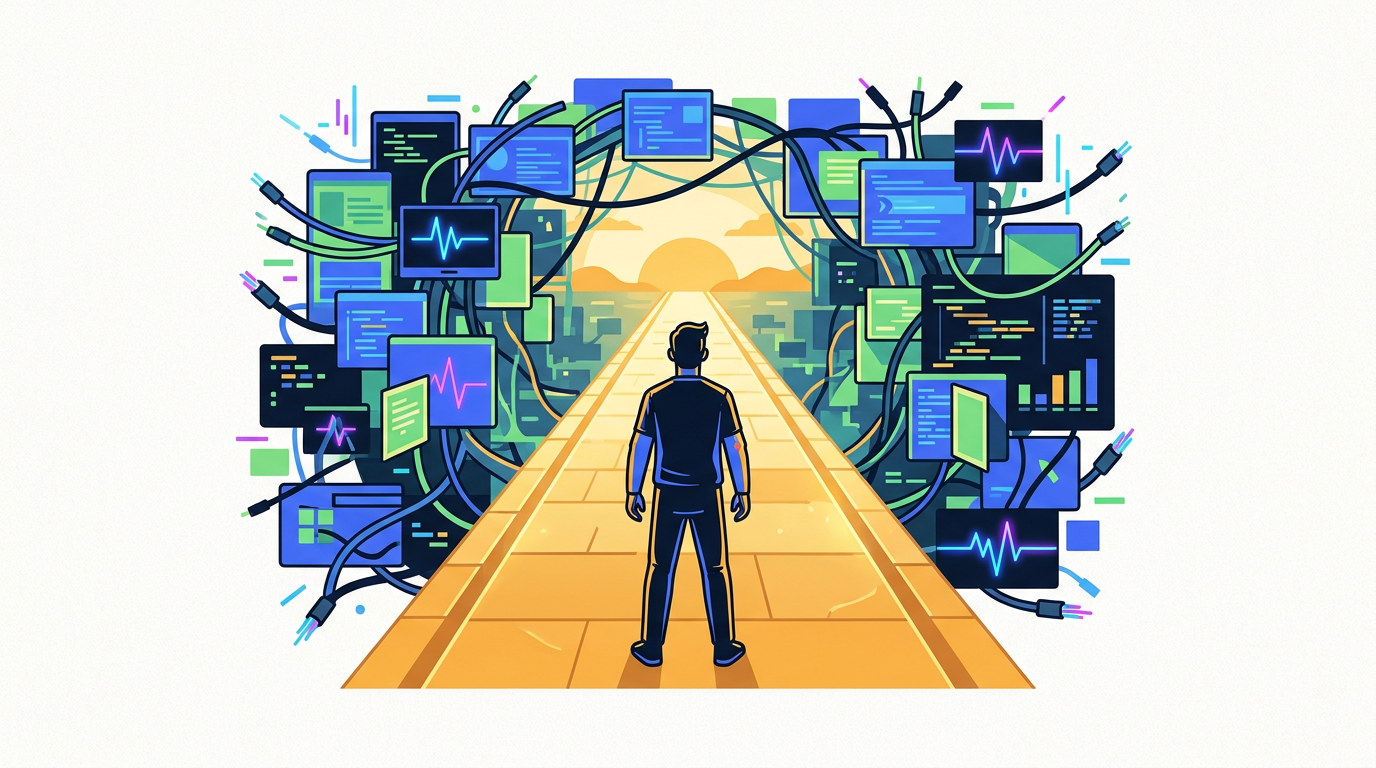
The future of AI is a shift from tools you operate to systems that operate alongside you. Expect multimodal models, autonomous agents, and AI woven into every industry by 2030 — not a robot takeover, but a rewiring of how work, decisions, and creativity happen.
Let’s get one thing straight. The future of AI isn’t going to look like a sci-fi movie. There will be no sudden robot uprising, no glowing red eyes, and (sadly) no flying cars delivered by an all-knowing machine brain. Most of the chatter about the future of artificial intelligence is either terrifyingly vague or breathlessly hypey.
The reality is far more interesting and, frankly, more useful.
The future with AI is less about a single, world-changing event and more about a quiet, pervasive integration. It’s a shift from AI as a tool you use (like a calculator or a spell-checker) to AI as a system that works alongside you. Think of it less like a hammer and more like a highly competent, slightly weird intern who can process a million documents before lunch.
This guide is about what’s actually coming. We’ll cut through the noise to show you the key trends that will define the next decade, how they’ll reshape industries and jobs, and what you can do to be ready. This isn’t a list of predictions; it’s a practical map for the road ahead.
By 2030, AI won’t feel like a separate “thing” you log into. It will be the invisible, intelligent layer powering the apps, services, and workflows you already use.
Imagine this: your project management software doesn’t just track tasks; it anticipates bottlenecks, drafts progress reports, and suggests reallocating resources based on team performance data. Your marketing platform doesn’t just schedule posts; it generates five different campaign concepts—complete with copy, images, and audience targeting—and runs small-scale tests to find the winner before you spend a real budget.
This is the core of the AI-driven future: ambient assistance. AI will become a utility, like electricity. You won’t think about the complex neural networks whirring away in data centers any more than you think about the power grid when you flip a light switch. You’ll just expect things to be smarter, faster, and more personalized.
The biggest change won’t be technological; it will be behavioral. We will learn to delegate cognitive tasks to machines, freeing up human attention for strategy, creativity, and connection. The future is AI, but it’s a future where humans do more of what only humans can do.
Before we talk about the future, let’s get our terms right. “AI” is a suitcase word, stuffed with everything from chatbots to self-driving cars. It’s become almost meaningless.
At its core, Artificial Intelligence is the science of making machines that can think, learn, and solve problems like a human. But even that is too broad. For our purposes, let’s break it down into two categories:
Narrow AI (ANI): This is the AI we have today. It’s designed and trained for one specific task. ChatGPT is a narrow AI for generating text. Midjourney is a narrow AI for creating images. A chess-playing computer is a narrow AI for, well, playing chess. It might be incredibly good at its one job—better than any human—but it can’t do anything else. You can’t ask a chess AI for a muffin recipe. (You could, but the results would be… unappetizing.)
General AI (AGI): This is the sci-fi stuff. Artificial General Intelligence refers to a machine with the ability to understand, learn, and apply its intelligence to solve any problem, just like a human. It wouldn’t need to be pre-trained on a specific task. AGI doesn’t exist yet, and we’ll discuss later whether it’s even on the horizon.
For now, and for the entire future discussed in this article, we are talking about increasingly sophisticated Narrow AI. The magic isn’t that one AI will do everything, but that many specialized AIs will be woven together into powerful, general-purpose systems.
The journey to the future of AI began with simple, rule-based systems. Think of early computer programs that could only do exactly what they were told. If X happens, do Y. This evolved with the rise of machine learning and deep learning, where instead of giving the machine rules, you give it tons of data and let it figure out the patterns for itself. This is how a neural network learns to recognize a cat in a photo—by analyzing millions of photos labeled “cat.”
This data-driven approach powered the first wave of modern AI tools: recommendation engines (Netflix, Amazon), computer vision systems (facial recognition), and natural language processing (Siri, Alexa). They were powerful but siloed. Your Netflix AI had no idea what your Amazon AI was doing.
The big shift that’s happening right now is the move to multimodal AI.
“Multimodal” is a fancy way of saying an AI can understand and work with different types of information at once—text, images, audio, video, and even code. Before, you had one AI for text and a separate one for images. Now, a single model can look at a picture of your refrigerator’s contents, listen to you say, “What can I make for dinner?”, and generate a text-based recipe.
This is a huge deal. It’s the difference between talking to a text-only chatbot and collaborating with a partner that can see what you see and hear what you say. This multimodal capability is the foundation for almost every major AI trend coming our way. It makes AI less of a specialized tool and more of a general-purpose collaborator.
Forget the flying cars. The real future of artificial intelligence is being built on three key pillars that will change how you work, create, and solve problems.
This is arguably the most significant trend for the next five years. An autonomous agent is an AI system that can take a goal, break it down into steps, execute those steps, and adapt to the results without constant human supervision.
Think about it this way:
Agents are the next logical step beyond chatbots. They move AI from a passive role (answering your questions) to an active one (completing your tasks). We’re seeing the beginning of this with tools that can browse the web or control your computer, but the real power will come when these agents are integrated directly into our business software and operating systems. This is the “highly competent intern” we talked about earlier, and it’s coming for every knowledge worker’s to-do list.
For the last few years, the AI arms race has been all about “bigger is better.” Companies spent hundreds of millions of dollars training massive, monolithic models. That’s changing.
The future for AI lies in a more diverse ecosystem of models:
This trend is critical. It means powerful AI won’t be locked away in the data centers of a few corporations. It will become a commodity, accessible to startups, researchers, and individual creators, leading to an explosion of new applications and services.
Let’s tackle the big, scary question head-on. The short answer is no, AI won’t take all the jobs. But it will absolutely change or eliminate many tasks within jobs. The future of AI in the workplace is about transformation, not just replacement.
Repetitive, rules-based tasks are the most vulnerable. Data entry, basic report generation, and scheduling are already being automated. This isn’t new; it’s the same process that saw switchboard operators replaced by automated exchanges.
But for every task that’s automated, new needs arise. AI creates work as much as it displaces it. The focus will shift from “doing the work” to “defining and managing the work.” Here are some of the roles we’ll see become commonplace:
The key takeaway is this: AI rewards judgment. Any job that requires critical thinking, creativity, emotional intelligence, and strategic decision-making is not only safe but will be amplified by AI. The future belongs to those who can ask the right questions, not just those who can find the answers.
The hype around AI and productivity is real, but not in the way most people think. The win isn’t just about making individual tasks faster. The real economic growth comes from how AI compounds output at a systemic level.
Here’s how it works:
Democratizing Expertise: AI puts the power of a data scientist or a senior strategist in the hands of a junior employee. A marketing intern can now run complex market segmentation analysis that once required a specialized team. A small business owner can generate a legal-ish privacy policy without hiring a lawyer for the first draft. This closes the skill gap and raises the baseline of performance across the board.
Reducing the Cost of Experimentation: Want to test ten different ad campaigns? Or a hundred? With generative AI, you can create countless variations of copy and visuals in minutes, for virtually no cost. This allows for a level of A/B testing and optimization that was previously only available to companies with massive budgets. More experiments mean a higher chance of finding what works, accelerating innovation.
Eliminating “Cognitive Gaps”: Think about how much time you waste switching between tasks—finding a file, logging into a different app, re-reading an email to get context. AI agents will work in the background, anticipating your needs, pulling the right information, and teeing up the next step. This smooths out workflows and keeps human attention focused on high-value work, not digital administration.
Across sectors, this looks like:
The productivity boom from the future of AI won’t come from one killer app. It will come from thousands of small, AI-powered improvements that add up to a massive increase in organizational efficiency and output.
As AI systems become more autonomous and influential, the need for rules of the road becomes urgent. This isn’t just about preventing a robot apocalypse; it’s about handling very real, present-day problems like bias, privacy, and accountability.
AI ethics asks what we should do. AI governance is the framework we build to ensure we do it.
The key challenges are:
Governments are scrambling to catch up. We’re seeing the first wave of AI regulation, like the EU’s AI Act, which attempts to classify AI systems by risk level. The debate between “move fast and break things” and “proceed with caution” will define the next decade of AI development. Finding the right balance between fostering innovation and ensuring public safety is one of the most important tasks in shaping the future with AI.
The most productive and forward-thinking view of the AI future is one of augmentation, not replacement. The goal isn’t to build machines that think like humans, but to build machines that think differently from humans, creating a partnership where the whole is greater than the sum of its parts.
This is often called the “centaur” model, named after the chess tournaments where a human player paired with a standard chess AI (a “centaur”) could consistently beat both the best human grandmasters and the most powerful supercomputers. The human provides strategy, intuition, and context, while the AI provides brute-force calculation, pattern recognition, and memory.
This collaborative model is the future of knowledge work.
The key skill for the future is learning how to be a good partner to an AI. This means understanding its strengths and weaknesses, learning how to prompt it effectively, and knowing when to trust its output and when to apply your own judgment. The future of AI is human-led.
So, what about Artificial General Intelligence (AGI), the holy grail of AI research? Is it coming?
The honest answer: nobody knows. Some prominent researchers believe it’s just a few years away; others think it’s decades off or even impossible. AGI remains a theoretical concept, and the hype often distracts from the real-world impact of the powerful (but still narrow) AI we have today. Chasing AGI is a bit like trying to build a spaceship to Mars when you haven’t even perfected the airplane yet.
What’s far more tangible and urgent is the environmental cost of our current AI trajectory. Training a single large AI model consumes an astonishing amount of energy and water. A recent study found that training GPT-3 consumed enough electricity to power dozens of homes for a year and used hundreds of thousands of gallons of water for cooling data centers.
As AI models get bigger and more numerous, this environmental footprint will become a major issue. The future of AI development must include a focus on efficiency—creating smaller, more specialized models and developing more energy-efficient hardware. The race for artificial intelligence cannot come at the expense of our natural intelligence in managing the planet.
The future of AI isn’t something that happens to you. It’s something you can prepare for and actively shape. You don’t need to learn to code, but you do need to cultivate a new kind of literacy.
The future for AI is bright, but it requires active participation. The people and businesses that thrive will be those who see AI not as a threat, but as the most powerful tool for human ingenuity ever created.
The future of AI is defined by its integration into everyday life as an ambient, assistive technology. Key developments will be autonomous AI agents that can complete multi-step tasks, the rise of smaller, specialized AI models, and multimodal systems that understand text, images, and audio. It’s a shift from AI as a standalone tool to an intelligent layer embedded in all software and workflows.
AI is unlikely to replace entire jobs en masse, but it will automate many tasks within them. This will transform most knowledge-work professions. While jobs based on repetitive, rules-based tasks are at risk, AI will also create new roles focused on AI management, ethics, and human-AI collaboration. The focus will shift from performing tasks to defining strategy and exercising judgment.
The three biggest AI trends to watch for by 2030 are:
Artificial General Intelligence (AGI), an AI with human-like cognitive abilities to understand and learn any task, is not on the immediate horizon. While progress in AI is rapid, current systems are still forms of Narrow AI, specialized for specific functions. Experts are divided on the timeline for AGI, with predictions ranging from a few years to many decades, and some believe it may not be achievable at all. For now, it remains a theoretical and long-term goal.

Part of the Thinker's Automation Labs content team. Researches with the SEO Blog Research Agent, drafts the piece, and routes it through review before publishing. Every claim is fact-checked against primary sources.
AI can’t see the future — it forecasts probabilities from patterns in past data. It’s remarkably good at…

Freelancing is becoming a core part of how work gets done, not a side hustle. AI and remote…
The future of HR is data-driven and skills-based. AI now handles screening and admin, freeing HR to focus…