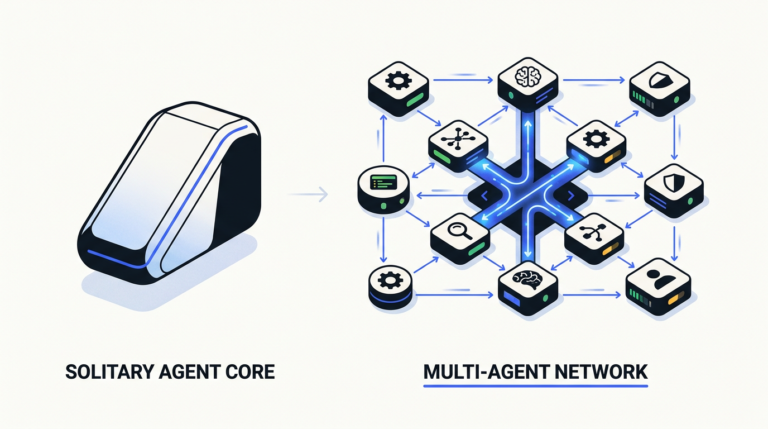
Single-Agent vs Multi-Agent Systems: A Clear Guide
A single-agent system uses one AI agent to handle a task end to end, while a multi-agent system…
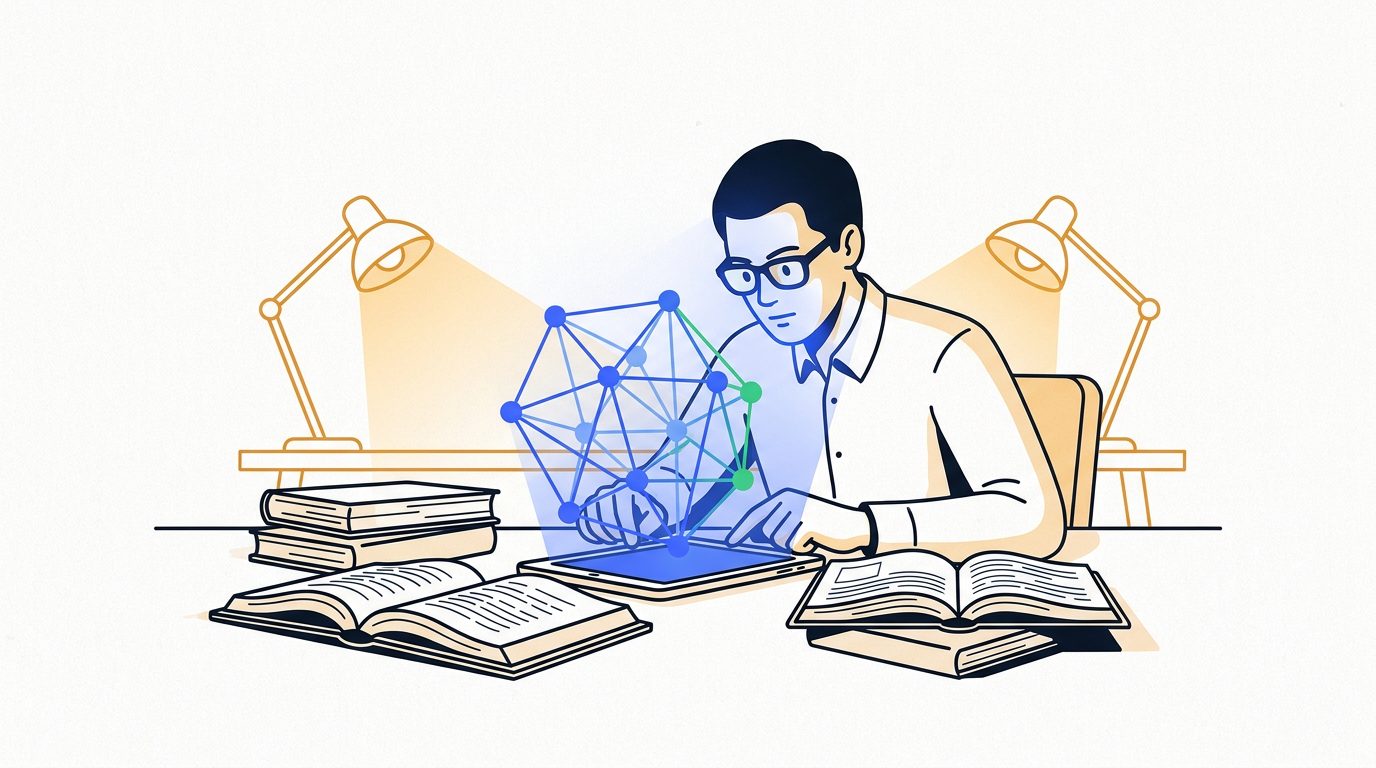
A multi-agent AI system is one where several autonomous agents interact, cooperating or competing, to solve problems too big for a single agent. Coordination, communication, and sometimes swarm-style emergent behavior let them handle logistics, simulations, and complex workflows. This guide explains how multi-agent systems and swarm intelligence work.
If you’ve ever watched a team of robots in a futuristic warehouse, you’ve seen a multi-agent AI system in action. It’s a group of independent, “smart” programs—called agents—working together (or against each other) to get something done. Forget the idea of one giant, all-knowing AI brain. The future is less about a single HAL 9000 and more about a very effective, very chatty committee.
This idea, called multi agent ai, is one of the most practical and powerful concepts in artificial intelligence today. It’s how we can tackle problems that are too messy, too distributed, or too enormous for one agent to handle alone. This guide breaks down what multi-agent systems are, how they work, and why you should care.
Before we dive into the tech, let’s talk about ants.
No single ant knows how to build an entire colony, find all the food, and defend against predators. Each ant operates on a few incredibly simple rules: follow the pheromone trail, carry a crumb back to the nest, attack the unfamiliar scent.
Yet, from these simple individual rules, something amazing emerges: a highly efficient, self-healing, and incredibly complex society. The colony as a whole displays an intelligence that far surpasses any of its individual members. This is the core idea behind swarm intelligence, and it’s a perfect entry point for understanding multi agent artificial intelligence. The magic isn’t in the individual ant; it’s in their interaction.
A multi-agent AI system (MAS) is a system composed of multiple autonomous agents that interact with each other and their environment. Each agent is its own self-contained program with its own goals and capabilities. They can perceive their surroundings, make decisions, and take actions independently. The collective behavior of these agents allows the system to solve problems that would be difficult or impossible for a single agent.
Think of it as a company. You don’t have one “CEO agent” doing all the work. You have a marketing agent, a sales agent, and a finance agent. Each is a specialist. They communicate and coordinate to achieve the company’s overall goal, even though each has its own tasks and perspective. This is a form of distributed AI.
The easiest way to grasp the value of a multi-agent approach is to see how it differs from a single-agent system. Most AI you interact with daily, like a chatbot or a grammar checker, is a single agent.
Here’s a quick breakdown:
| Characteristic | Single-Agent System | Multi-Agent System |
|---|---|---|
| Structure | One central AI brain makes all decisions. | A decentralized network of multiple autonomous agents. |
| Problem-Solving | Solves problems from a single, global perspective. | Breaks down problems and solves them collaboratively or competitively. |
| Best For | Clearly defined, centralized tasks (e.g., translating a sentence). | Complex, distributed problems (e.g., managing a city’s traffic). |
| Resilience | A single point of failure. If the agent fails, the system fails. | Highly resilient. The system can often continue if one or more agents fail. |
| Scalability | Hard to scale. Making the single agent more powerful is complex. | Easy to scale. Just add more agents to the system. |
The bottom line: Single-agent systems are great for focused tasks. Multi-agent systems are what you need for the messy, real-world problems that involve many moving parts.
Agents in a multi-agent system communicate through predefined protocols, much like how computers on the internet use HTTP to talk to each other. The two most common methods are message passing, where agents send direct messages to one another, and shared memory (or “blackboard systems”), where agents post and read information from a common space. These communication methods allow for coordination, cooperation, and negotiation.
Let’s break that down. Getting a team of autonomous agents to work together isn’t magic; it’s a problem of orchestration.
Message Passing: This is the most direct method. It’s like sending an email or a text message. Agent A packages up a piece of information and sends it directly to Agent B. This is great for direct requests, commands, or sharing specific data. The agents need a common language and protocol to understand each other.
Blackboard Systems (Shared Memory): Imagine a shared whiteboard in an office. Instead of talking to each other directly, team members write their findings, questions, and results on the board for everyone to see. In an MAS, a “blackboard” is a shared database or memory space. Agents can post information (e.g., “I found a path to the objective”) and other agents can read it and act on it. This is useful when agents don’t need to know about each other, just about the state of the problem.
Negotiation Protocols: What happens when agents have conflicting goals or need to divide up work? They negotiate. One classic example is the Contract Net Protocol.
Whether it’s through direct messages, a shared whiteboard, or a formal bidding process, clear communication is the foundation of any effective multi-agent system.
“Multi-agent system” is a broad term. In practice, they come in many flavors, depending on the design of the individual agents and the structure of the team.
OpenAI hide and seek experiment, where agents developed complex strategies to win, is a perfect example of competition driving learning.Swarm intelligence in AI is a subfield of multi agent ai inspired by the collective behavior of social insects like ants, bees, or birds. It focuses on creating systems where complex, intelligent group behavior emerges from the interactions of many simple agents, none of which are intelligent on their own. The key idea is that there is no central controller; order arises naturally from local rules.
This emergent behavior is the “magic” of swarm systems. You don’t program a flock of simulated birds to “avoid the obstacle as a group.” You just program each individual bird with three simple rules:
When thousands of agents follow these simple local rules, the global behavior of a fluid, obstacle-avoiding flock emerges automatically. This is a powerful, bottom-up approach to creating adaptive and robust systems. Swarm agents in ai are particularly good for optimization and search problems, like finding the most efficient delivery routes.
The biggest recent shift in multi agent ai is the arrival of Large Language Models (LLMs) like GPT-4. Before LLMs, programming an agent’s “brain” was a difficult, painstaking process. You had to manually code every rule, plan, and behavior.
LLMs change the game entirely.
Now, you can give an agent an LLM as its core reasoning engine. Instead of a list of if-then rules, the agent gets a powerful, general-purpose brain. This unlocks several new capabilities:
multi agent planning in ai.When you combine multiple LLM-powered autonomous agents in ai, you get something that looks less like a swarm of ants and more like a team of autonomous junior employees. One agent might be a “research specialist” that browses the web, another a “writing specialist” that summarizes findings, and a “manager agent” that orchestrates their work. This approach, seen in experimental frameworks like AutoGen and BabyAGI, points to a future where we can assemble AI teams to tackle complex knowledge work.
Examples of multi-agent systems are found in logistics, finance, robotics, and telecommunications. Common applications include fleets of warehouse robots, algorithmic trading bots competing in stock markets, smart electrical grids that balance power loads, and traffic control systems that optimize vehicle flow.
Here are a few more concrete examples:
OpenAI Hide and Seek project use MAS to explore how complex strategies and even tool use can emerge from simple competitive goals.So, why go to all the trouble of building a multi-agent system?
Of course, it’s not all sunshine and roses. Herding a team of autonomous AI agents has its own unique headaches.
emergent behavior that makes swarm intelligence so powerful can also be a liability. Sometimes, undesirable and unpredictable group behaviors can emerge from the agent interactions.distributed AI.How do you “program” a multi-agent system?
You typically don’t program the system as a whole. Instead, you program the behavior of a single, representative agent: its goals, its rules for interacting with the environment, and its communication protocols. Then, you instantiate (create copies of) that agent many times and let them interact. The system’s overall behavior emerges from these interactions.
Is a multi-agent system the same as distributed AI?
They are closely related but not exactly the same. Distributed AI is a broader term for any AI system where processing or data is spread across multiple locations. A multi-agent system is a specific type of distributed AI that emphasizes the autonomy and interaction of individual agents. All MAS are a form of distributed AI, but not all distributed AI is a MAS.
What is the future of multi-agent AI?
The future is looking very collaborative. With the rise of LLMs as agent “brains,” we’re moving towards more capable and flexible systems. Expect to see more AI “teams” designed to automate complex business workflows, conduct scientific research, and manage intricate real-world systems like city infrastructure and global supply chains. The focus will shift from programming individual behaviors to designing effective team structures and communication protocols.

Part of the Thinker's Automation Labs content team. Researches with the SEO Blog Research Agent, drafts the piece, and routes it through review before publishing. Every claim is fact-checked against primary sources.
A single-agent system uses one AI agent to handle a task end to end, while a multi-agent system…
A learning agent is an AI agent that improves its own performance over time by learning from feedback.…
A goal-based agent is an AI agent that chooses actions by asking whether they move it closer to…