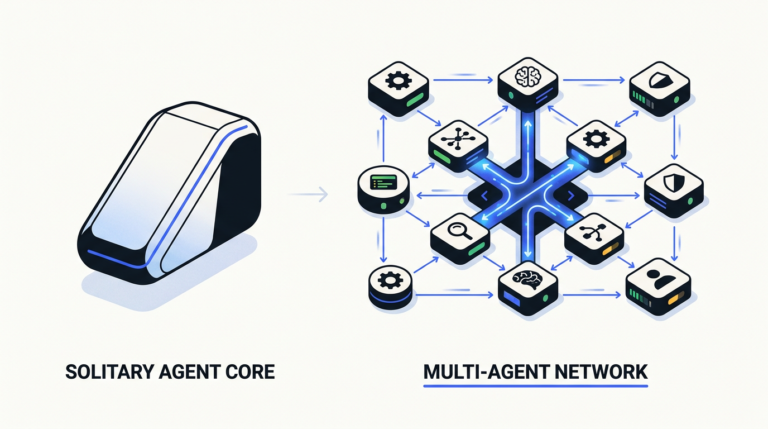
Single-Agent vs Multi-Agent Systems: A Clear Guide
A single-agent system uses one AI agent to handle a task end to end, while a multi-agent system…
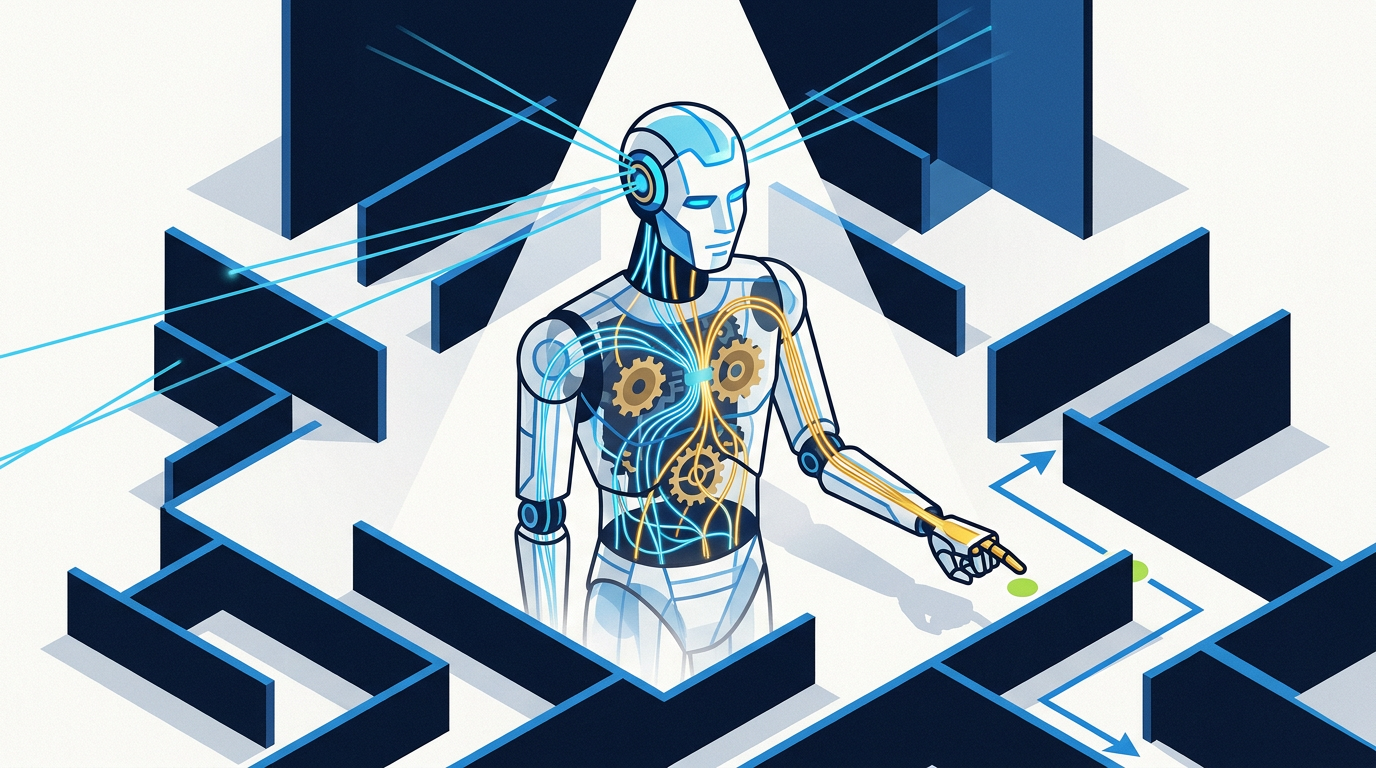
A rational agent in AI acts to achieve the best expected outcome given what it knows and perceives. It maximizes a performance measure rather than aiming for perfection. Rationality depends on the goal, the agent’s knowledge, and its environment. This guide explains what “rational” really means, with examples.
When people hear “rational agent in AI,” they often picture a flawless, all-knowing machine like HAL 9000 (before he went off the deep end). They imagine a system that makes the perfect choice every single time.
That’s a myth. And it’s the biggest misunderstanding in all of AI.
In artificial intelligence, “rational” doesn’t mean perfect. It doesn’t even mean “thinking” in the human sense. It means something much simpler and more practical: a rational agent is a system designed to do the best it can with what it has. It’s about making the most logical move to achieve a specific goal, based on the information available. Let’s clear up what that actually means.
First, let’s get this out of the way. A rational agent is not omniscient. It doesn’t know everything. It can’t predict the future with perfect accuracy.
Think of it like a GPS. Your GPS is a rational agent. Its goal is to get you from Point A to Point B as efficiently as possible. When it suggests a route, it’s making a rational decision based on its knowledge of maps, speed limits, and current traffic data (its percepts).
If there’s a sudden, un-reported accident, the GPS couldn’t have known about it. Its route is no longer the “perfect” one, but the decision it made was still rational based on the information it had at the moment. Rationality is about the decision-making process, not necessarily the final outcome. An agent that does the right thing for the wrong reason isn’t rational. An agent that makes a logical choice that turns out poorly is rational.
A rational agent in AI is any entity that perceives its environment through sensors and acts upon that environment through actuators to achieve the best expected outcome. In simple terms, it’s a program or system that takes in information and uses it to make a choice that maximizes its chances of success for a given task.
The key word here is “maximizes.” A rational AI agent isn’t trying to be perfect; it’s trying to get the highest possible score on a “performance measure” that we define for it. Its entire existence is a calculated effort to get the best result, not a perfect one.
An agent’s rationality isn’t an inherent quality; it’s defined by four things:
An agent is rational if its chosen action, for every possible sequence of percepts, is the one that maximizes its expected performance, given the evidence from those percepts and any built-in knowledge.
To design a rational agent, AI developers use a simple but powerful tool called the PEAS framework. It stands for Performance, Environment, Actuators, and Sensors. Defining these four components is the first step in building any AI rational agent. It forces you to be crystal clear about what you’re trying to build.
Let’s break it down with a common rational agent in AI example: a robotic vacuum cleaner.
| Component | Description | Robotic Vacuum Example |
|---|---|---|
| Performance Measure | How do we define success? What makes a “good” outcome? | Cleanliness of the floor, battery life consumed, time taken. A good agent maximizes cleanliness while minimizing power and time. |
| Environment | Where does the agent operate? What are the rules of this world? | A single room, a whole house, carpets, hardwood floors, furniture, pets, people. |
| Actuators | How does the agent act on its environment? What are its tools? | Wheels (to move), brushes (to clean), vacuum motor (to suck), speakers (to make noise). |
| Sensors | How does the agent perceive its environment? What are its senses? | Camera, infrared sensors (for cliffs like stairs), bump sensors (for walls), dirt sensors, battery level sensor. |
By filling out the PEAS framework, you create a precise job description for your agent. You know exactly what it’s supposed to do, where it will do it, and what tools it has to succeed.
At their core, all rational agents operate on a continuous loop. It’s a simple, powerful cycle that drives all of their behavior.
This perception-action cycle is the fundamental heartbeat of every rational AI.
Not all rational agents are created equal. They range from incredibly simple to mind-bogglingly complex, depending on how they handle the “reasoning” part of the loop.
For most modern applications, developers are building utility-based agents that are also learning agents. They want systems that not only make the best choice but also get better at it over time.
You can’t talk about a rational agent without talking about its environment. The “world” an agent operates in dictates what kind of agent you need. Environments can be:
The more complex the environment (partially observable, stochastic, dynamic), the more sophisticated the agent needs to be to act rationally.
This is the part most AI hype ignores. Perfect rationality is a myth, even for machines. In the real world, agents are limited. They don’t have infinite time or computing power to calculate the absolute best move.
This is the concept of bounded rationality. An agent must make a decision that is “good enough” within a reasonable amount of time. It’s a trade-off between finding the optimal choice and acting before it’s too late.
Think of a firefighter. They don’t have time to calculate the exact structural integrity of every beam in a burning building. They use their training and experience to make a quick, rational-enough decision under extreme pressure. AI agents are no different. Bounded rationality acknowledges that making the perfect decision is often impossible, so the goal is to make the best possible decision given the constraints of reality. For complex problems, this is the only way forward.
You interact with rational agents every day, probably without realizing it.
Understanding rational agents isn’t just an academic exercise. It’s the core concept behind nearly every useful AI system in the world today.
What is the difference between a rational agent and an intelligent agent?
In the context of AI, the terms are often used interchangeably. “Rationality” is the more precise, technical term for the behavior we are trying to achieve, which is maximizing a performance measure. “Intelligence” is a broader, more human-centric term. All rational agents are considered intelligent in the AI sense.
Is a human a rational agent?
Not always! Humans are subject to emotions, biases, and cognitive shortcuts that often lead them to make decisions that are not perfectly rational from a mathematical perspective. This is a major topic in behavioral economics. AI rational agents, by contrast, are designed to follow their programming and maximize their utility function without emotion.
What is the PEAS framework?
The PEAS framework is a design tool used to define a task for a rational agent. It stands for Performance, Environment, Actuators, and Sensors. By specifying these four elements, developers can create a clear and complete description of the agent’s job.
What is an example of a rational agent?
A great example is a self-driving car. Its Performance measure is safety, speed, and efficiency. Its Environment is the road system. Its Actuators are the steering, accelerator, and brakes. Its Sensors are cameras, LiDAR, and radar. It continuously perceives its environment and acts to achieve the best outcome.

Part of the Thinker's Automation Labs content team. Researches with the SEO Blog Research Agent, drafts the piece, and routes it through review before publishing. Every claim is fact-checked against primary sources.
A single-agent system uses one AI agent to handle a task end to end, while a multi-agent system…
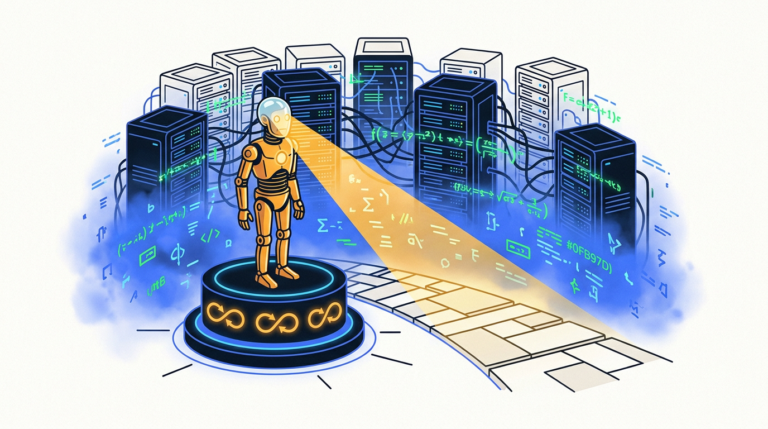
A learning agent is an AI agent that improves its own performance over time by learning from feedback.…
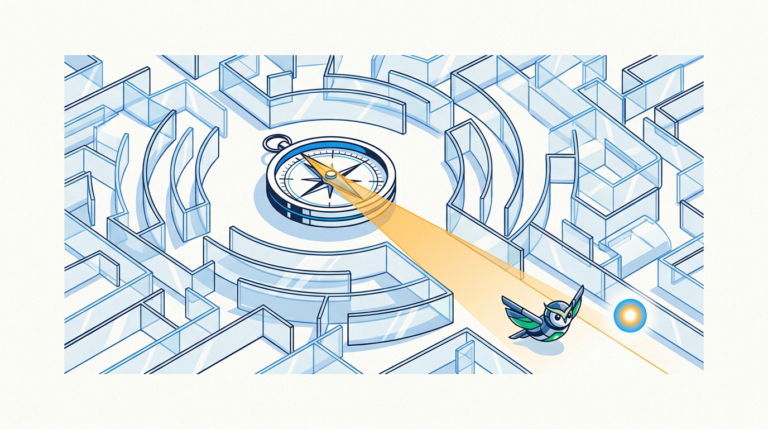
A goal-based agent is an AI agent that chooses actions by asking whether they move it closer to…