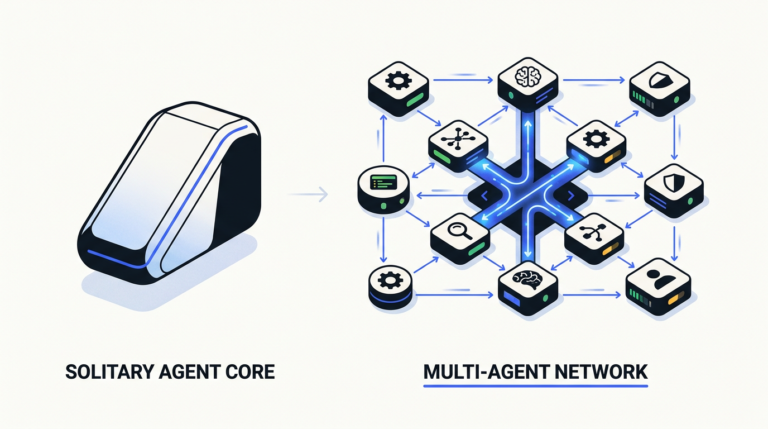
Single-Agent vs Multi-Agent Systems: A Clear Guide
A single-agent system uses one AI agent to handle a task end to end, while a multi-agent system…
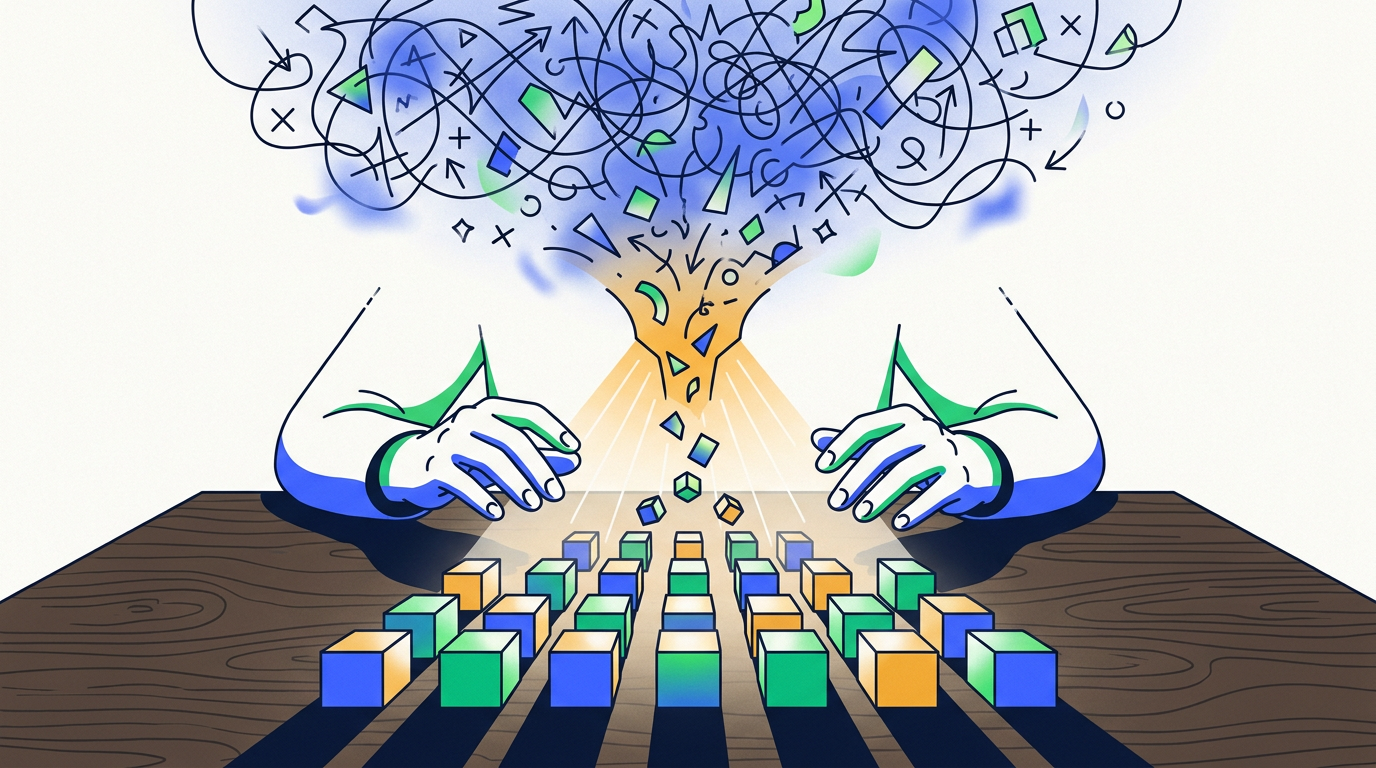
A learning agent is an AI agent that improves its own performance over time by learning from experience and feedback. It has four parts, the learning element, performance element, critic, and problem generator, that let it adapt to new situations. This guide explains how learning agents work, with examples.
Most AI tools are just that—tools. You give them a command, they execute it. A text generator writes what you ask. An image generator creates a picture from your prompt. They’re incredibly useful, but they don’t get any smarter on their own. They’re static.
A learning agent in AI is different. It’s the difference between a hammer and a carpenter who gets better with every house they build. This is the kind of AI that doesn’t just follow instructions; it actively tries to improve itself. It observes, acts, gets feedback, and adjusts its own strategy for next time. This is where AI stops being a simple calculator and starts looking a lot more like actual intelligence.
If you want to understand where AI is really headed, you need to understand learning agents. They are the foundation for everything from self-driving cars to AI that can beat the world’s best Go players. Let’s break down how they work, without the jargon.
A learning agent is an artificial intelligence program that can improve its own performance over time. Unlike a simple reflex agent that only reacts to its current environment based on fixed rules, a learning agent adapts its behavior based on past experiences and feedback. It learns from its mistakes and successes to make better decisions in the future.
Think of it this way: a simple thermostat is an agent. It senses the room temperature (perception) and turns the heat on or off (action). But it never gets better at its job. It just follows its pre-programmed rule: “If temp < 68°F, turn on heat.”
A learning agent is more like a person learning to cook. The first time, you follow the recipe exactly. Maybe you burn the onions. The “feedback” is the burnt taste. Next time, you adjust—you lower the heat or stir more often. The agent does the same thing, just with data and algorithms instead of a stovetop. It has a goal, it tries things, it measures success, and it updates its internal “cookbook” to do better.
So how does an AI actually “learn”? It’s not magic. A learning agent in artificial intelligence is built from four distinct parts that work together in a continuous loop. Understanding these four components is the key to understanding how an agent gets smarter.
| Component | What It Does | Simple Analogy |
|---|---|---|
| Performance Element | The “doer.” It perceives the world and decides which action to take right now based on its current knowledge. | The part of your brain that swings the bat at a baseball. |
| Critic | The “judge.” It evaluates how good the action was and provides feedback. | The feeling of satisfaction from a solid hit, or disappointment from a miss. |
| Learning Element | The “student.” It takes the feedback from the Critic and uses it to update the Performance Element’s strategy. | Your brain analyzing the miss and deciding to swing earlier next time. |
| Problem Generator | The “explorer.” It suggests new, untried actions to see what happens, helping the agent find better strategies. | Your curiosity wondering, “What if I tried a different stance?” |
The Performance Element is the agent’s hands and eyes. It takes in information from its sensors (like a camera on a car) and uses its current knowledge base to choose an action, which it executes with actuators (like the car’s steering wheel). This is the part that is actively interacting with the environment.
The Critic is the feedback mechanism. It compares the outcome of the action to a standard of success. Did the action lead to a reward (e.g., getting closer to the destination) or a penalty (e.g., swerving out of the lane)? This feedback is crucial; without it, the agent has no way of knowing if it’s doing a good job.
The Learning Element is the brains of the operation. It takes the feedback from the Critic and figures out how to change the Performance Element’s rules. This is where the actual machine learning happens. It might use techniques like neural networks to adjust its decision-making logic, making it more likely to earn a reward next time.
Finally, the Problem Generator is what keeps the agent from getting stuck in a rut. The Performance Element wants to do what it knows works (exploitation). The Problem Generator encourages it to try new, exploratory actions to gather more data (exploration). It might suggest taking a slightly different route or trying a novel move in a game. This is essential for discovering new, more effective strategies that it wouldn’t find by just playing it safe.
The four components don’t work in isolation. They operate in a tight, continuous loop that allows the agent to improve with every action it takes. This cycle is the engine of adaptation.
Perceive: The agent uses its sensors to gather data about the current state of its environment. A robot vacuum “sees” an obstacle with its infrared sensors. A stock trading bot “sees” the latest market prices.
Act: Based on this perception, the Performance Element selects and executes an action using its actuators. The vacuum turns to avoid the obstacle. The trading bot places a “buy” order.
Evaluate: The Critic observes the outcome. Did the vacuum successfully avoid the obstacle and continue cleaning? Did the stock price go up after the purchase? It generates a feedback signal—positive or negative.
Learn: The Learning Element receives this feedback. If the feedback was positive, it reinforces the connection that led to that successful action. If it was negative, it weakens that connection. It updates the agent’s internal knowledge base. The Problem Generator might also suggest a new action to try in a similar situation in the future to gather more information.
This “perceive-act-evaluate-learn” cycle repeats endlessly. With each iteration, the learning agent refines its performance, becoming more effective and efficient at achieving its goal.
A “learning agent” isn’t just one type of technology. The “learning element” component can be powered by several different kinds of machine learning. The choice of method depends on the task and the type of data available.
Supervised Learning: This is like learning with a teacher who provides a complete answer key. The AI is trained on a massive dataset of labeled examples. For instance, you can train a learning agent to identify spam by showing it millions of emails that have already been labeled as “spam” or “not spam.”
Unsupervised Learning: This is like being thrown into a library and asked to organize the books without knowing any genres. The AI is given unlabeled data and must find its own patterns and structures.
Reinforcement Learning: This is the quintessential learning method for many agents. It’s learning through trial and error, guided by rewards and penalties. The agent isn’t told what to do, only whether its actions are good or bad.
Continuous Learning: This isn’t a separate category so much as a crucial capability. It’s the agent’s ability to learn incrementally over its lifetime without needing to be retrained from scratch. It adapts to new data on the fly.
Theory is great, but where do you actually see these learning agents in the wild? They are becoming more common than you might think.
A perfect learning agent example in AI is a self-driving car.
Learning agents are not just for futuristic cars. Their ability to optimize and adapt makes them valuable in many fields:
As powerful as learning agents are, they are not a silver bullet. It’s important to be honest about their limitations.
The Bias Problem: A learning agent is only as good as the data it learns from. If the data reflects real-world biases, the agent will learn and often amplify those biases. For example, if a hiring agent is trained on historical data where managers favored candidates from certain backgrounds, the agent will learn to replicate that unfair preference.
The “Black Box” Issue: For complex agents using deep learning and neural networks, it can be nearly impossible to understand why it made a specific decision. This lack of interpretability is a huge problem in critical applications like medicine or finance, where you need to be able to explain the reasoning behind a decision.
Data and Computational Cost: Training a sophisticated machine learning agent requires an enormous amount of data and staggering computational power. This is expensive and time-consuming, putting the development of cutting-edge agents out of reach for many.
Exploration vs. Exploitation: The agent constantly faces a dilemma: should it exploit the knowledge it already has to get a guaranteed, decent reward, or should it explore a new, risky action that might lead to a much bigger reward (or a total failure)? Balancing this trade-off is one of the hardest problems in AI. Get it wrong, and the agent either gets stuck in a rut or never learns anything useful.
Frankly, building a truly effective and safe learning agent is incredibly difficult. For most businesses and creators right now, simpler AI tools are more practical. But understanding this frontier is key to knowing what’s coming next.
A learning agent in AI is a type of intelligent agent that can automatically improve its performance by learning from its experiences. It uses a feedback loop to evaluate its actions and update its internal decision-making process to perform better in the future.
The four main components are the Performance Element (takes actions), the Critic (evaluates the actions), the Learning Element (updates the agent’s strategy based on the evaluation), and the Problem Generator (suggests new actions to try for exploration).
AI agents learn through a cycle of perceiving their environment, taking an action, evaluating the outcome of that action (feedback), and then using that feedback to modify their internal knowledge or strategy. This process is often powered by machine learning models like supervised, unsupervised, or reinforcement learning.
A self-driving car is a classic example. It uses sensors to perceive the road, acts by steering and braking, gets feedback from successful or unsuccessful maneuvers (or human intervention), and uses that data to constantly update its driving model to become safer and more efficient.

Part of the Thinker's Automation Labs content team. Researches with the SEO Blog Research Agent, drafts the piece, and routes it through review before publishing. Every claim is fact-checked against primary sources.
A single-agent system uses one AI agent to handle a task end to end, while a multi-agent system…
A learning agent is an AI agent that improves its own performance over time by learning from feedback.…
A goal-based agent is an AI agent that chooses actions by asking whether they move it closer to…