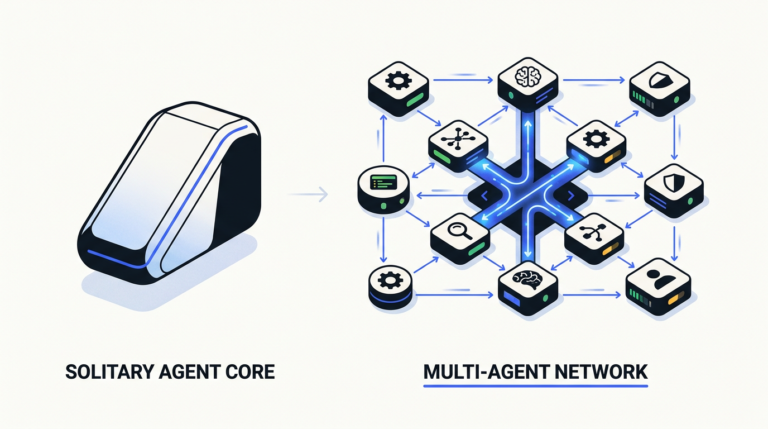
Single-Agent vs Multi-Agent Systems: A Clear Guide
A single-agent system uses one AI agent to handle a task end to end, while a multi-agent system…
A goal-based agent chooses actions that move it toward a defined goal, using search and planning to weigh future outcomes. A utility-based agent goes further, scoring each possible outcome with a utility function to pick the best one, not just a good-enough one. This guide explains both with examples.
Imagine you need to get to the airport. You have a single, clear objective: arrive at Terminal B. You pull up your map, find a route, and follow it. You don’t care if it’s the most scenic drive or if it passes your favorite coffee shop. You just need to get there. That’s a goal-based approach.
Now, imagine you want the best trip to the airport. You still need to get to Terminal B, but you also want to avoid traffic, pay the lowest tolls, and maybe grab that coffee if it doesn’t add too much time. You’re weighing multiple factors to find the optimal path. That’s a utility-based approach.
In the world of artificial intelligence, this is the core difference between a goal-based agent in AI and a utility-based agent. One is focused on achieving a binary pass/fail state (Did I reach the goal? Yes/No). The other is focused on maximizing a “happiness score” or utility, finding the most desirable way to succeed. Understanding this distinction is key to seeing how AI makes decisions.
Most of us interact with goal-based agents every day without realizing it. Your GPS finding a route to your destination, a Roomba cleaning until the floor is covered, or an enemy in a video game trying to get to a specific point on the map—all are working towards a defined objective.
A utility-based agent is the intelligent evolution of this. It’s a more sophisticated type of AI that doesn’t just ask “How can I achieve my goal?” but rather “Out of all the ways I could achieve my goal, which way is the best for me?” This involves trade-offs and a more nuanced view of the world. It’s the difference between a self-driving car simply staying on the road (goal) and one that also aims for a smooth ride, passenger comfort, and optimal fuel efficiency (utility).
A goal-based agent is an AI entity that uses information about a specific goal to guide its actions. Unlike simpler agents that just react to their immediate surroundings (like a thermostat turning on when it gets cold), a goal-based agent considers the future. It asks, “If I take this action, will it get me closer to my goal?”
To make this “look before you leap” approach work, a goal-based agent relies on three core concepts:
Think of it like planning a vacation. Your goal is “relax on a beach in Greece.” You search for flights, hotels, and connections (search). You then select a specific itinerary that gets you there (planning). Finally, you book the tickets and go (execution).
Let’s make this concrete with a goal-based agent in AI example: a simple robot in a warehouse. Its goal is to retrieve a specific package from a shelf.
Here is the continuous loop it runs through:
This perception-planning-action loop is what allows the agent to function in a dynamic environment where things can change unexpectedly.
Breaking it down, a typical goal-based agent has these key components or modules:
A utility-based agent is a more advanced type of agent that not only has a goal but also a way to measure how “good” a particular state of the world is. It goes beyond the simple pass/fail logic of a goal-based agent. Instead of just finding a path to the goal, it seeks to find the best path, based on a set of preferences.
The magic behind this is the utility function. This is essentially a scoring mechanism that assigns a numerical value (a utility score) to every possible state of the world. A higher score means a more desirable state.
For example, an autonomous vehicle’s goal is to get you from A to B. But a utility-based agent controlling it would also consider:
The utility function takes all these factors, weighs them, and calculates a single score for each potential route. The car then chooses the route with the highest overall utility. This allows it to make intelligent trade-offs. A slightly longer route might be chosen if it’s significantly safer and more comfortable. This process of finding the best outcome is called optimization.
The simplest way to see the difference is that all utility-based agents are goal-based, but not all goal-based agents are utility-based. A utility agent is a goal agent with an extra layer of smarts for measuring the quality of the outcome.
Here’s a direct comparison:
| Feature | Goal-Based Agent | Utility-Based Agent |
|---|---|---|
| Objective | Achieve a specific, binary goal (e.g., reach a location). | Maximize a “utility” or “happiness” score (e.g., find the fastest, safest, cheapest route). |
| Decision-Making | Finds a sequence of actions that leads to the goal state. | Finds a sequence of actions that leads to the state with the highest utility. |
| Best For | Problems with a clear, single definition of success. | Problems with multiple conflicting objectives or where the quality of the solution matters. |
| Example | A GPS finding any valid route. | A GPS finding the route that best balances speed, traffic, and tolls. |
The main difference is that a goal-based agent operates on a simple “goal achieved / not achieved” basis. It searches for any path that leads to success. A utility-based agent, however, evaluates how well a goal is achieved by using a utility function to score different outcomes, allowing it to choose the most desirable or optimal path among several successful options.
These agents don’t just magically find paths. They use powerful algorithms and frameworks to do their planning. You don’t need to know the math, but understanding the concepts is helpful.
Action: PickUp(Package), Precondition: RobotAt(Shelf) AND HandIsEmpty, Effect: Holding(Package) AND NOT HandIsEmpty.These tools provide the underlying “thinking” machinery that allows a goal-based agent in AI to figure out what to do next.
A great goal-based agent in AI example is a vacuum cleaner robot like a Roomba. Its goal is simple: have all accessible floor space in a room be clean. It uses sensors to perceive its environment, builds a map (a world model), and plans a path to cover the entire area. It doesn’t care if the path is elegant; it just cares about achieving the “floor is clean” state.
Here are other real-world applications:
Goal-Based Agent Examples:
Utility-Based Agent Examples:
These agents are powerful, but they are not the solution to every problem. Sometimes, they are overkill; other times, they aren’t sophisticated enough.
Don’t use them when a simpler agent will do.
If your task is a simple “if-this-then-that” reflex, you don’t need complex planning. A simple reflex agent is faster and cheaper.
Don’t use them when the agent needs to learn and improve from unknown patterns.
Goal-based agents execute plans; they don’t inherently learn from their successes and failures to change their fundamental strategies. For that, you need a Learning Agent.
The bottom line: use a goal-based agent when you have a clear objective and a predictable-enough environment to plan for. Use a utility-based agent when you need to make trade-offs between multiple conflicting objectives. For everything else, another type of agent might be a better choice.
A model-based agent uses an internal “model” of how the world works to make decisions. A goal-based agent is a type of model-based agent. It uses its model of the world specifically to plan sequences of actions that will lead it to a future goal state. All goal-based agents are model-based, but not all model-based agents are goal-based (e.g., a model-based reflex agent).
Yes, and this is where they truly shine. A utility-based agent handles multiple goals by incorporating them into its utility function. For instance, the goals of “arrive quickly,” “use less fuel,” and “have a safe trip” are all balanced by the utility function, which calculates the best compromise among them.
The biggest challenges are computational resources and uncertainty. Searching through all possible action sequences to find a plan can be incredibly time-consuming, especially in complex environments. Furthermore, if the agent’s world model is inaccurate or the environment is highly unpredictable, its plans may fail, forcing it to constantly re-plan, which is inefficient.

Part of the Thinker's Automation Labs content team. Researches with the SEO Blog Research Agent, drafts the piece, and routes it through review before publishing. Every claim is fact-checked against primary sources.
A single-agent system uses one AI agent to handle a task end to end, while a multi-agent system…
A learning agent is an AI agent that improves its own performance over time by learning from feedback.…
A goal-based agent is an AI agent that chooses actions by asking whether they move it closer to…