
Best AI Search Engines in 2026 (Compared)
The Best AI Search Engine in 2026 (Compared & Tested) The best AI search engine delivers synthesized, cited…
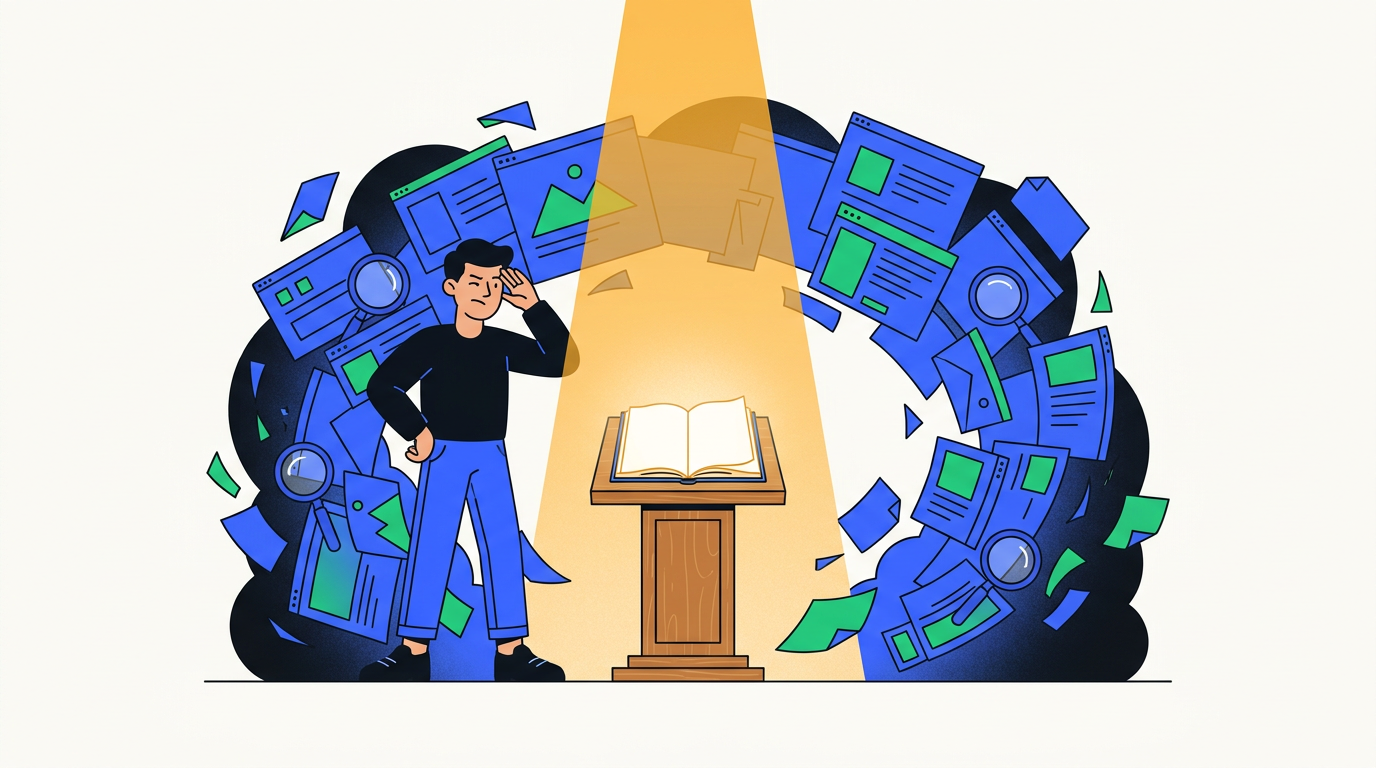
The best AI content detectors scan text for patterns that signal AI authorship and return a likelihood score. None have perfect accuracy, so treat them as a signal, not a verdict. This guide compares the top tools like Originality.ai and GPTZero to help you find the right one.
Let’s be honest. The moment AI text generator tools like ChatGPT became mainstream, a second industry popped up overnight: the ai writing detector. The promise is simple: paste in some text, and the tool will tell you if a human or a robot wrote it.
This has created a quiet arms race. AI models get better at sounding human, and detectors get better at sniffing them out. But here’s the uncomfortable truth: these detectors are flawed, sometimes deeply flawed.
So, are they useless? Not quite. You just have to know which ones to use and, more importantly, how to use them. I’ve tested the most popular tools to give you a straight answer on what works, what’s overhyped, and what to check.
An AI content detector is another AI model, called a classifier, trained on millions of examples of human-written and AI-generated text. It learns to spot the subtle patterns and word choices that give AI away, performing a sophisticated form of AI detection.
These tools primarily look at two key metrics:
When you paste text into an ai writing detector, it analyzes these factors and spits out a probability score, like “98% AI” or “100% Human.”
| Tool | Free? | Our Accuracy Grade | Best For |
|---|---|---|---|
| Originality.ai | No (paid credits) | A- | Publishers & Agencies |
| GPTZero | Yes (freemium) | B+ | Educators & Students |
| Copyleaks | Yes (freemium) | B | Academic Institutions |
| Sapling | Yes (limited) | B- | Business Teams |
| ZeroGPT | Yes (ad-supported) | C | Quick, low-stakes checks |
Here’s the breakdown of the tools that matter, from the professional standard to the quick and free options.
What it is: A paid, professional-grade ai writing detector and plagiarism checker built for serious content publishers. It’s widely considered the most accurate GPT detector on the market.
What it is: An AI detector that started as a college student’s thesis project. It has a generous free tier and paid plans for more features.
What it is: A comprehensive academic integrity suite that includes an AI detector alongside a powerful plagiarism checker.
What it is: A business-focused AI tool that offers an AI detector as part of a broader suite of writing assistants for sales and support teams.
What it is: A free, ad-supported detector that’s one of the most popular on Google.
No, not entirely. The accuracy of an ai writing detector is a huge point of contention. While the best tools are right more often than they’re wrong, none are perfect. The biggest problem is the false positive—when the tool incorrectly flags human-written text as AI-generated.
Studies have shown these tools can be biased against non-native English speakers, whose prose can mimic AI patterns. Even companies like OpenAI have admitted that a reliable classifier is extremely difficult to create. Think of a detector score as a suggestion, not a fact.
For the best balance of usability and reliability without paying, GPTZero is the best free AI detector. Its free plan is generous enough for most individuals, the interface is clean, and its sentence-by-sentence highlighting gives you more useful feedback than a simple percentage score from a tool like ZeroGPT.
Yes, absolutely. AI detectors can and do make mistakes. They frequently flag human-written content as AI-generated (a false positive) or fail to spot AI text that has been edited (a false negative). Never treat a detector’s result as infallible proof; it’s just one piece of data.
Yes, and it’s surprisingly easy. Simply editing AI-generated text—fixing awkward phrasing, combining sentences, and injecting your own voice—is often enough to fool most detectors. More advanced techniques involve “paraphrasing” tools designed to rewrite AI text to evade detection.
The original idea of a digital watermark embedded in AI text has not proven to be a practical solution for AI detection. This cat-and-mouse game is why you can’t fully trust any detector.
After all this, you might wonder if these tools are even worth it. They are, but only if you use them correctly.
The golden rule is this: An ai writing detector is a signal, not a verdict. It can’t prove anything. Use it to flag text that needs a closer look.
If a tool says something is 90% AI, your job isn’t to punish the writer—it’s to open a conversation and review the work more carefully. Never use a detector score as the sole basis for an accusation of misconduct.
Can an AI detector prove a student cheated?
No. It can only provide a probability score. Using this score as the only piece of evidence is irresponsible and has led to high-profile false accusations. It should only be used as a starting point for a conversation.
Is using an AI writer the same as plagiarism?
Not technically. Plagiarism is passing off someone else’s existing work as your own. Using an AI is generating new content. It’s a different kind of ethical and academic integrity issue, and policies are still evolving.

Part of the Thinker's Automation Labs content team. Researches with the SEO Blog Research Agent, drafts the piece, and routes it through review before publishing. Every claim is fact-checked against primary sources.
The Best AI Search Engine in 2026 (Compared & Tested) The best AI search engine delivers synthesized, cited…

Microsoft Designer is the best overall free AI image generator, offering a generous 100 daily images powered by…

The best AI video generator for most people is Runway, offering a powerful and accessible suite of creative…